

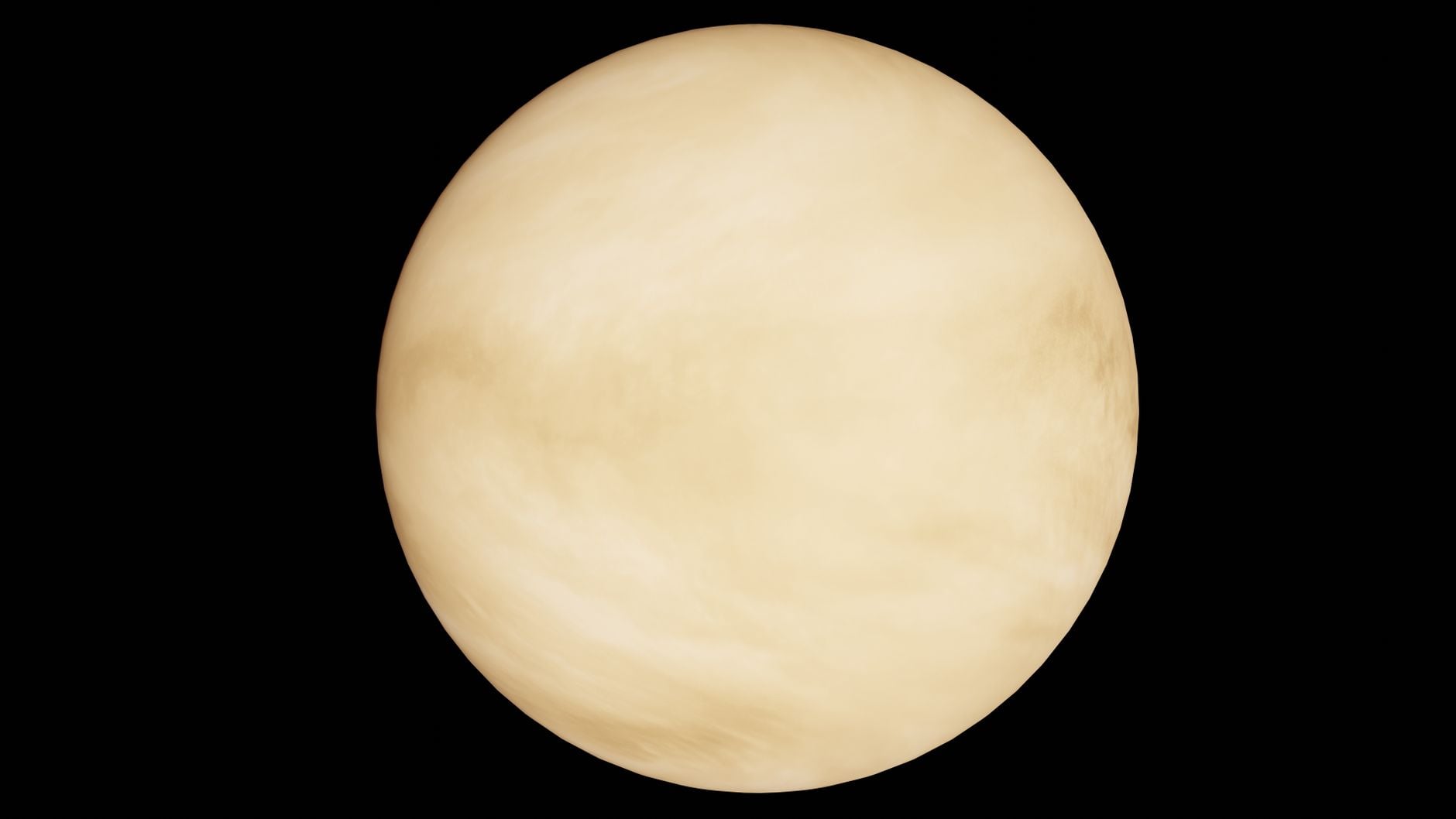
Venus and Earth make a useful pair because the comparison begins so neatly and then breaks almost completely.
They formed in the same young solar system about 4.6 billion years ago. They are rocky planets, close neighbours by astronomical standards, and nearly the same size. NASA gives Earth’s equatorial diameter as 12,756 kilometres. Venus, according to NASA’s Venus facts page, measures about 12,104 kilometres across.
That is the unsettling part. The difference between a living planet and a ruined one did not begin with a dramatic difference in size. It began with small differences in distance, atmosphere, water, geology, and time, then compounded until the two worlds became almost unrecognisable as siblings.
The twin that stopped being a twin
NASA describes Venus as similar to Earth in structure and size. If the two planets could be cut open and set side by side, both would show an iron core, a rocky mantle, and a thin outer crust. The similarity is not superficial.
But the surface conditions are now radically different. Earth has liquid water on its surface and is the only known planet inhabited by living things. Venus has a dense carbon dioxide atmosphere, clouds of corrosive acid, and surface temperatures NASA puts at about 467 degrees Celsius, hot enough to melt lead. Its surface pressure is about 93 times Earth’s sea-level pressure, comparable to being more than 900 metres underwater.
The simple version is that Earth stayed habitable and Venus did not. The more useful version is that Venus shows how a rocky planet can move from possibility to permanence. Once enough water is lost, enough carbon dioxide remains in the air, and enough heat is trapped, the planet does not need to keep making the wrong choice. The system begins enforcing it.
Distance mattered, but not by itself
Venus orbits the Sun at about 0.72 astronomical units, compared with Earth’s 1 astronomical unit. It receives more solar energy than Earth, but distance alone does not explain the present surface.
Mercury is closer to the Sun, yet Venus is hotter. That tells us the atmosphere is doing much of the work. Venus is not simply baked from above. It is insulated by a thick atmosphere that traps heat with unusual efficiency.
The phrase usually attached to this is runaway greenhouse effect. It is useful, provided it is not treated as a slogan. In the likely sequence, higher temperatures allowed more water vapour into the atmosphere. Water vapour itself traps heat, raising temperatures further. Over time, ultraviolet light from the Sun could break water molecules apart in the upper atmosphere, allowing hydrogen to escape to space. What remained was a planet losing its water while retaining a heavy carbon dioxide blanket.
The details of Venus’s early water remain an active research question. NASA’s Venus page describes early Venus and Earth as similar in size and interior structure, and says both may have had oceans in their younger days. More recent work has argued over how much water Venus actually had and for how long. The safe reading is that Venus’s past is not fully settled, but its present dryness is central to the problem.
Earth had a way to move carbon around
One of Earth’s great advantages is not simply that it has water. It is that water, rock, atmosphere, and geology interact over long timescales.
On Earth, carbon dioxide does not only accumulate in the air. It dissolves into rainwater and seawater, reacts with rocks, becomes locked into carbonate minerals and sediments, and is carried through geological cycles. Plate tectonics helps recycle material between the surface and the interior. This is not a perfect thermostat, but it is a stabilising system over deep time.
Venus appears to have followed another path. NASA notes that Magellan radar mapping revealed extreme volcanism and a relatively young surface in geological terms. Venus has volcanoes, mountains, deformed terrain, and signs of major resurfacing, but it does not operate like modern Earth with active plate tectonics in the same familiar form.
That matters because carbon cycling is not just a climate detail. It is part of how a rocky planet avoids letting its atmosphere become a one-way archive of volcanic gases.
The clouds hide a hard surface
Venus looks soft from far away. It is bright, cloud-covered, and visually smooth. That appearance is misleading.
The Soviet Venera landers that reached the surface between the 1960s and 1980s lasted minutes to a little over two hours before the heat and pressure ended their work. NASA notes that their photographs showed a barren, dim, rocky landscape under a yellowish sky. Later radar mapping by Magellan filled in a wider view: volcanic plains, mountains, impact craters, and deformed terrain beneath the cloud deck.
That hiddenness has shaped the science. Mars has been easier to photograph, land on, and narrate. Venus has been harder to touch. Its atmosphere is both the main object of study and the barrier that makes study difficult.
This is part of why the planet is returning to mission plans. NASA is developing DAVINCI and VERITAS, two Venus missions intended to examine the atmosphere and surface in different ways. DAVINCI is designed to descend through the atmosphere and measure its composition. VERITAS is intended to map the surface with radar and study the planet’s geological history.
Why Venus matters beyond Venus
The question is not only why Venus became Venus. It is how often rocky planets that look promising from a distance turn out to be hostile when examined closely.
For exoplanet science, Venus is a warning about false familiarity. A world with roughly Earth’s size, roughly Earth’s bulk composition, and a location near a star’s habitable zone is not automatically Earth-like in the sense that matters for life. Atmosphere, water history, geology, rotation, clouds, and stellar radiation can all change the result.
That makes Venus one of the most useful planets in the solar system, not because it is pleasant, but because it is nearly familiar. Mars shows one way a rocky planet can lose habitability: thin air, cold surface, exposed ground. Venus shows another: too much atmosphere, too much retained heat, and water lost until the surface becomes unreachable to ordinary chemistry of life.
The comparison with Earth is uncomfortable because it removes the comfort of difference. Venus is not a gas giant, an ice world, or a distant object from another system. It is the planet next door, built from much the same early inventory, close enough in size to invite comparison, and different enough to show how narrow the outcome may have been.
The lesson is in the divergence
Venus did not become hostile because one factor changed everything at once. It became hostile through linked processes that reinforced one another: solar heating, atmospheric trapping, water loss, carbon dioxide accumulation, volcanic history, and the absence of an Earth-like long-term stabilising cycle.
Earth became a world of oceans and forests because its own linked systems held together differently.
That is why Venus remains more than a cautionary planet. It is a nearby test of what habitability means when the first, reassuring numbers are almost the same.