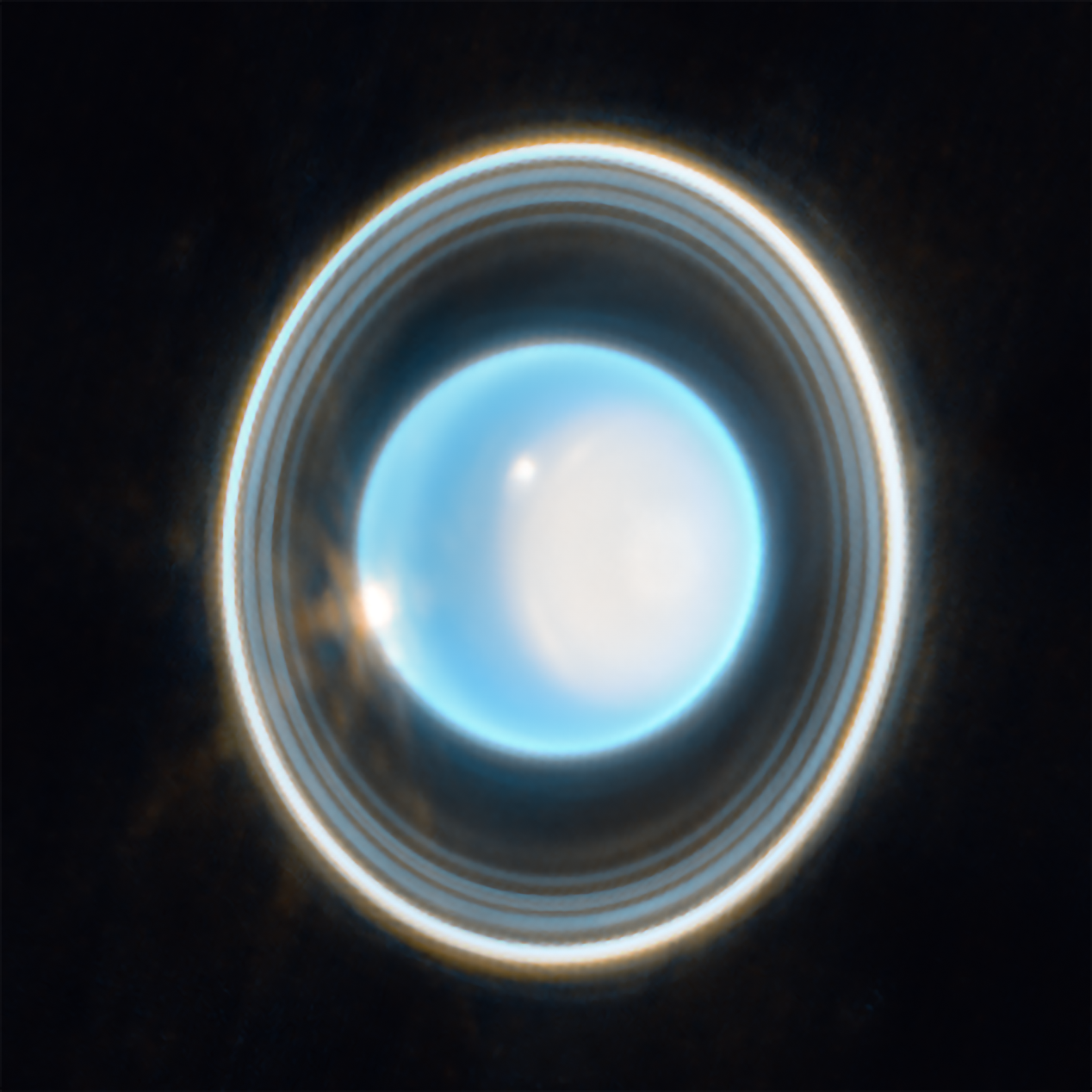
Uranus looks as though something knocked it over. Its moons are why that apparently simple explanation refuses to stay simple.
The planet’s spin axis is inclined by 97.77 degrees relative to its orbit. In the usual convention, that places it just 7.77 degrees beyond lying perfectly sideways and makes its rotation formally retrograde. Its regular moons, meanwhile, orbit close to the planet’s dramatically tilted equatorial plane and move prograde relative to Uranus’s own spin.
Those two observations have to emerge from the same history. A giant collision can deliver a large tilt. The awkward question is what happens to the material that becomes Miranda, Ariel, Umbriel, Titania and Oberon.
One influential set of calculations concluded that Uranus could not have gone from upright to its present orientation in a single abrupt blow if a moon-forming disk already surrounded it. Under that model, the final satellites would circle in the wrong direction. The authors inferred that the planet must already have been tilted before the last collision, implying at least two giant impacts if collisions caused both stages.
That is a real result, but it is not a universal verdict for every single-impact scenario. Newer simulations change when the moons form. If the decisive collision tips Uranus and creates a fresh debris disk, the current moons can assemble afterwards on prograde orbits. The disagreement is less about arithmetic than about which disk survived which event.
The direction of a moon’s orbit is the clue
“Prograde” can be slippery when the planet itself is almost upside down. Here it means that the regular moons travel around Uranus in the same rotational sense as the planet turns. It does not mean that their orbital plane resembles the broad plane in which the planets circle the Sun.
The major moons are nearly circular and nearly coplanar with Uranus’s equator. Their architecture looks like the product of an organised disk, not five unrelated captures. Yet a disk inherited from before the tilt begins in a very different orientation from the final equator.
In an earlier SpaceDaily article on Uranus’s 97.77-degree tilt, I described the moons as one reason the giant-impact case remains open. The more precise issue is not merely that they followed the equator. A model must also preserve or recreate the correct direction of their angular momentum.
How a pre-existing disk can follow a tilted planet
A 2012 paper in Icarus by Alessandro Morbidelli, Kleomenis Tsiganis, Konstantin Batygin, Aurélien Crida and Rodney Gomes tried to solve the alignment problem. Their model began with a proto-satellite disk already surrounding young Uranus.
A giant impact then changed the planet’s spin axis and placed a much more massive, compact disk inside the Roche limit, the region where tides inhibit a large moon from holding itself together. The paper called this inner structure the collision-generated disk, or C-disk.
The inner disk temporarily amplified the gravitational effect normally represented by Uranus’s J2, a measure of how the planet’s non-spherical mass distribution influences orbits. Different parts of the old outer disk then precessed at different rates. Instead of remaining one coherent tilted sheet, the disk spread around the new equatorial plane.
Collisions among particles could damp their inclinations and flatten that dispersed material into a thin disk aligned with the new equator. In the calculations, a C-disk containing about one per cent of Uranus’s mass could extend this reorientation beyond Oberon’s present distance. New regular moons could then assemble from the flattened material.
That dealt with the plane. It did not automatically deal with the direction.
Why one abrupt tilt made the modelled moons retrograde
Suppose the young planet began with zero obliquity, with its disk in the Solar System’s common plane, and one collision instantly carried its spin to 98 degrees. Relative to Uranus’s new spin axis, the old disk’s angular momentum now has the wrong sign.
Precession and collisions can redistribute that disk and press it into the new equator, but they do not conveniently reverse its total angular momentum. In the 2012 calculation, the result was therefore an equatorial but retrograde satellite system, unlike the one around Uranus today.
The authors ran Monte Carlo calculations in which Uranus had different obliquities before the final tilting episode. Depending on whether the prior disk was rigidly precessing or already equatorial, the probability of a prograde final disk was zero when the earlier tilt was below four or eight degrees. It rose quickly with initial obliquity and exceeded 40 per cent at 30 degrees, roughly Neptune’s present tilt.
Their conclusion was direct: within this collisional, pre-existing-disk scenario, Uranus was not tipped from 0 to 98 degrees in one shot. It needed a meaningful earlier obliquity and then the final impact. If the earlier tilt was also collision-made, at least two giant collisions followed.
There is an important boundary around that sentence. The researchers did not simulate two complete hydrodynamic impacts and identify a unique successful history. They modelled disk dynamics and the probability of its final direction, then inferred an earlier tilting event. “At least two” belongs to the assumptions of that model.
Later work tested the hidden requirement
The C-disk was doing a great deal of work in the 2012 explanation. It needed to contain at least 10−2 Uranus masses to make material as distant as Oberon lose its old orbital coherence and settle around the new equator.
Raluca Rufu and Robin Canup tested that requirement more directly in a 2022 Astrophysical Journal study. They simulated impacts capable of producing the tilt while keeping the post-impact system’s angular momentum reasonably close to the value observed today.
The resulting compact disks typically held roughly 10−5 to 10−3 Uranus masses, well below the required one per cent. Impacts that produced more massive disks tended to leave the planet-and-disk system with two to four times too much angular momentum, with no demonstrated way to remove the excess.
That result weakens the particular sequence in which an old outer satellite system is destroyed and realigned by a sufficiently massive inner impact disk. It does not say that an impact could never create Uranus’s current moons. It says the old-disk rescue mechanism appears to ask for a compact disk that physically constrained impacts struggle to provide.
How one impact becomes possible again
A different family of models starts the moon clock after the collision. One oblique impact both changes Uranus’s spin and throws rock and ice into orbit. The regular moons then grow from that newly generated disk rather than from a disk whose angular momentum predates the tilt.
That removes the specific backward-orbit problem. The debris can inherit angular momentum consistent with the post-impact planet, so prograde moons do not need an older disk to reverse itself.
High-resolution impact calculations have found cases that tilt Uranus while ejecting enough orbiting material to seed regular moons. A 2020 Nature Astronomy study led by Shigeru Ida then followed a step that simple impact snapshots miss: the evolution of an initially hot, compact and mostly vaporised water-rich disk.
As that disk viscously spread, much of its mass returned to Uranus or was lost as vapour. It cooled until water ice could condense at about 240 kelvin. The authors’ N-body simulation assembled satellites from the resulting solids and reproduced important features of the observed trend in which moon mass changes with distance. In this picture, a disk initially too massive and too compact evolves into something closer to the present system.
A 2022 Icarus study by Jonathan Woo and colleagues combined smoothed-particle hydrodynamics for the impact, a model of viscous disk spreading and N-body moon assembly. Its best match used a purely rocky impactor about three Earth masses striking the young planet obliquely, with an impact parameter of 0.75. The resulting framework could produce prograde, near-circular moons while also accounting for the large tilt in a single impact.
These models do not prove that one collision happened. They show that the 2012 retrograde result does not apply when today’s moons form from post-impact material. A different initial condition changes which angular momentum has to be preserved.
There may not have been a giant impact at all
Collisions remain a leading explanation, but Uranus’s obliquity is not itself a fossil impact counter. A 2022 Astronomy & Astrophysics model found that a now-lost massive satellite could have migrated through a secular spin-orbit resonance and gradually tilted Uranus towards 90 degrees.
In those calculations the moon eventually became unstable and collided with the planet, freezing Uranus into a highly tilted state. This route has its own demanding assumptions about the missing satellite’s mass, migration and timing, but it shows why “one or two impacts?” is not the only possible question.
What the simulations can and cannot tell us
All these studies are constrained reconstructions. Researchers choose a young Uranus structure, an initial spin, impactor mass and angle, disk composition, viscosity and cooling prescription. They then ask whether the simulated endpoint resembles the planet and moons we see. More than one path can arrive in the right neighbourhood.
The useful conclusion is therefore narrower than a count of collisions. If today’s regular moons descend substantially from a disk that existed before the final abrupt tilt, their prograde direction is evidence that Uranus was already tilted and may have suffered multiple giant impacts. If the moons assembled from debris created by the tilting impact, one collision remains physically possible.
The planet’s sideways equator tells us that its early history was unusual. The moons tell us that the order of events matters. What they do not yet tell us, without a model-dependent translation, is how many times Uranus was hit.