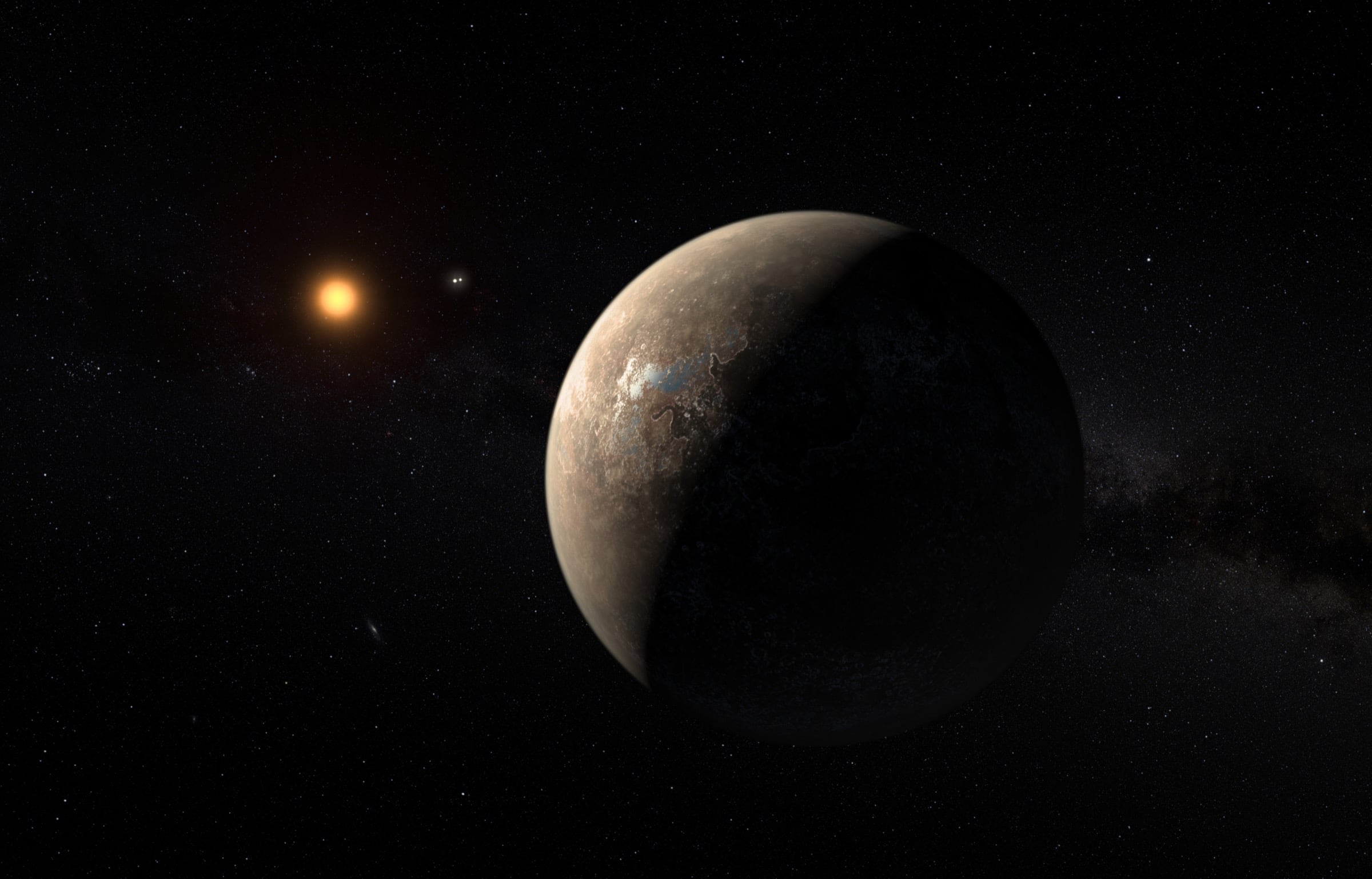
Eleven light-years is a tiny distance on a galactic map. Within that radius, astronomers now know of two confirmed planets receiving the amount of starlight that places them in or near their stars’ habitable zones.
The first is Proxima Centauri b, the closest known exoplanet to Earth. The second is GJ 887 d, whose status changed from an intriguing signal to a confirmed planet in a 2026 paper in Astronomy & Astrophysics.
It is a remarkable neighbourhood, but the phrase “habitable-zone planet” is doing limited work here. It means an orbit receives enough energy for liquid surface water to be possible under suitable atmospheric conditions. It does not tell us whether either planet has air, oceans or life.
GJ 887 d took six years to confirm
GJ 887 is a red dwarf 10.7 light-years away. In 2020, a team using the HARPS spectrograph announced two planets orbiting it every 9.3 and 21.8 days. The same data contained a possible third signal near 50 days, but the researchers stopped short of calling it a planet.
That restraint mattered. Starspots, rotation and magnetic activity can shift a star’s spectral lines in ways that imitate the gravitational tug of an orbiting world. A weak periodic signal is not automatically a planet.
For the 2026 study, Christian Hartogh and colleagues added 101 new HARPS radial-velocity observations and 12 measurements from ESPRESSO. They modelled the star’s activity and found that a four-planet interpretation best explained the data. One of those worlds, GJ 887 d, completes an orbit every 50.77 days.
NASA’s Exoplanet Archive lists a minimum mass of 6.1 times Earth’s, an orbit of 0.212 astronomical units and an estimated incident flux about 81 per cent of Earth’s. It is commonly called a super-Earth because of its mass, but that label does not establish what it is made of.
Proxima b remains the nearer comparison
Proxima Centauri b was reported in Nature in 2016 after astronomers detected the small back-and-forth motion it induces in the nearest star to the Sun. It orbits every 11.2 days at only about 0.049 astronomical units from its red dwarf.
The latest values collected by the NASA Exoplanet Archive put its minimum mass close to 1.1 Earth masses. That makes a rocky composition plausible, although the planet does not cross its star from our viewing angle, so astronomers do not have a measured radius or density.
At 4.24 light-years, Proxima b is far closer than GJ 887 d. Yet our knowledge of both worlds comes mainly from the movement of their stars. Neither detection is a picture of a planetary surface.
The habitable zone is a first filter
A planet in the habitable zone occupies a range where liquid water could persist on the surface if the atmosphere and other conditions cooperate. Move the same planet inward and water may evaporate; move it outward and it may freeze. The boundaries depend on the star and on climate assumptions.
That definition is useful because it narrows a vast search. It is not a verdict on habitability. Venus, Earth and Mars show how planets receiving broadly comparable sunlight can develop very different surfaces and atmospheres.
This is one study, not settled consensus on every property of GJ 887 d. The planetary signal is now treated as confirmed, but its mass is only a lower limit because radial velocity does not reveal the orbit’s tilt. The planet could be rocky, rich in water, wrapped in a thick envelope of gas, or something between those categories.
Red dwarfs offer time and trouble
Both planets orbit red dwarfs, the small, cool stars that make up most of the Milky Way’s stellar population. Their low luminosity brings the habitable zone close to the star, which gives astronomers frequent orbits to measure and comparatively strong radial-velocity signals.
The same proximity complicates the climate question. Close-in planets may become tidally locked, keeping one hemisphere facing the star. Red dwarfs can also produce flares and high-energy radiation capable of changing or stripping an atmosphere. NASA notes that Proxima Centauri’s periodic flaring lowers the planet’s prospects, although the outcome depends heavily on an atmosphere we have not detected.
GJ 887 has appeared comparatively quiet in visible-light observations. The original 2020 discovery paper reported photometric variability below 500 parts per million. Quiet in one dataset does not mean harmless across every wavelength or throughout the star’s history, but it makes the system unusually attractive for follow-up.
Near enough to study, not to visit
The real importance of 4.24 and 10.7 light-years is observational. Nearby systems appear more widely separated on the sky and deliver more light to our instruments than comparable systems hundreds of light-years away. That can make future efforts to detect atmospheres or directly image planets more practical.
There are limits. Neither world is known to transit, removing the most established method for examining an exoplanet atmosphere as starlight passes through it. Direct imaging must separate a faint planet from a much brighter star at a very small angle.
The two discoveries therefore leave us with a useful kind of uncertainty. Proxima b shows that a roughly Earth-mass world can occupy a temperate orbit around the star next door. GJ 887 d shows that a more massive world can do the same around another of our nearest red dwarfs.
What neither tells us is whether a habitable zone has produced a habitable place. Answering that will require atmospheric measurements, better constraints on mass and orbit, and patience. Proximity gives astronomers a better chance to ask those questions. It does not answer them for us.