

Titan is one of the rare worlds where space travel seems to get easier after the atmosphere begins.
On Mars, the air is too thin to slow a spacecraft easily but thick enough to cause dangerous heating. On the Moon, there is no air at all. Venus has too much atmosphere and too much heat. Titan, by contrast, offers a strange gift: thick, cold air wrapped around a low-gravity world.
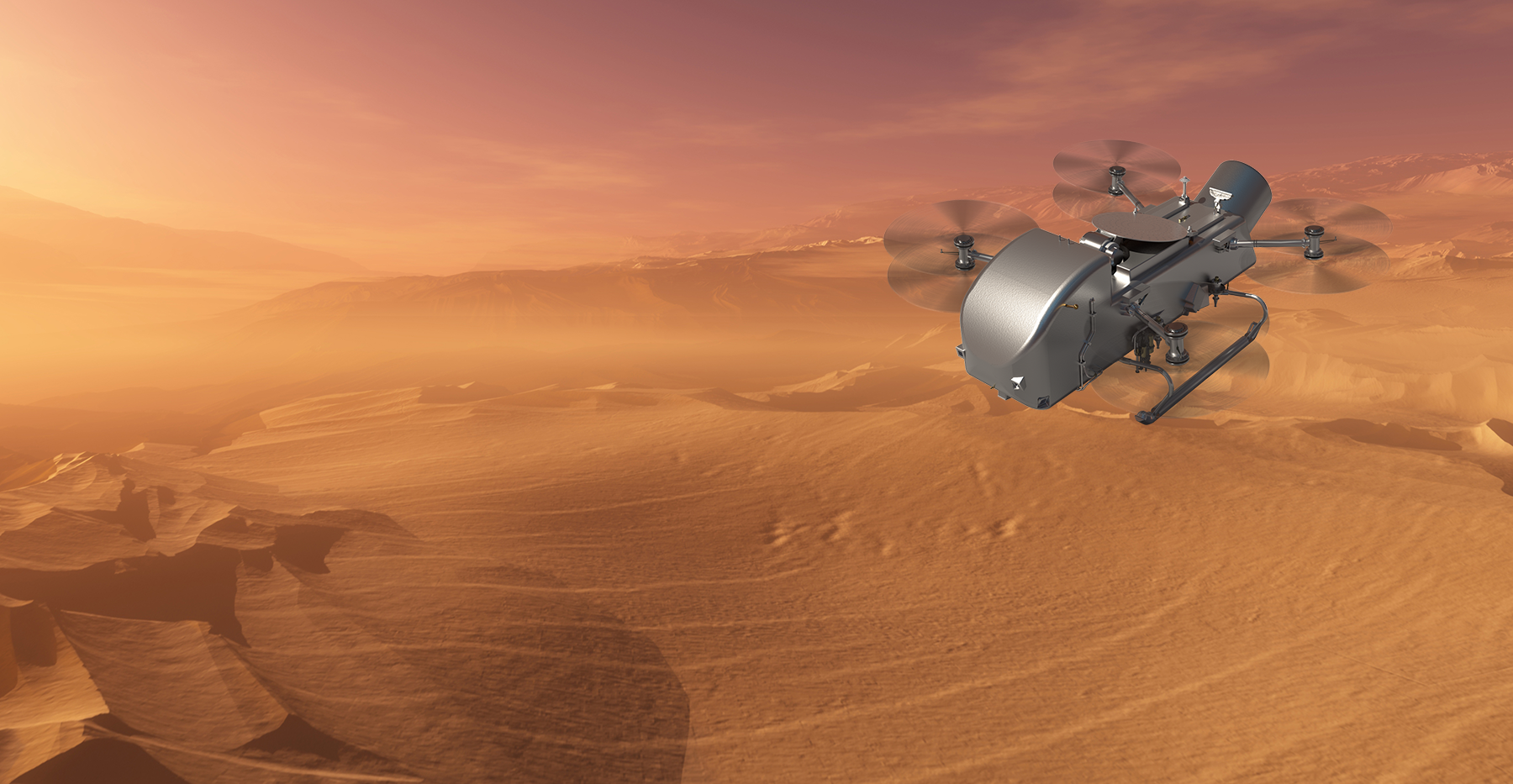
That combination is why NASA says Titan’s dense atmosphere, low gravity and frigid temperatures will help its Dragonfly rotorcraft stay easily aloft and fly farther with little energy. It is also why the idea of human-powered flight there is not pure fantasy. Titan’s sky is simply much more willing to hold things up.
The catch is that the same world sits at about -179 degrees Celsius. That is nearly 90 degrees below the -89.2 degrees Celsius cold record measured at Antarctica’s Vostok Station, which the World Meteorological Organization lists as Earth’s lowest recorded surface air temperature. Titan may be generous to wings and parachutes, but it is merciless to anything warm.
Why Titan Is So Easy To Fly In
Flight is mostly a bargain between lift and weight. A wing has to push against air hard enough to support the thing attached to it. Dense air helps, because there is more material for the wing, rotor or parachute to work with. Low gravity helps because there is less weight to overcome.
Titan has both.
NASA’s Titan facts page says its surface atmospheric pressure is about 60 percent greater than Earth’s, roughly the pressure a person would feel swimming about 17 feet below the ocean surface. NASA’s Dragonfly overview puts the other half of the equation plainly: Titan has the only dense atmosphere of any moon in the solar system, and its gravity is low enough that flying vehicles can exploit that air rather than fight it.
That is why The Planetary Society can make the startling but physically serious point that, on Titan, a human could plausibly strap wings onto a spacesuit, flap, run and take off. The details would be ugly in practice. A real person would need insulation, oxygen, heating, pressure control and protection from the cold. The suit would change the mass and the aerodynamics.
But the underlying physics is not a joke. Compared with Earth, Titan gives a wing more air to push against and gives gravity less pull to beat. The result is the closest thing in the solar system to a natural human-flight laboratory.
Even walking would feel different. A person would weigh only a fraction of their Earth weight, while still standing in a substantial atmosphere. Jumping, gliding and slow falling would become ordinary motions rewritten by another world’s air.
Related watch:
The Same Physics Helps Spacecraft Land
The part that makes Titan especially interesting is that this does not only apply to imagined wingsuits. It applies to spacecraft.
Landing on a world is usually a fight against speed. A spacecraft arrives fast, and the planet or moon has to remove that speed before the surface arrives. Thick air helps by providing drag. Low gravity helps by stretching the descent and reducing the downward pull. Titan gives mission designers both advantages at once.
NASA’s technical summary for Dragonfly’s entry and descent system says Titan’s dense atmosphere, large atmospheric scale height and low gravity allow for a slow-paced entry and descent sequence lasting more than 100 minutes, in sharp contrast to the short, frantic landing sequence often associated with Mars.
That does not mean Titan landings are easy. The atmosphere is hazy, the winds matter, the cold is brutal and communication delays are enormous. But compared with thin-atmosphere worlds, Titan lets a spacecraft spend a long time slowing down. It turns descent into a drawn-out aerodynamic process rather than a final sprint.
Huygens proved this in 2005. The European Space Agency probe, carried to Saturn by NASA’s Cassini orbiter, parachuted through Titan’s atmosphere for two hours and 27 minutes before touching down. NASA’s mission account says Huygens descended for 2.5 hours and landed at about 15 feet per second, later returning data and images from the surface.
That was not a winged aircraft, but it was the same basic gift. Titan’s atmosphere took hold of the probe and slowed it gently enough for humanity’s most distant landing to end not in a crater, but in a soft, sandy-looking plain scattered with icy pebbles.
The World That Welcomes Descent
Titan’s atmosphere is not only dense near the ground. It extends far above the surface because gravity is weak. That creates a long vertical region where drag can matter. NASA’s Dragonfly podcast notes that the mission’s entry interface is roughly 1,270 kilometres above Titan, because the atmosphere is so extended that even Cassini had to plan high-altitude flybys carefully to avoid drag effects.
For a lander, that extended atmosphere buys time. Parachutes can deploy. Heat can be shed. Instruments can sample the air. Navigation systems can work through stages instead of needing everything to happen in a few violent minutes.
This is why Titan has attracted so many aerial mission concepts: balloons, airplanes, rotorcraft and guided parachutes. NASA’s JPL robotics work on Titan precision landing notes that dense atmosphere and low gravity make guided parachutes or parafoils attractive for large diverts at comparatively low cost. On another world, a parachute is usually only a brake. On Titan, it can become a steering tool.
Dragonfly takes the idea further. It is not just a lander that survives descent. It is a rotorcraft designed to use Titan’s air as transportation, flying from site to site across dunes and impact deposits while investigating the chemistry that may resemble the prebiotic chemistry of early Earth.
That mission would be impossible on most solid worlds. On the Moon, rotors have nothing to push against. On Mars, Ingenuity proved powered flight was possible, but only by spinning oversized blades extremely fast in thin air. Titan is different. It is the rare place where the atmosphere does not merely allow flight. It invites it.
The Cold Rewrites Everything
Then there is the cold.
At -179 degrees Celsius, water ice on Titan is not a fragile frost. It behaves more like rock. Methane and ethane, gases in ordinary Earth conditions, can exist as liquids, forming lakes, seas, rain and channels. The landscape has weather, rivers and shorelines, but the working fluid is not water. It is hydrocarbon.
That is why Titan can seem both familiar and impossible at the same time. It has clouds, dunes, lakes and rain, but the chemistry is shifted into a temperature regime far beyond human experience. A person could not simply enjoy that forgiving air. They would need a life-support system built for an environment colder than the coldest place ever measured on Earth by almost a full 100 Celsius degrees.
The same is true for machines. Electronics, lubricants, batteries, seals and moving parts have to survive a world where heat is precious and the surrounding atmosphere is eager to drain it away. The landing may be gentle, but the surface is not hospitable.
This is Titan’s paradox. It is one of the easiest solid worlds to move through aerodynamically and one of the hardest worlds to endure thermally. It cushions you on the way down, then freezes almost everything you bring.
A Sky That Changes The Rules
Titan shows how misleading the word “hostile” can be. A world can be hostile in one way and helpful in another. Mars is easier to keep warm on than Titan, but much harder to slow down through the atmosphere. The Moon is close, but gives no air for flight or parachutes. Venus has atmosphere in abundance, but its surface heat and pressure are devastating.
Titan’s balance is unique: cold enough to preserve methane seas, massive enough to hold a thick nitrogen atmosphere, light enough that gravity barely tugs by Earth standards. That combination makes human-powered flight a real physics possibility and makes spacecraft descent unusually forgiving.
The dream version is a person gliding under an orange sky. The engineering version is Dragonfly, using rotors to hop across alien dunes. The historical version is Huygens, drifting for hours through haze before touching another moon.
All three are expressions of the same fact. On Titan, the sky does not behave like Earth’s sky, and gravity does not demand what Earth’s gravity demands. The air is thick, the pull is weak, and flight becomes easier than it has any right to be.
Only the cold keeps the fantasy honest.