

A billion kilometres sounds like the distance to a remote world. In Tianwen-2’s case, it was the accumulated length of a carefully shaped path to an asteroid that never strays especially far from Earth’s neighbourhood.
The distinction matters. Kamoʻoalewa was not sitting one billion kilometres from Earth waiting to be reached. China reported that its spacecraft covered roughly that distance during a 400-day heliocentric transfer, repeatedly adjusting its path until it was moving almost alongside a target that may be only 20 metres wide.
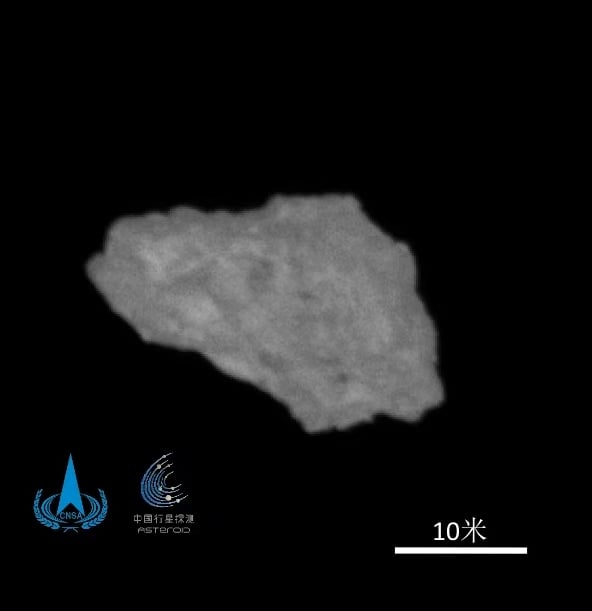
On 2 July 2026, Tianwen-2 photographed Kamoʻoalewa from about 20 kilometres away. The China National Space Administration released the image on 6 July, showing an elongated grey object against black space with a 10-metre scale bar. It was the first close view of a body that telescopes had previously recorded as little more than a moving point of light.
The portrait arrives at a scientifically awkward moment. Kamoʻoalewa’s unusual spectrum and Earth-like orbit had made a fragment of the Moon a compelling possibility. New telescope data, laboratory experiments and population models have reopened that interpretation without yet replacing it with one agreed alternative.
A billion kilometres is a flight path, not a separation
Spacecraft rarely travel to a small body by pointing at its current position and flying straight toward it. Both spacecraft and target orbit the Sun. The task is to leave Earth on a trajectory that intersects the asteroid’s future path, then reduce the difference in position and velocity until the two can travel together.
This is why an apparently nearby target can require an enormous cumulative journey. Kamoʻoalewa follows an orbit similar to Earth’s, but similar is not identical. Tianwen-2 had to reshape its own solar orbit and arrive with a low enough relative speed for controlled proximity operations.
The mission launched on 29 May 2025 aboard a Long March 3B. CNSA says the probe made deep-space and mid-course corrections before first detecting the asteroid on 6 June 2026. On 7 June, from about 30,000 kilometres away, it performed capture control and entered coplanar flight. By 19 June it was 2,000 kilometres away.
Those stages were not ceremonial milestones. Before arrival, Kamoʻoalewa’s position was derived from faint ground-based observations and carried an uncertainty of hundreds of kilometres. Optical navigation during the approach reduced that error to the kilometre scale. A spacecraft trying to meet a 20-metre rock cannot treat a hundred-kilometre uncertainty as a small detail.
The image changes the scale of the object
Early estimates often put Kamoʻoalewa somewhere between 40 and 100 metres across. Asteroid sizes inferred from brightness depend on albedo, or how efficiently the surface reflects sunlight. A small bright body and a larger dark one can return similar amounts of light.
In February 2026, the James Webb Space Telescope observed Kamoʻoalewa with NIRSpec. A June preprint led by Benjamin Sharkey used the faint thermal emission beyond about 4.5 micrometres to estimate a mean diameter of 18 plus or minus 2 metres. The model favoured an unusually high visible albedo, although lower-reflectivity solutions remained possible.
The Webb light curve independently confirmed that the object spins once every 27.9 minutes. Its changing brightness suggested an axis ratio near 1.4 and dimensions spanning roughly 15 to 21 metres as it rotates. Tianwen-2’s first image, with its visible elongation and scale bar, is consistent with that compact interpretation.
It is still an early navigation image, not a completed shape model. Perspective, illumination and image processing can make a small irregular body appear broader or narrower. The careful statement is that Kamoʻoalewa may be only about 20 metres wide, not that one frame has measured every axis precisely.
A fast-spinning object with almost no gravity
The smaller size makes the rendezvous more impressive and the sampling problem harder. Gravity at the surface is extremely weak. The spacecraft cannot settle into an ordinary circular orbit in the way a satellite does around Earth, and a small command error can send it drifting away or into the terrain.
The 27.9-minute rotation brings a second complication. Surface features move quickly beneath the probe. A sampling site selected from one viewing angle soon rotates out of sight, while loose material may behave differently near ridges or the tips of an elongated body.
CNSA describes the close phase as gradual exploration while flying, with hovering and active arcs used to build shape, composition and internal-structure maps. Tianwen-2 carries 11 scientific instruments, including colour and multispectral cameras, visible-infrared and thermal spectrometers, radar, a magnetometer, particle analysers and navigation sensors.
The first picture therefore proves something specific: the navigation system found the target and the spacecraft could approach to 20 kilometres. It does not yet reveal whether Kamoʻoalewa is one coherent rock, a fractured aggregate or a rubble pile held together by its own faint gravity.
Why Kamoʻoalewa is not Earth’s second moon
Kamoʻoalewa is often called a quasi-moon, but it is not gravitationally bound to Earth. It orbits the Sun in a 1:1 resonance, taking about as long as Earth to complete a year. From the moving planet, their relative paths make the asteroid appear to trace loops around Earth.
That configuration keeps it in the neighbourhood for long intervals while allowing it to remain a solar-orbiting object. Its formal designation is 469219 Kamoʻoalewa, and it was discovered in 2016 by the Pan-STARRS 1 telescope at Haleakalā in Hawaiʻi.
The orbit helped make a lunar origin plausible. Numerical work showed that impact ejecta can escape the Moon, enter heliocentric space and, through rare pathways, settle into an Earth co-orbital state. A 2024 Nature Astronomy study proposed the 22-kilometre Giordano Bruno crater on the lunar far side as a possible source, with an age of roughly one to ten million years.
Compatible dynamics are not a reconstructed biography. The simulations showed that the route can work; they did not demonstrate that this particular object took it.
The red spectrum that made it look lunar
The more arresting clue came from composition. A 2021 reflectance study found that Kamoʻoalewa had a very red spectral slope and a silicate absorption feature. Among the available comparisons, space-weathered lunar material provided a close match.
Airless surfaces are steadily altered by solar-wind particles and micrometeorite impacts. This space weathering can darken and redden their spectra. Kamoʻoalewa’s unusually red infrared colours therefore looked like mature lunar soil rather than the more familiar surfaces of near-Earth asteroids.
That evidence was meaningful, but reflected light is not a laboratory assay. A spectrum blends mineral composition, grain size, roughness, viewing geometry and weathering history. More than one physical surface can sometimes produce a similar curve.
SpaceDaily’s earlier report on Tianwen-2’s arrival laid out how the lunar case joined two indirect lines of evidence: a lunar-looking spectrum and a dynamically possible path. The newest work has put pressure on both.
Three different challenges reopened the debate
The first challenge comes from new observations. Webb’s February 2026 spectrum was notably less red between 1 and 2.5 micrometres than the earlier ground result. New Large Binocular Telescope measurements obtained in April, processed in a way comparable with the 2021 observations, agreed with Webb.
Sharkey’s team found colours resembling S-, V- or E-type silicate asteroids more closely than strongly reddened lunar material. The authors noted possible similarities to oldhamite-bearing, enstatite-rich compositions. Their paper remains a preprint, so the result should not be treated as the final classification.
The second challenge is experimental. In a 2026 Nature Communications paper, Pengfei Zhang and a large team reanalysed the one-micrometre absorption band and irradiated meteorite samples with lasers to imitate space weathering. Highly weathered LL-chondrite powder reproduced Kamoʻoalewa’s spectrum better than the three lunar samples they compared.
That points toward material broadly like the asteroid Itokawa, possibly delivered from the Flora family in the inner main belt. The authors explicitly left the lunar door open because the Moon is compositionally diverse and the asteroid spectra have limited signal-to-noise. Their result shows that a lunar composition is not required, not that every lunar possibility has been excluded.
The third challenge is statistical. A 2026 Astronomy & Astrophysics population study estimated an average of about 1.23 Kamoʻoalewa-like bodies supplied by the wider near-Earth-asteroid population, compared with roughly 0.042 from Giordano Bruno ejecta. That makes the main-belt route more productive in the model by more than an order of magnitude.
A population comparison cannot identify the origin of one asteroid. It says ordinary asteroid pathways should create this type of object more often than the specific lunar-crater scenario.
What the close-up cannot answer
The first Tianwen-2 frame shows shape, scale and successful navigation. It cannot discriminate between lunar silicate, weathered LL chondrite or an enstatite-rich surface. Grey pixels are not a mineral spectrum, and an angular outline records nothing about isotope ratios.
Later remote sensing will be far more informative. Multispectral images can map colour variations, infrared instruments can resolve absorption bands, thermal measurements can constrain surface texture, and radar may distinguish a monolith from internal voids or a rubble structure.
Even those data may leave degeneracies. Space weathering and grain size are precisely why the Earth-based spectra became disputed. The mission’s defining experiment is the return of physical material.
A sample can turn resemblance into identification
The current plan is to collect material from Kamoʻoalewa and return a capsule to Earth in late 2027. Laboratory teams can measure mineral grains, elemental abundances, isotope ratios and exposure histories at resolutions no remote instrument can match.
If those properties match lunar samples, the lunar-fragment hypothesis will have survived the new spectral and population objections. Kamoʻoalewa could then preserve material from a young far-side impact, potentially linking an asteroid to a source region on the Moon.
If the sample is LL-chondritic or otherwise asteroidal, the result will be equally useful. It would show that extreme weathering of fine regolith can make an ordinary asteroid resemble lunar material, a caution that would apply to the classification of other faint near-Earth objects.
Tianwen-2 is designed to continue after the capsule departs. The main spacecraft is expected to use Earth for the next stage of a longer journey toward active main-belt asteroid 311P/PANSTARRS, targeted for study in the 2030s.
For now, the July image marks the end of the transfer and the beginning of the measurement. A billion kilometres of navigation delivered Tianwen-2 to within 20 kilometres of a body roughly a million times smaller than the distance already travelled. The picture shows that the target is real and reached. The argument about where it came from will have to wait for the rock itself.