

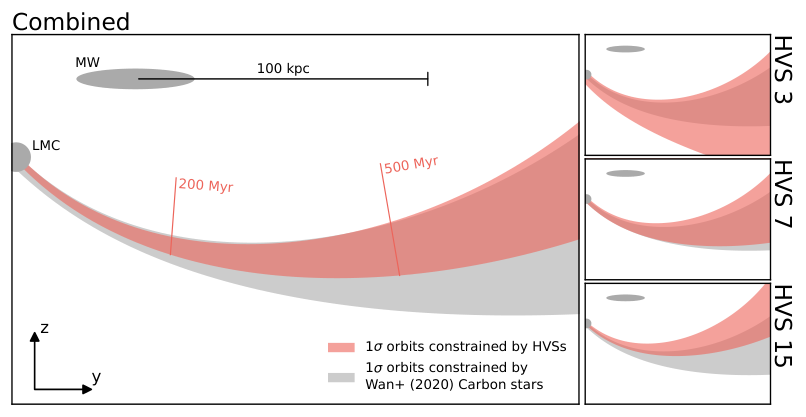
Three stars moving fast enough to escape a galaxy have been used to recover part of the Large Magellanic Cloud’s own path through space. Scott Lucchini and Jiwon Jesse Han, both at the Center for Astrophysics | Harvard & Smithsonian, report in The Astrophysical Journal Letters that the stars narrow the allowed corridor of the galaxy’s recent orbit by about half.
The result rests on HVS 3, HVS 7 and HVS 15, three late B-type stars whose motions are difficult to reconcile with an origin in the Milky Way’s centre. The authors treat them as markers dropped from the Large Magellanic Cloud, then ask which candidate histories of that galaxy pass through each marker at the right time.
This is one study, not settled consensus. Its answer depends on the three stars really having been ejected from the Large Magellanic Cloud and on the gravitational model used to wind their motions backwards.
Why an escaping star preserves a location
A hypervelocity star can be produced when a binary system passes close to a massive black hole. One star is captured and the other is thrown away at high speed. Once outside its home galaxy, the departing star carries a record of where it came from in its present position and velocity.
The connection to the Large Magellanic Cloud has been developing for years. SpaceDaily covered 2017 modelling of runaway stars from the LMC, while a 2025 Astrophysical Journal study used the distribution of hypervelocity stars to argue for a massive black hole in the galaxy. The new paper puts the best three candidates to another use: dated position markers.
The inferred ejection times are widely separated. HVS 3 left about 19 million years ago, HVS 7 about 219 million years ago and HVS 15 about 299 million years ago. Each star therefore asks the LMC’s orbit to pass through a different point at a different time.
How the possible orbits were tested
Lucchini and Han generated 10,000 possible LMC orbits. For every one, they sampled 10,000 possible trajectories for each star, allowing for uncertainty in distance, proper motion and radial velocity. The Milky Way and the LMC were represented by extended gravitational potentials that could respond to each other, with dynamical friction included. The stars were treated as test particles.
A candidate orbit scored well when the backward path of a star came within a one-kiloparsec cube around the modelled centre of the LMC at the inferred ejection time. Combining three separate likelihood maps leaves much less room than any one star does alone.
In the authors’ open version of the paper, the red one-sigma corridor derived from the stars is roughly half as broad as the grey corridor obtained by simply integrating backwards from a previously measured present-day centre. The published result appears in Astrophysical Journal Letters, volume 993.
What the 50 per cent reduction means
The number is easy to overread. It does not mean the LMC’s entire history is now 50 per cent more accurate, and it is not a 50 per cent change in the galaxy’s estimated speed. Inside this model, the viable parameter space for the recent orbital trajectory was reduced by a factor of about two compared with the chosen conventional extrapolation.
The authors also widened the uncertainty in the LMC’s present proper motion to cover differences among several stellar tracers. The factor-of-two reduction survived that test. Their additional runs including the Small Magellanic Cloud produced only modest average changes over 400 million years.
Why the map extends to 800 million years
None of the three stars has been travelling for 800 million years. The oldest inferred ejection in the sample is about 299 million years ago, and the individual stellar integrations run back 400 million years. The longer span comes from using those encounters to select a narrower family of LMC orbits, then following that family farther into the past.
The paper says those constrained orbits remain useful to roughly 800 million years ago. Beyond that point, mass loss, hydrodynamic drag, dynamical friction and other details make the extrapolation increasingly sensitive. The older part of the reconstruction is therefore model-supported history, not a direct stellar breadcrumb left 800 million years ago.
What remains unresolved
The narrowed corridor agrees best with two rather different published histories: a hydrodynamic simulation in which the LMC is on its first passage around the Milky Way, and a collisionless simulation that permits a second passage. The three stars therefore do not settle the larger first-or-second-passage debate.
They do offer a second result. By combining the ejection paths, the authors infer a likely present position for the LMC’s massive black hole near right ascension 80.72 degrees and declination minus 67.79 degrees, about 1.5 degrees north of the average of several conventional centre estimates. That remains an indirect prediction rather than a detection of the black hole itself.
The immediate next step is narrow and practical: improve the Gaia DR3 proper motions of these three stars with Hubble or Webb observations, and search for older LMC ejecta. Each additional well-measured star would add another dated crossing that the galaxy’s true orbit has to satisfy.