
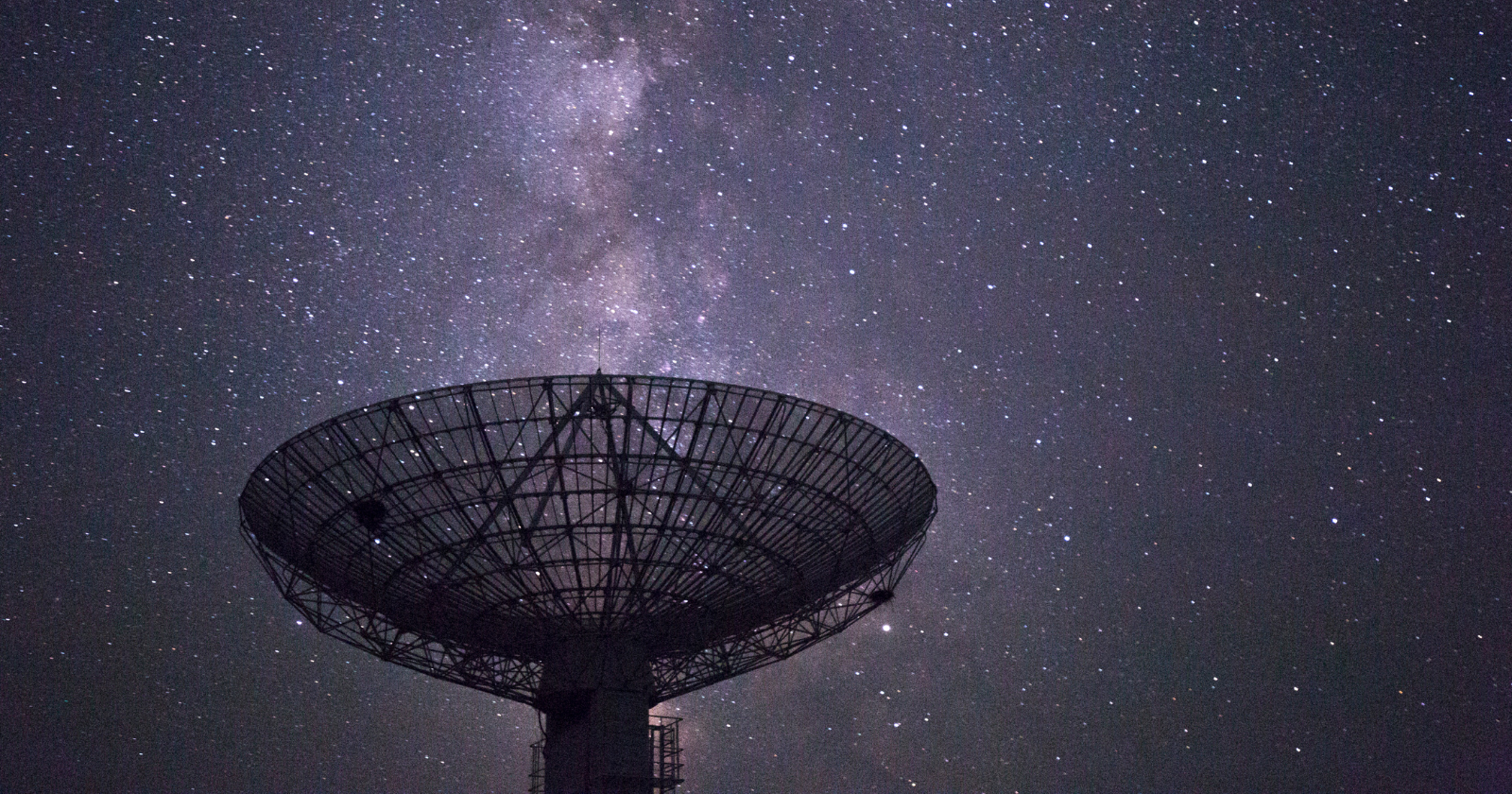
On 15 August 1977, the Big Ear radio telescope at Ohio State University recorded a narrowband radio signal that lasted roughly 72 seconds. It came from the direction of the constellation Sagittarius, at a frequency near 1420 MHz, the natural emission line of neutral hydrogen. The astronomer Jerry R. Ehman, reviewing the printout a few days later, circled the sequence “6EQUJ5” representing the signal’s intensity, and wrote “Wow!” in the margin. The name has stuck.
Big Ear was a stationary instrument. It observed a strip of sky by letting Earth’s rotation carry sources through its beam. Seventy-two seconds was approximately the window during which a fixed point in the sky could be observed before drifting out of view. The signal lasted the full window. It rose, peaked, and fell in the pattern that the telescope would produce for a true point source on the sky. Then it was gone.
It has never been observed again.
Why it stood out
The Wow! Signal was unusual on several counts at once. It was narrowband, meaning concentrated in a very small frequency range, which is characteristic of engineered transmission and uncommon in natural astrophysical sources. It was strong, registering near the upper limit of what Big Ear could measure. It was at 1420 MHz, the hydrogen line, which in a 1959 paper in Nature the Cornell physicists Giuseppe Cocconi and Philip Morrison had proposed as a logical frequency for any technological civilisation attempting interstellar contact. It came from a direction where nothing notable was known to be radiating. And its intensity profile across the observation window was consistent with a fixed celestial source, not a local interference event.
It also did not repeat. Numerous follow-up searches, beginning with Ehman himself and continuing with successive radio telescopes, have failed to detect anything in that location at that frequency. The signal sits alone in the record.
The decades of follow-up
The Big Ear telescope was decommissioned in 1998. The Very Large Array, the Green Bank Telescope, the Allen Telescope Array, and others have all looked at the same patch of sky in the years since. Nothing matching has been found.
In 2016, the astronomer Antonio Paris proposed that two comets unknown in 1977 might have been the source, with hydrogen clouds around them producing the signal. The proposal, published in the Journal of the Washington Academy of Sciences, attracted scepticism from other astronomers who noted that hydrogen emission from comets is typically diffuse rather than narrowband. The hypothesis is not generally accepted.
In 2020, amateur astronomer Alberto Caballero identified a sun-like star, 2MASS 19281982-2640123, near the right region of Sagittarius as a possible source. Big Ear’s positional resolution was limited and the star identification rests on a coincidence of geometry. It remains a curiosity rather than an explanation.
The 2024 hydrogen-cloud hypothesis
The most substantial new work has come from the Arecibo Wow! project at the University of Puerto Rico at Arecibo. A paper posted to arXiv in August 2024 by Professor Abel Méndez of the Planetary Habitability Laboratory, Kevin Ortiz Ceballos of the Harvard-Smithsonian Center for Astrophysics, and Jorge I. Zuluaga of the University of Antioquia in Colombia, proposes a natural astrophysical mechanism that fits the signal’s observed properties.
The hypothesis runs as follows. Cold interstellar hydrogen clouds, common throughout the galaxy, normally emit a faint, narrowband signal at the hydrogen line. If a strong transient radiation source, such as a magnetar flare or a soft gamma repeater, passes behind such a cloud, it can briefly stimulate the cloud to emit at much higher intensity. The mechanism is similar to that of an astrophysical maser. The result is a short, narrowband, single-occurrence radio burst at the hydrogen line, which is what Big Ear recorded.
The team reported fainter narrowband signals matching parts of this profile in archived 2020 Arecibo data, in multiple locations, two orders of magnitude weaker than the original Wow! event. Identifying the actual transient source behind the 1977 signal, if one is to be found, requires further targeted observation.
Méndez has been careful about the framing. In statements accompanying the paper, he has said the result does not solve the mystery of the Wow! Signal but narrows it. The hypothesis explains the observed properties, including the lack of repetition. It does not confirm what produced the signal.
What the question still is
In our reading, the Wow! Signal has aged into something quite specific. It is not a deus-ex-machina argument for extraterrestrial intelligence. It is also not, on the available evidence, conclusively explained by any natural mechanism. The Méndez et al. work is the most credible natural hypothesis that fits the observed properties, but the actual triggering event, if there was one, has not been identified.
The original frame around the signal, that it remains one of the strongest and most famous candidate signals in SETI history, has not been overturned. Nor has it been confirmed. Nearly forty-nine years is a long time for either outcome to stay pending.
The Arecibo Wow! team have published a second paper in the series, refining the signal’s frequency to 1420.726 MHz and tightening its position in the sky. That refinement makes targeted observation of any background transient source more tractable. Whether such a source is identifiable depends on whether one existed, was active around August 1977, and left observable traces.
The signal itself, recorded on line-printer paper at an observatory that no longer exists, points at a piece of sky and asks anyone with a sensitive enough telescope to look again.
