
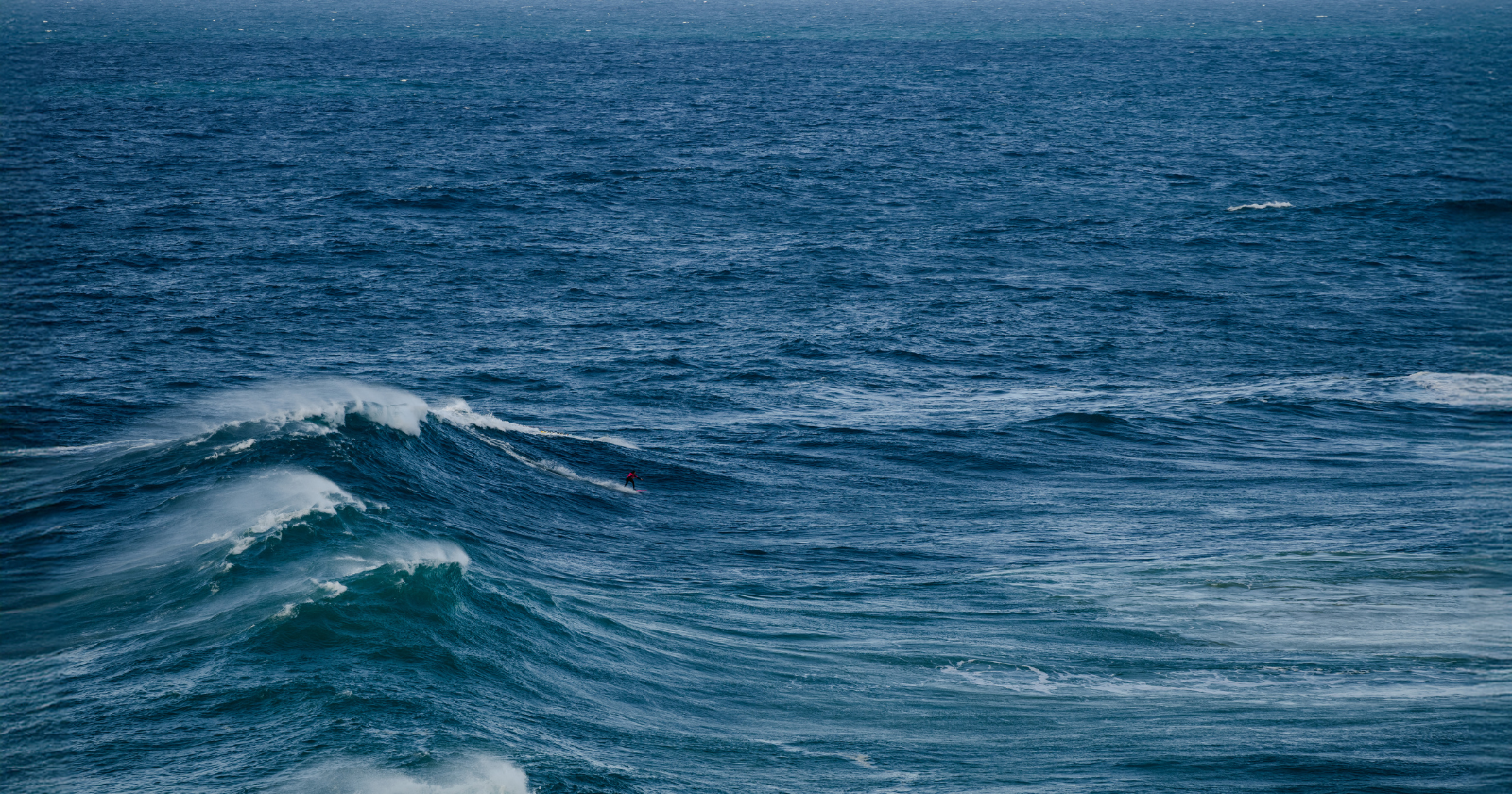
Lay every continent and island on the planet side by side, and the total land area comes to roughly 149 million square kilometres. The Pacific Ocean, by most accounts, is larger than that. You could fit all the world’s land inside it and still have open water left over.
The exact surplus depends on whose figure you use, but the direction of the comparison does not change. The US National Oceanic and Atmospheric Administration puts the Pacific at more than 155 million square kilometres and states plainly that this is larger than the landmass of all the continents combined. Other references run higher.
Why the number is a range
Ask for the area of the Pacific and you will get different answers. NOAA gives more than 155 million square kilometres. Britannica lands near 162 million while explicitly leaving out the South China Sea. Some definitions that draw the southern boundary all the way to Antarctica put it closer to 165 million.
The disagreement is not about the water. It is about where the water stops. An ocean has no fixed edges, so the totals shift depending on whether you count the marginal seas and where you draw the southern boundary against the Southern Ocean. On the largest common figures the leftover area, the part of the Pacific that no continent would cover, is roughly 16 million square kilometres, not far off the size of Russia, the biggest country on Earth. On the smaller figures it is more modest. The continents fit inside the ocean in every version.
The biggest ocean is also a shrinking one
It will not hold the title forever.
The Pacific is ringed by subduction zones, the chain of trenches and volcanoes known as the Ring of Fire, where old sea floor is dragged down into the mantle. Around much of its rim that old crust is being consumed at the trenches, and over geological time this has helped make the Pacific a shrinking basin, even as new crust forms along its spreading centres. The Atlantic, by contrast, fed by the mid-ocean ridge running down its middle, is widening.
On the timescales of plate tectonics, tens of millions of years, the Pacific is the surviving remnant of far older and larger oceans, and it is gradually closing. The size that makes it singular today is a feature of this geological moment, not a permanent fact about the planet.
Where “blue planet” undersells, and where it oversells
By area, the premise is fair. Seen from space the Earth is mostly water, the Pacific most of all, and a single ocean outsizes all the dry ground there is. On that measure “blue planet” is, if anything, an understatement.
By volume, though, the impression reverses. The ocean is wide, but it is not deep, at least not relative to the body it sits on. The Pacific averages around 4,000 metres, and Earth’s radius is about 6,371 kilometres, so even the deepest ocean is a skin over the rock. The US Geological Survey makes the point with a thought experiment. Gather every drop of water on the planet, the oceans, ice caps, lakes, rivers, groundwater and atmosphere, into a single sphere, and that sphere would be only about 1,385 kilometres across. Set against a world nearly 12,800 kilometres wide, it is small. The Woods Hole Oceanographic Institution puts the same idea as a basketball and a ping-pong ball: if Earth were the basketball, all of its water would fit in the ping-pong ball.
The USGS calls the oceans a “thin film” on the surface, and the description is accurate.
Both things are true
So the blue is real and it is enormous in reach, covering more than two-thirds of the surface and, in the Pacific alone, more ground than every landmass put together. It is also shallow, mobile, and slowly rearranging itself as the plates beneath it move.
The figure worth carrying away is the first one, because it is the one that catches people off guard. The largest single feature on the surface of the Earth is not a continent. It is an ocean wider than all of them at once.
