Take a breath beside a forest and the source of oxygen seems obvious. Leaves surround you. Trees are visibly alive. Their relationship with sunlight appears in every green surface.
Take the same breath beside the open ocean and there may be nothing green in sight. The water looks blue, empty and almost mineral. Yet if the question is who carries out the planet’s oxygen-producing photosynthesis each year, roughly half of the answer is in that water.
The work is done mainly by phytoplankton, a loose community of microscopic organisms drifting through the sunlit upper ocean. Some are algae. Some are cyanobacteria. Some build shells of silica or calcium carbonate. Many live for only days, but together they perform photosynthesis on a scale comparable with all plants on land.
That statement needs more care than the familiar claim that every second breath comes from the sea. Oxygen molecules do not arrive with labels. The atmosphere is thoroughly mixed, and much of its oxygen accumulated over hundreds of millions of years. The ocean also consumes nearly as much oxygen as it produces.
The real story is more interesting than the slogan. The planet’s most prolific photosynthetic system is not a single forest. It is a restless, rapidly renewing layer of microbial life spread across most of Earth’s surface.
Phytoplankton are not one kind of plant
The name comes from Greek roots meaning plant and wanderer. It describes a way of life rather than a single branch of the evolutionary tree.
Diatoms enclose themselves in intricate silica walls. Coccolithophores cover their cells with plates of calcium carbonate. Dinoflagellates can propel themselves with whip-like flagella, and some can also eat other organisms. Cyanobacteria are bacteria rather than plants, but some possess the molecular machinery for oxygen-producing photosynthesis. NASA’s guide to the diversity and ecology of phytoplankton shows how much biological variety is concealed by one convenient name.
What unites phytoplankton is that they drift in water and use light to build organic matter from carbon dioxide. Chlorophyll and other pigments capture solar energy. That energy drives reactions that take electrons from water, incorporate carbon into sugars and release molecular oxygen as a byproduct.
They therefore need to remain where light can reach them. The productive layer may extend to around 200 metres in exceptionally clear water, but it can be much shallower where sediment, dissolved material or dense populations block the light. Below that zone, photosynthesis becomes impossible even though the ocean continues for kilometres.
This dependence on light makes phytoplankton sensitive to the structure of the water above and below them. They need carbon dioxide and sunlight, but they also require nitrogen, phosphorus, iron and other nutrients. Sunlit surface water can be nutrient-poor. Deeper water can contain nutrients regenerated from dead organisms but receive too little light. Wind, currents and upwelling determine where those requirements meet.
How microscopic cells rival every forest on land
No individual phytoplankton cell does much. The scale emerges from area, abundance and speed.
The ocean covers about 71 per cent of Earth’s surface. Across its illuminated regions, phytoplankton can divide rapidly when light and nutrients are favourable. A bloom can transform the colour of hundreds of square kilometres of water in days or weeks. Grazers, viruses and sinking remove cells just as quickly, so the standing mass at any moment conceals a huge rate of production.
This is the difference between inventory and turnover. A forest stores a large amount of living carbon in trunks, roots and branches that may persist for decades or centuries. The ocean’s microscopic producers hold far less biomass, but replace it at extraordinary speed.
A landmark global analysis published in 1998 estimated that land and ocean together produced about 104.9 billion tonnes of carbon in new biological material each year, with roughly equal contributions from each realm. Later methods have refined the maps and seasonal detail, but the broad conclusion remains: marine photosynthesis is a planetary process comparable in scale with terrestrial photosynthesis.
One of its smallest practitioners is Prochlorococcus, a cyanobacterium generally less than a micrometre across. It thrives across enormous reaches of warm, nutrient-poor ocean. Its discovery and study helped overturn the assumption that the clearest blue waters were biological deserts.
Size, in this case, is almost irrelevant. What matters is how many cells are working, how quickly they renew, and how much of the planet they occupy.
Why “every second breath” is useful but incomplete
The ocean is credited with roughly half of global oxygen production because photosynthesis splits water and releases oxygen while fixing carbon. But production is not the same as a permanent addition to the atmosphere.
Phytoplankton respire. Zooplankton eat them. Fish eat the grazers. Bacteria decompose waste and dead cells. Each of those processes consumes oxygen and returns carbon dioxide. Across the modern ocean, respiration and decomposition use roughly as much oxygen as marine photosynthesis produces.
The same accounting applies on land. A tree releases oxygen while photosynthesising, then uses some oxygen for its own respiration. Animals, fungi and microbes consume much of the rest. When wood and leaves decay, decomposers complete most of the return journey.
That is why it is misleading to imagine the Amazon as a giant oxygen cylinder continually topping up the world’s air. The forest performs immense gross photosynthesis, but a mature ecosystem also contains immense respiration and decomposition. Its net contribution to the atmospheric oxygen reservoir is close to balanced.
This does not make forests dispensable. The Amazon stores carbon, recycles moisture, shapes rainfall, cools its region and supports exceptional biological and cultural diversity. Oxygen is simply the wrong measure of its importance.
For oxygen to accumulate over geological time, some newly made organic carbon has to escape immediate respiration. If a fraction is buried in sediment or otherwise isolated, the corresponding oxygen can remain behind. Repeated over immense spans of time, that imbalance helped build an atmosphere containing about 21 per cent oxygen.
In my earlier article about Earth’s long delay in becoming detectably oxygenated, I explored how life existed for billions of years before enough oxygen accumulated to be visible from another planetary system. Photosynthesis could be active while rocks, gases and organisms consumed its product. The existence of oxygen makers did not guarantee an oxygen-rich sky.
So the second-breath phrase captures the scale of present-day gross production, not the biography of the molecules entering your lungs. Most of the oxygen in the room is part of a vast, old atmospheric reservoir, mixed by weather and maintained by long-term planetary cycles.
We detect an invisible forest by watching the ocean change colour
Researchers can collect phytoplankton from ships, identify cells under microscopes and measure photosynthesis in bottles. Those observations are detailed but local. No fleet can sample every ocean often enough to reveal a global picture.
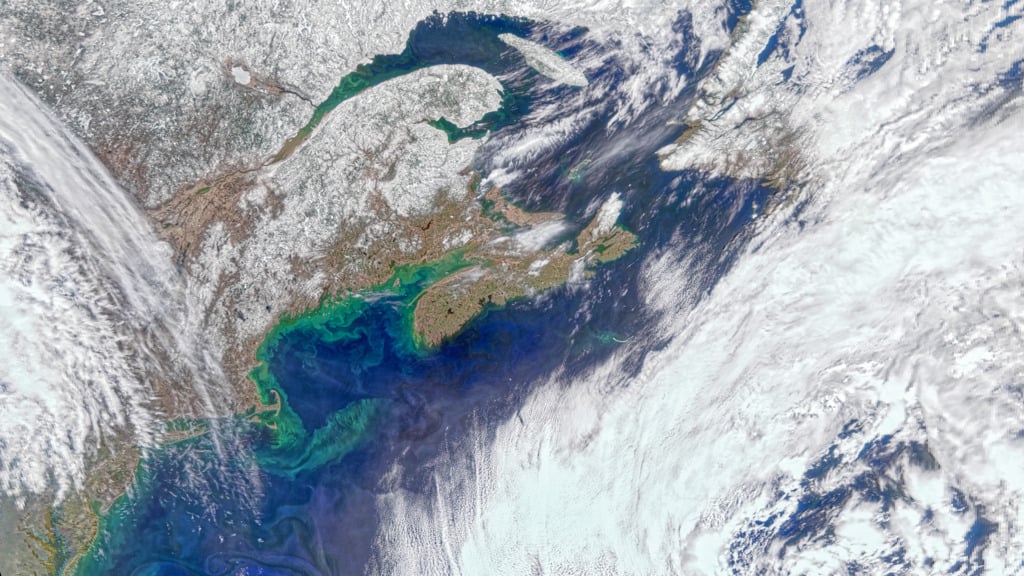
Satellites solve part of that problem by measuring ocean colour. Chlorophyll absorbs blue and red wavelengths while reflecting more green light. Other pigments and mineral shells alter the spectrum in different ways. When phytoplankton multiply in huge numbers, the water can turn green, turquoise, brown or milky blue.
NASA’s PACE satellite, launched in February 2024, carries an Ocean Color Instrument able to measure hundreds of wavelength bands. That expanded spectrum helps researchers distinguish communities that older sensors might have recorded simply as chlorophyll. Images from the mission now reveal phytoplankton wrapped into eddies and currents across entire seas.
Even so, a satellite does not count oxygen molecules leaving the sea. It measures reflected light from the surface and scientists use that information, together with temperature, light and ecological models, to estimate chlorophyll, biomass and productivity. Clouds hide the ocean. Pigment does not translate into one fixed rate of photosynthesis. Important cells can also live below the depth visible from space.
The roughly-half estimate is therefore not a census. It is the synthesis of satellite observations, field measurements and models, and it changes with season, region and climate conditions.
The same organisms that make oxygen can help create dead zones
Phytoplankton’s relationship with oxygen has an apparent contradiction. A dense bloom can release oxygen near the surface during daylight, then contribute to severe oxygen loss after it dies.
In coastal waters, excess nitrogen and phosphorus from fertiliser and wastewater can stimulate unusually large blooms. Much of that organic material eventually sinks. Bacteria decomposing it consume dissolved oxygen. If the lower water is stratified and cannot mix readily with oxygen-rich surface water, oxygen can fall below the level needed by fish, shellfish and many other animals.
The result is hypoxia, often called a dead zone. It does not mean photosynthesis failed to occur. It means oxygen consumption during the breakdown of the resulting biomass became concentrated in a place where replacement was slow.
Most phytoplankton blooms are not harmful. They feed marine food webs and sustain fisheries. A minority of species produce toxins, while otherwise non-toxic blooms can still cause trouble when nutrient pollution drives excessive growth and decay.
This is the same accounting lesson in a compressed form. Gross oxygen production can be high while the local net outcome is oxygen loss.
Oxygen is only one part of the service they provide
Phytoplankton are also the entry point for energy into most marine food webs. Zooplankton graze on them, small fish eat the grazers, and energy passes through networks that ultimately support tuna, seabirds, seals and whales. Remove the microscopic producers and the ocean’s visible abundance loses its foundation.
They also move carbon. Most carbon fixed near the surface is quickly recycled, but some sinks in cells, faecal pellets and other particles. This biological carbon pump transfers about 10 billion tonnes of carbon from the atmosphere into the deep ocean each year, although much eventually returns through circulation and respiration.
The contrast with my article on Lake Vostok is revealing. That Antarctic lake has remained beneath kilometres of ice, cut off from sunlight, so any ecosystem there cannot depend on ordinary surface photosynthesis. Earth’s open ocean is different precisely because its illuminated skin supports a continuous rain of energy and organic material into the darkness below.
Warming can alter that system. Warmer surface water tends to strengthen stratification, reducing the vertical mixing that returns nutrients to the light. Responses vary by region and species, and predicting a single global direction is difficult. But changes in phytoplankton communities can affect food webs and carbon cycling long before anyone would notice a meaningful change in the atmosphere’s enormous oxygen reserve.
That is the most useful reason to understand the ocean’s oxygen producers. They are not an emergency backup tank hidden beneath the waves, and losing part of their productivity would not make the atmosphere suddenly unbreathable. They are the living machinery connecting sunlight, carbon, oxygen and food across most of the planet.
A forest makes photosynthesis visible at human scale. The ocean hides the same chemistry inside cells smaller than the eye can resolve and spreads them across a moving surface larger than all the continents combined.
Roughly half of annual oxygen production comes from that invisible world. The surprise is not that the sea has replaced the forest. It is that Earth’s two great photosynthetic systems, one rooted and towering, the other microscopic and drifting, are comparable at all.