
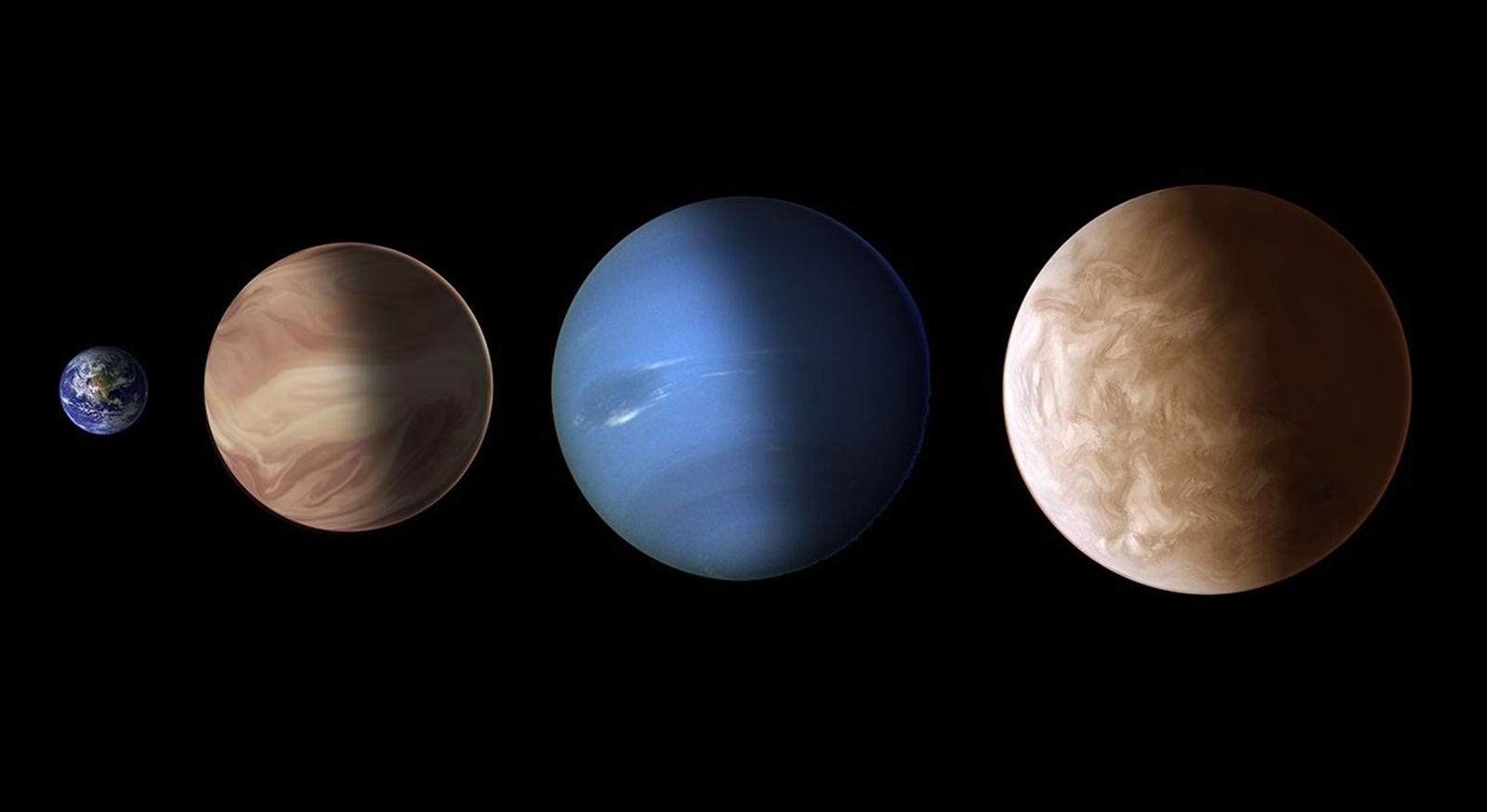
The strangest thing about our solar system may be what it is missing.
Line up the planets by size and there is a clean jump. Earth is the largest rocky planet. Neptune is nearly four times wider. Between them, there is nothing. No planet 1.5 times Earth’s radius. No 2.5-Earth-radius world wrapped in a thick atmosphere. No warm sub-Neptune skimming close to the Sun.
Beyond the solar system, that empty size range is not empty at all. It is crowded.
NASA describes super-Earths as planets unlike anything in our solar system: larger than Earth, smaller than Neptune, and common among worlds found so far in the galaxy. Closely related mini-Neptunes or sub-Neptunes occupy the same missing middle, often with thick hydrogen, helium or water-rich atmospheres over heavier interiors.
That makes the most common kind of planet in the known exoplanet population one that our own neighbourhood entirely skipped. NASA’s Webb team has described warm-to-hot sub-Neptunes as the most common type of planet observed in the galaxy, even though no close analogue circles the Sun.
The numbers are no longer small. NASA’s public exoplanet catalog now contains more than 6,000 confirmed entries, and a current query of the NASA Exoplanet Archive’s confirmed-planet table returns 3,260 planets with measured radii larger than Earth and smaller than Neptune. The exact count will keep changing as new discoveries are added, but the shape of the pattern is already clear.
The galaxy seems to like building planets in the gap our solar system left blank.
The missing middle
For most of human history, the solar system was the only planetary system anyone could study. It set the template. Small rocky worlds inside, giant planets outside, with the asteroid belt and icy outer debris as leftovers. That arrangement looked natural because it was all we had.
Then exoplanets broke the template.
The first wave of discoveries revealed hot Jupiters, giant planets orbiting so close to their stars that their years lasted days. Later came compact systems of multiple small planets, planets around two stars, planets around dead stars, and worlds so puffy that their densities looked almost absurd. The solar system was not the rulebook. It was one outcome among many.
Super-Earths and sub-Neptunes may be the clearest example of that shift. They are not rare oddities. They appear again and again in transit surveys, especially in close orbits where telescopes can catch them passing in front of their stars. Many are bigger than Earth but not large enough to be Neptune-like ice giants in the familiar solar system sense.
That leaves astronomers with a deceptively simple question: what are they?
Some may be rocky planets with massive atmospheres. Some may be water-rich worlds. Some may be small Neptunes whose gas envelopes survived close to their stars. Others may have lost part of an original atmosphere, leaving behind a stripped core. The same radius can hide very different interiors, which is why size alone is not enough.
That uncertainty is built into the names. “Super-Earth” does not mean Earth-like. It does not guarantee oceans, continents, plate tectonics or life. It mainly says the planet is more massive or larger than Earth but below the scale of Uranus and Neptune. “Sub-Neptune” is similarly descriptive rather than definitive. It says the planet is smaller than Neptune, not that it is a miniature copy of Neptune.
Why the solar system skipped them
The absence of these worlds around the Sun is now a scientific problem in its own right. If planets between Earth and Neptune are so common elsewhere, why are Mercury, Venus, Earth and Mars all small, while the next step up is already an ice giant?
One possibility is that the early solar system did begin forming such planets, but migration and collisions erased them. Another is that Jupiter’s early growth shaped the disk of gas and dust in a way that starved the inner solar system of material. A third possibility is that our system’s architecture simply reflects a rare combination of timing, disk mass and giant-planet movement.
None of those answers is settled. The missing middle forces scientists to study our own planetary system as a special case, not as the default.
It also changes how astronomers think about habitability. A planet just slightly bigger than Earth can still be a plausible rocky world. But add too much mass, too much gas or too much stellar heating, and it may become something very different: a deep atmosphere over crushing pressure, a global ocean with no exposed rock, or a dense envelope that hides the surface completely.
That boundary matters because many of the easiest small exoplanets to find sit in this in-between range. If astronomers want to know how common Earth-like planets really are, they first have to learn where Earth-like ends and sub-Neptune begins.
Clouds, haze and hidden interiors
The James Webb Space Telescope has made sub-Neptunes especially important. These worlds are large enough that their atmospheres can be studied more easily than those of true Earth-size planets, yet small enough to probe the transition between rocky and gaseous worlds.
But they have not made things easy. Many appear to be wrapped in clouds or haze that flatten the spectral fingerprints astronomers use to identify atmospheric gases. A planet can pass in front of its star dozens of times, and the light that filters through its atmosphere can still refuse to reveal what lies below.
That is why sub-Neptunes are often described as both common and mysterious. They are statistically ordinary but physically obscure. We know they are everywhere. We do not yet know whether they are mostly scaled-up Earths, scaled-down Neptunes, water worlds, or several classes of planet wearing similar sizes.
NASA’s own classification reflects that caution. Its exoplanet pages group confirmed worlds into broad types: gas giants, Neptune-like planets, super-Earths and terrestrial planets, with mini-Neptunes sitting as subcategories within that larger scheme. The categories are useful, but they are not final answers.
A different kind of normal
The discovery of thousands of worlds between Earth and Neptune has quietly inverted a very old assumption. The solar system once looked like the obvious pattern because it was the only one visible. Now it looks unusually sparse in the very size range the galaxy appears to produce most readily.
That does not make our solar system defective. It makes it informative. Its missing planets are data too.
Every new sub-Neptune added to the archive sharpens the contrast. Around other stars, the space between Earth and Neptune is filled with worlds that have no local example, no spacecraft photograph, no familiar surface and no name that quite captures them. They are too large to be Earth, too small to be Neptune, and too common to ignore.
The most ordinary planet in the galaxy may turn out to be the one our own solar system never made.
