
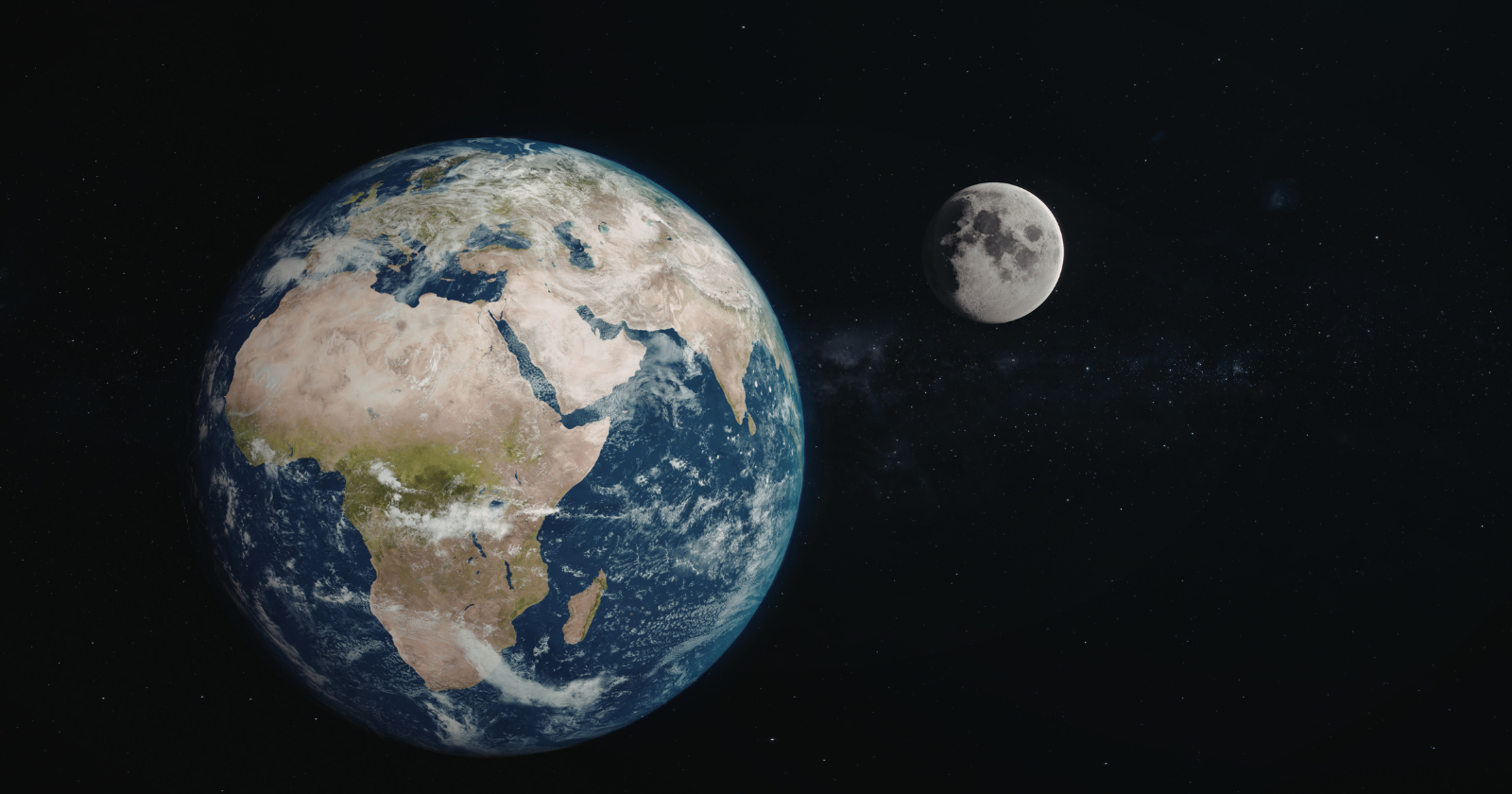
Earth’s spin is slowing, the day is getting longer, and the Moon is drifting outward at about 3.8 centimetres a year, a figure measured by bouncing lasers off the reflectors the Apollo missions left on the surface. Two things in the popular telling are worth correcting, though, because both make a careful process sound more dramatic, and stranger, than it is.
The Moon is not stealing anything. And the day did not stretch from 19 hours to 24 in the order that phrasing implies.
Nothing is being stolen
The “stealing time” image is vivid, but it describes a straightforward transfer rather than a theft.
The Moon raises tidal bulges in Earth’s oceans. Because Earth rotates faster than the Moon orbits, our planet’s spin drags those bulges slightly ahead of the line between the two bodies. The displaced water pulls gravitationally on the Moon, and the Moon pulls back. The result is a brake on Earth’s rotation and a push that nudges the Moon into a higher, wider orbit.
What ties the two together is a conservation law. The total angular momentum of the Earth-Moon system stays constant. As Earth’s rotation loses angular momentum, the Moon’s orbit gains exactly that amount, which is why it moves away. Nothing is lost from the system and nothing is taken from outside it. The “theft” is bookkeeping: one column falls, the other rises by the same figure. A less colourful description, but the accurate one is a transfer, not a heist.
Where the 19 hours actually fits
The bigger problem with the popular version is the timeline. It suggests the day began at 19 hours and has been climbing steadily to 24 ever since. The real sequence runs the other way at the start, and includes a long pause in the middle.
Soon after the Moon formed, roughly 4.5 billion years ago, Earth was spinning far faster than now. Estimates for that early day run well under 19 hours, somewhere in the region of 10 hours or less. The day then lengthened over time as tidal braking did its work. So 19 hours is not the beginning of the story. It is a point partway through.
And it is a striking point, because the day appears to have stalled there. A 2023 study in Nature Geoscience by Ross Mitchell and Uwe Kirscher found that Earth’s day held at roughly 19 hours for about a billion years during the mid-Proterozoic, between around two billion and one billion years ago. This is one study built on a compilation of geological constraints, not a settled count, but the mechanism it proposes is elegant. Lunar ocean tides were slowing Earth’s spin, as always. At the same time the Sun’s heating of the atmosphere drove atmospheric tides that pushed the other way, speeding the spin up. For roughly a billion years the two effects came close to cancelling, and the day stopped lengthening.
So the honest version is almost the reverse of the slogan. The day began far shorter, lengthened over time, then appears to have paused near 19 hours for roughly a billion years before the slow climb toward 24 hours resumed.
Measured with Apollo’s mirrors
The present-day half of the claim, that the Moon is still moving away, is the part we can measure most directly, and the method belongs on a page about space.
Three Apollo missions and two Soviet landers left arrays of corner-cube reflectors on the lunar surface. Observatories on Earth fire laser pulses at them and time the round trip. Multiplying by the speed of light gives the Earth-Moon distance to within a few centimetres, and tracking it across decades shows the Moon receding at about 3.8 centimetres a year, close to the rate a fingernail grows.
One caution about that number. It is the present rate, not a constant, and it cannot simply be run backwards. Project 3.8 centimetres a year into the past and the Moon would have been touching Earth around 1.5 billion years ago, which is impossible given that it formed some three billion years before that. The recession rate depends on how the continents and ocean basins are arranged, and today’s layout, with an Atlantic close to a tidal resonance, makes the braking unusually strong. In the deep past the rate was slower. The Moon is leaving, but not on a straight line drawn from today’s speed.
What to keep from the factoid
Earth’s spin is slowing, the day is lengthening by a couple of milliseconds a century, and the Moon is edging away, all driven by tides and all measured rather than guessed.
The two refinements worth carrying are quieter than the slogan. No time is being stolen, because the angular momentum Earth loses is precisely the amount the Moon’s orbit gains. And 19 hours was not a starting line but a thousand-million-year pause, a stretch when two tides held the day still before the slow lengthening resumed.
