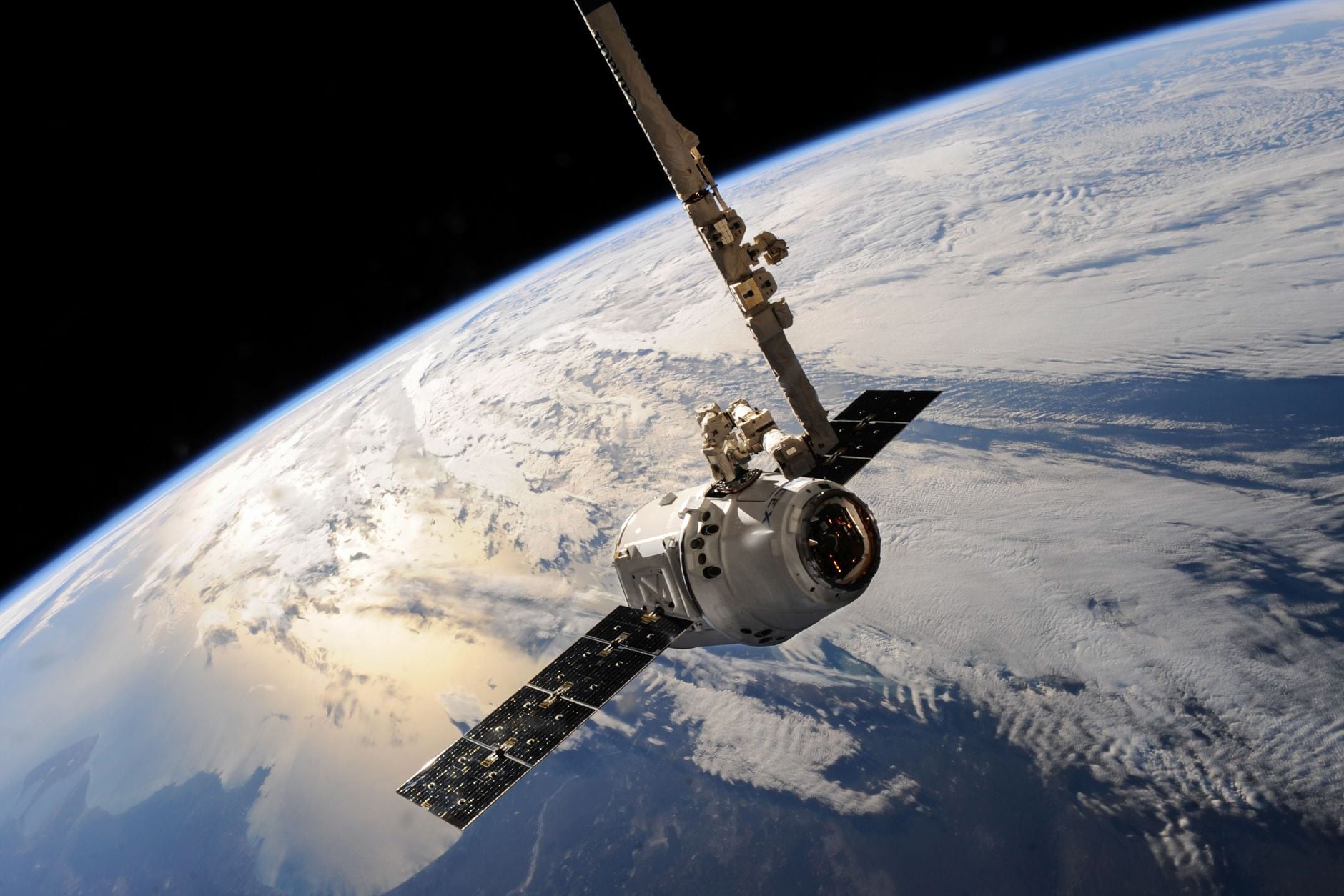
A SpaceX Falcon 9 launched the Mission Robotic Vehicle on July 21, carrying two articulated arms, interchangeable tools, cameras and autonomous control software intended to service other satellites in geostationary orbit.
The launch is complete. The central demonstration is not.
According to DARPA’s July 21 announcement, the spacecraft will spend about a year travelling to geostationary orbit, roughly 36,000 kilometres above Earth. Only after it arrives can the programme test whether one commercial vehicle can inspect, relocate, upgrade and extend the lives of satellites that were never meant to meet a robotic mechanic.
That gap between launch and proof is the story. The Mission Robotic Vehicle, or MRV, offers a plausible preview of future spacecraft as serviceable infrastructure, but the difficult work still lies ahead.
What actually launched
MRV combines a spacecraft built and operated by SpaceLogistics, a Northrop Grumman company, with the Robotic Servicing of Geosynchronous Satellites payload developed through a DARPA-led partnership with the US Naval Research Laboratory and NASA.
Each of the two manipulator arms has seven joints and a tool drive. DARPA says the vehicle also carries interchangeable tools, sensors, lighting and flight software designed for close-proximity operations. Planned tasks include inspection, anomaly resolution, satellite relocation and the installation of small propulsion modules called Mission Extension Pods.
The programme says one of those pods could add six or more years of station-keeping life to a client satellite. That is a programme target, not yet an in-orbit result from MRV.
Geostationary satellites are unusually attractive servicing clients. They occupy valuable orbital positions and often carry communications, weather or national-security payloads that remain functional after their onboard propellant runs low. Replacing the whole satellite because it can no longer hold position can discard working hardware worth hundreds of millions of dollars.
Life extension has already been demonstrated
SpaceLogistics is not beginning from zero. In a company announcement, Northrop Grumman reported that Mission Extension Vehicle 1 docked with Intelsat 901 in February 2020. Mission Extension Vehicle 2 docked directly with the operational Intelsat 10-02 satellite in April 2021.
Those vehicles did not open panels or replace components. They attached to the client satellites and supplied propulsion and attitude control, effectively becoming external engines. MRV is meant to move beyond that model by manipulating hardware with robotic arms.
I find that distinction more useful than calling every servicing mission a repair mission. Docking and taking over station-keeping have flight history. Performing varied mechanical tasks on ageing satellites in geostationary orbit is the capability now awaiting evidence.
Old satellites are hard clients
Most satellites currently in orbit were designed around a one-launch, one-life model. They may have no standard grapple fixture, visual marker, accessible fuel connection or replaceable module. A servicer must approach an expensive object without colliding, match its motion and work around hardware that was not arranged for robotic access.
NASA’s cancelled On-orbit Servicing, Assembly, and Manufacturing 1 project shows how difficult that can become. OSAM-1 was intended to grapple and refuel Landsat 7, a satellite not designed for servicing. NASA’s account of the cancellation cites technical, cost and schedule problems, along with an industry shift away from refuelling unprepared spacecraft.
The agency began an orderly shutdown in October 2024 after concluding that a proposed 2026 launch carried substantial remaining integration and mission risk. MRV is not the same design or mission, but OSAM-1 is a useful warning against treating robotic servicing as routine before the hardware has performed the work.
Future spacecraft may be designed for the second visit
The easier version of orbital servicing begins on the ground. A future satellite can leave the factory with a grapple point, navigation markers and standard connections for fuel, power or data.
NASA calls these “prepared” spacecraft. Its 2025 review of in-space servicing, assembly and manufacturing describes interfaces ranging from simple grapple fixtures and fiducial markers to integrated connections able to transfer power, data or fluids. Preparing the client can reduce the complexity demanded of the visiting robot.
This changes what a spacecraft is. Instead of a sealed machine whose configuration is fixed at launch, it can become a platform with parts that are replenished, augmented or replaced later. Larger observatories and communications systems could also be assembled from pieces that do not need to fit inside one launch fairing.
NASA’s current servicing programme describes low-mass markers and prepared interfaces as a route towards autonomous refuelling and repair. That is an agency development goal, not evidence that common standards or a broad servicing market already exist.
The next evidence will arrive slowly
MRV now has to complete its transfer to geostationary orbit, commission its systems, approach client spacecraft safely and demonstrate useful work without damaging assets that may still be operating. The business case must be demonstrated alongside the robotics: satellite owners need the added life or capability to be worth the servicing price and operational risk.
The most immediate milestone is therefore not another rendering of a robot repairing a satellite. It is MRV’s arrival in geostationary orbit, followed by a documented servicing attempt.
If those operations succeed, future spacecraft may be shaped as much by what can visit them after launch as by the rocket that carries them up.