
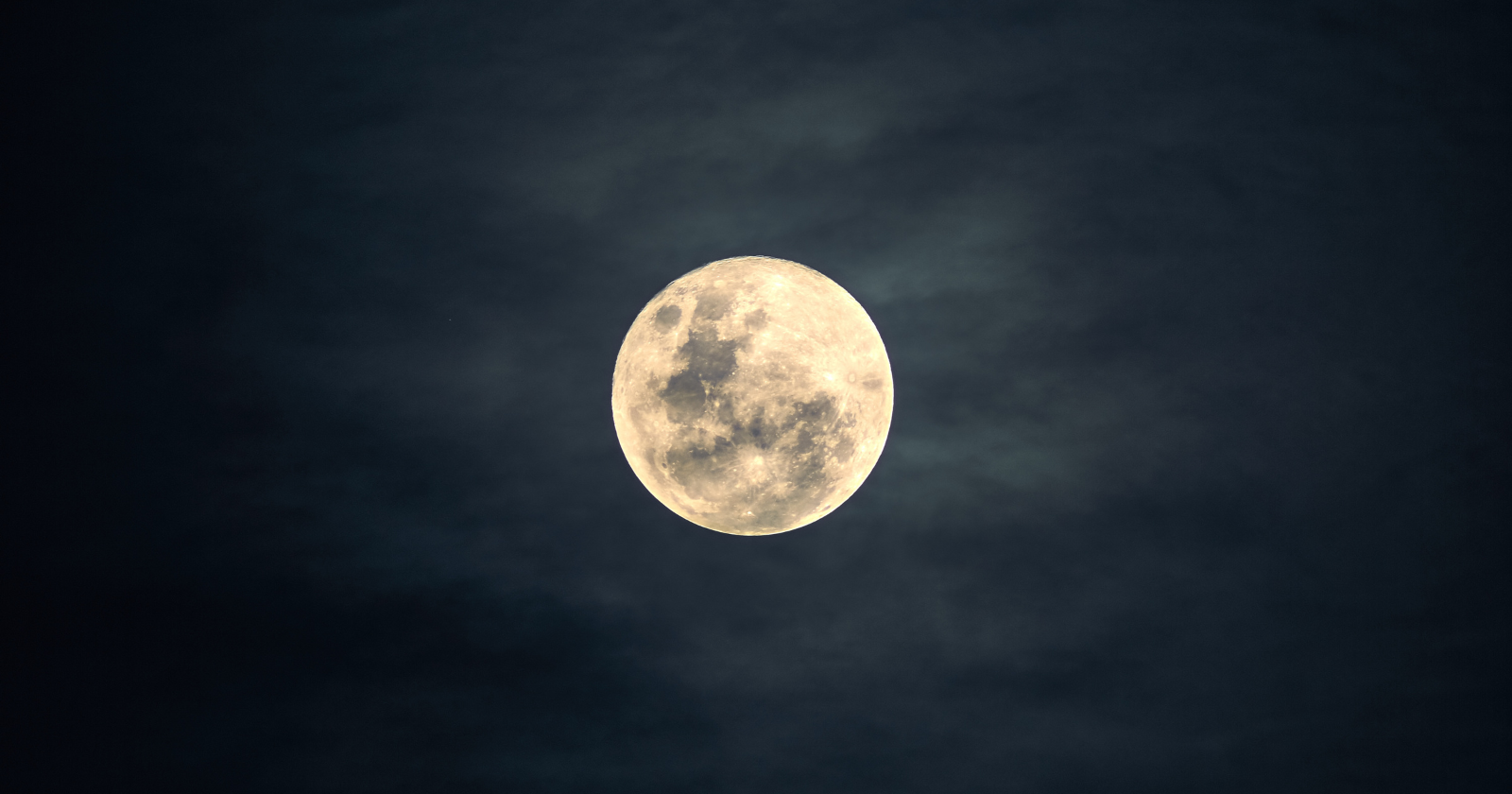
The leading account of where the Moon came from is a collision. Early in the Solar System’s history, a young planet roughly the size of Mars, given the name Theia, is thought to have struck the proto-Earth a glancing blow. The debris thrown into orbit gathered into the Moon. This is the giant-impact hypothesis, and it has been the mainstream view among planetary scientists for decades.
A 2023 study added a striking idea to it: that Theia did not simply vanish into the young Earth, and that two continent-sized masses sitting near our planet’s core may be what is left of it. The idea is well argued and genuinely interesting. It is also a single modelling study proposing a hypothesis, not a settled finding, and the two deserve to be kept apart.
Why the impact hypothesis leads
The giant-impact model earned its place because it explains several things at once. It accounts for the Moon’s large size relative to Earth, for the Earth-Moon system’s angular momentum, and for the Moon having only a small iron core, which fits an object assembled mostly from the rocky outer layers of two bodies after their metal had sunk to the centres.
It is the leading hypothesis rather than the only one. It also carries an unresolved problem worth stating plainly: the Earth and the Moon are almost identical in the isotopes of several elements, far more alike than the model easily predicts if the Moon were built largely from a separate impactor with its own distinct composition. The match is close enough that researchers have called it a significant puzzle for prevailing Moon-formation models. Various fixes have been proposed, from a more violent and thoroughly mixed impact to alternative formation models, and the question is not closed. The impact hypothesis is the best account available, not a proven event.
The blobs are real. Their origin is the open question.
The two masses near the core are not in doubt. Seismologists identified them in the 1980s by watching how earthquake waves slow as they pass through the lowermost mantle, and they have a formal name: large low-velocity provinces, or LLVPs. One sits beneath Africa, the other beneath the Pacific. Each is continent-sized, and they appear to differ in composition from the mantle around them.
What has never been settled is where they came from. They could be accumulations of dense oceanic crust dragged down over billions of years of plate tectonics. They could be material left over from an early magma ocean. They could be a primordial layer that never mixed in. The blobs are an observed feature of the deep Earth with several competing explanations, and that was the state of the question before 2023.
What the 2023 study actually argued
The new proposal came from a team led by Qian Yuan, then at Arizona State University and Caltech, published in Nature. Its claim is specific. If Theia’s mantle was richer in iron than the proto-Earth’s, then fragments of it would have been denser than the surrounding rock. Some of that dense Theian material, rather than being flung into orbit or fully blended in, could have sunk through the young Earth and settled atop the core, where it could clump and survive for billions of years as the LLVPs we detect today.
The team supported this with simulations: models of the impact itself, then models of how dense blobs would move through the mantle over time. In those runs, material around 2 to 3.5 per cent denser than the surrounding mantle sank and gathered into piles resembling the LLVPs. So the study offers a physical pathway by which the blobs could be Theia, and shows that pathway is consistent with the physics. The authors’ own framing is careful. In the paper they write that the LLVPs “may represent” buried relics of Theia, not that they are.
What the study does not show
This is where the popular version tends to outrun the research. A simulation that produces LLVP-like structures from Theian material demonstrates that the idea is possible and self-consistent. It does not, on its own, confirm that this is what happened.
No piece of Theia has been held in a hand or measured directly. The blobs sit roughly 2,900 kilometres down and cannot be sampled. The case rests on the impact hypothesis being correct, on assumptions about Theia’s composition that are themselves inferred, and on models rather than physical evidence. Other explanations for the LLVPs have not been ruled out. A coherent model that links two of the deepest puzzles in Earth science, the Moon’s birth and the blobs near the core, is an elegant result and a reason to take the idea seriously. It is not the same as having found the impactor.
What to watch
The interesting work now is whether the link can be tested rather than only modelled. If the LLVPs really are Theian, they might carry a chemical signature distinguishable from ordinary mantle, and traces of deep material brought toward the surface by mantle plumes are one place researchers look for it. Independent lines of evidence about the Moon’s composition, and refinements to the impact models, will also bear on whether the iron-rich-Theia assumption holds.
For now the honest summary is layered. The Moon most likely formed from a giant impact. Two real, continent-sized anomalies sit near Earth’s core. One well-argued study proposes that the second is the leftover of the first. The first claim is mainstream, the second is observed, and the third is a hypothesis worth following rather than a closed case.
