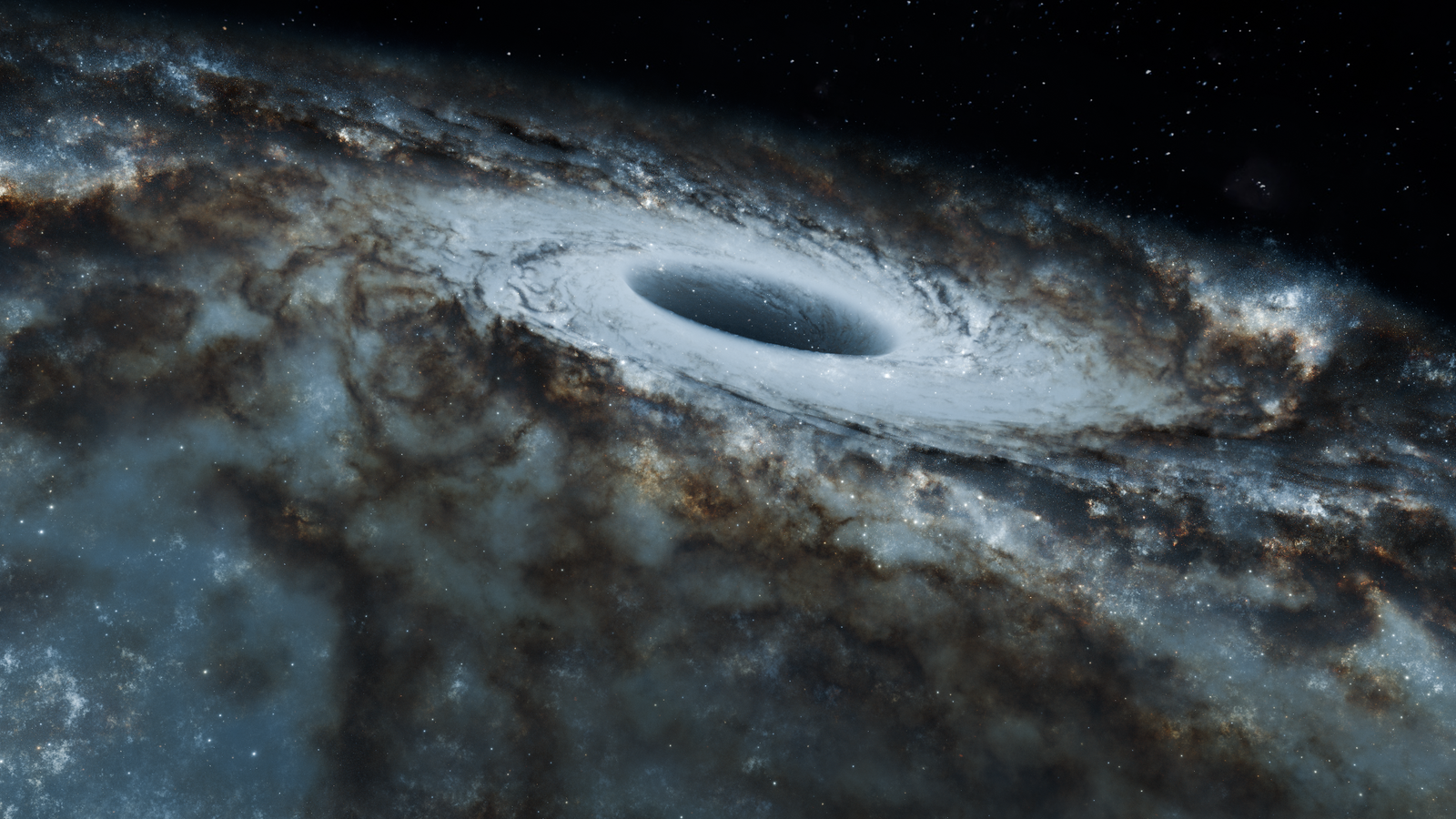
Between 2019 and 2022, astronomers managed something that had never been done: they took two direct images of the region immediately around a black hole. The first, released in April 2019 by the Event Horizon Telescope collaboration, showed a lopsided ring of light circling the giant at the centre of the galaxy M87, an object with a mass about 6.5 billion times that of the Sun. The second, released in May 2022, showed the far smaller black hole at the centre of our own galaxy, Sagittarius A*, roughly four million solar masses and about 27,000 light-years away.
Neither is a photograph in the ordinary sense. A black hole gives off no light of its own. What the telescopes recorded was the glow of hot gas bent around the edge of the event horizon, the boundary past which nothing escapes, with a dark shadow at the centre where the light falls in. The ring is the last thing we can see before the drop.
Those two images are the closest look we have ever had at objects that, for most of the twentieth century, were a mathematical prediction more than an observed fact.
What the word supermassive is doing
Black holes come in a wide range of sizes. The ones formed when a massive star collapses at the end of its life weigh a few to a few dozen times the mass of the Sun. Supermassive black holes are a different category entirely, measured in millions to billions of solar masses, and they sit at the centres of galaxies rather than being scattered through them.
The current understanding is that most large galaxies host one. Sagittarius A*, at about four million solar masses, is a fairly ordinary example. M87’s black hole, at 6.5 billion, is one of the largest ever weighed. The gap between those two figures is a useful reminder that supermassive is a broad label, not a single size.
The evidence at our own galactic centre
The case that a supermassive black hole sits at the heart of the Milky Way did not rest on an image. It was built over decades by tracking the motion of stars.
The 2020 Nobel Prize in Physics was split for exactly this work. Half went to Roger Penrose for showing that black hole formation is a robust prediction of general relativity. The other half went to Reinhard Genzel and Andrea Ghez for the discovery of a supermassive compact object governing the orbits of stars at the galactic centre. Their teams followed individual stars for more than two decades as they swung around an invisible point. The orbits only make sense if something with roughly four million solar masses is packed into a region smaller than our solar system. No cluster of ordinary stars or gas fits that description. A black hole does.
This is the strongest single line of evidence we have that these objects are real and not just a convenient way to explain a bright radio source.
Why their masses seem to track their galaxies
One of the more striking patterns in the data is that a galaxy’s central black hole mass tends to correlate with the motion of stars far outside its reach. The relationship, known as the M-sigma relation, links black hole mass to the velocity dispersion of stars in the surrounding bulge, and it is surprisingly tight. Reviews of the measurements, such as one published in General Relativity and Gravitation, put the scaling at roughly the fifth power of that velocity.
The correlation is real and well measured. What it means is less settled. A black hole’s direct gravitational influence extends only a tiny distance compared with the size of its galaxy, so the tightness of the link suggests some shared history rather than direct control. The common interpretation is that black hole and galaxy grew together, with energy from gas falling onto the black hole helping regulate star formation across the wider system. That is a reasonable reading of the pattern, but it is an inference from a correlation, not a directly observed mechanism.
The problem the James Webb telescope has created
For years the coevolution picture held together reasonably well. Then the James Webb Space Telescope started looking at the early universe, and the neat story developed a complication.
Webb has found a large population of compact red objects, nicknamed little red dots, in the first billion years or so after the Big Bang. Many appear to contain actively feeding black holes that are already very large for the age of the universe. In the more extreme cases, the black hole’s mass rivals or exceeds the combined mass of all the stars in its host galaxy, inverting the usual ratio seen nearby. As Quanta Magazine reported, these early accreting black holes also turned up far more often than the count of adult quasars had led astronomers to expect.
The identity of the little red dots is still debated. Some recent work, including a study published in Nature, argues they are young supermassive black holes wrapped in dense cocoons of ionised gas. Other explanations remain in play. The proposed fixes for how the black holes got so big so fast, from unusually heavy initial seeds formed by the direct collapse of gas clouds to bursts of rapid feeding, are competing hypotheses rather than a settled answer.
None of this overturns the two images from 2019 and 2022, or the star orbits at our own galactic centre. What it does is reopen a question many had treated as roughly solved: where these giants came from, and whether they formed before, alongside, or after the galaxies that now surround them.
What to watch next
The near-term progress will come from spectroscopy rather than portraits. Better spectra of the little red dots should show whether the light is dominated by a feeding black hole or by stars, which would settle a good deal of the current argument. On the imaging side, the Event Horizon Telescope collaboration is working towards time-lapse observations that would show gas moving around M87’s black hole rather than a single frozen frame.
For now, supermassive black holes occupy an unusual position in astronomy. We have photographed two of them and weighed thousands more through the motion of nearby stars and gas, and yet the basic question of how the earliest ones assembled is more open today than it was a decade ago.