
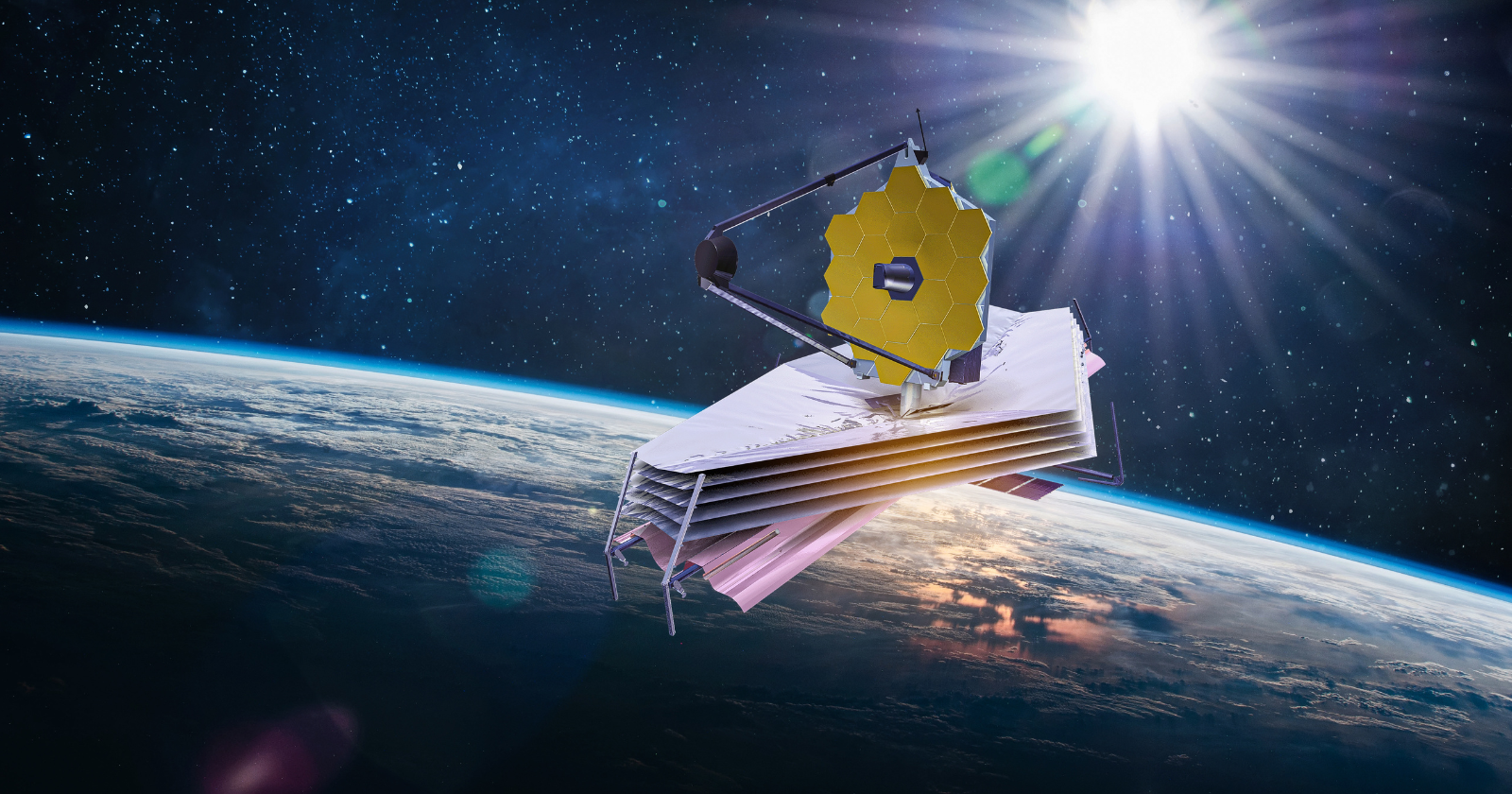
The James Webb Space Telescope has confirmed MoM-z14, the most distant spectroscopically confirmed galaxy yet, whose light left it about 280 million years after the Big Bang. It is one of a growing population of early galaxies that are brighter and more numerous than the models built before Webb predicted. That population is forcing a revision of how quickly the first galaxies turned gas into stars. What it is not doing, despite some of the early headlines, is breaking the Big Bang.
The distinction matters, because the two readings point in very different directions. One would overturn cosmology. The other revises astrophysics, which is the part of the story the evidence actually supports.
What Webb has actually seen
The robust result is an excess of ultraviolet-bright galaxies at very high redshift, the era astronomers call cosmic dawn, beyond redshift 10. This showed up in Webb’s first data in 2022 and has since been confirmed with spectroscopy out to redshift 14 and beyond.
Two record-holders anchor the picture. JADES-GS-z14-0, confirmed by Stefano Carniani and the JADES collaboration in 2024, sits at a spectroscopic redshift of 14.32, less than 300 million years after the Big Bang, and was reported in a NASA announcement. It is luminous and spatially extended, more than 1,600 light-years across, and that extent argues the light comes from young stars rather than a growing black hole, implying a stellar mass of several hundred million suns. The newer record, MoM-z14, was placed at redshift 14.44 by Rohan Naidu and colleagues and has since been published in The Open Journal of Astrophysics.
The surprise is less any single galaxy than how many there are. In the most extreme samples, near redshift 14 to 15, the MoM-z14 team put the excess at more than a hundredfold above pre-Webb consensus models. More broadly, Webb has found bright galaxies beyond redshift 10 to be more common than many pre-launch models expected.
Where “more massive” got ahead of the data
The strongest version of the puzzle, the one that produced phrases like “universe breakers,” came from a 2023 paper in Nature by Ivo Labbé and colleagues reporting candidate galaxies that looked too massive to have formed so early. Those mass estimates have not held up as first stated.
Brightness is observed. Mass is inferred, and the inference depends on assumptions about the stars producing the light. Later work found that some of the apparent heft came from active black holes rather than stars. Many of the compact red sources nicknamed little red dots appear to host accreting black holes that inflate a galaxy’s brightness, and accounting for that contamination, as Katherine Chworowsky and colleagues did in 2024, brought the masses down. The galaxies are not as massive as the first estimates suggested. They are still more abundant than the models expected.
What is actually being rethought
Cosmology has so far survived the encounter. Nashwan Sabti and colleagues used Hubble’s ultraviolet observations of the same epoch to show there is little room to fix the discrepancy by altering the cosmological model, a point Scientific American summarised as the galaxies bending astrophysics rather than cosmology.
The candidate explanations are astrophysical, and several may operate together. One is that star formation was simply more efficient in the dense, low-metallicity gas of the early universe, where the stellar feedback that normally regulates it had less effect. Another is that early star formation was bursty, so galaxies flared brightly and faded, which would bias a brightness-selected sample toward the moments they were brightest. A third is that the earliest stars formed with a top-heavy distribution of masses, producing more light per unit of stellar mass, so the same brightness implies less mass. Reduced dust and the contribution of accreting black holes round out the list.
None of these is settled, and the relative weight of each is still argued. What they share is that they adjust how galaxies built themselves, not the framework of the expanding universe they built themselves in.
What to watch
The frontier is now pushing toward the first 200 million years, and the next constraints will come from larger spectroscopic samples that pin down how common these bright galaxies really were, rather than from any one record-setting object. Chemistry is part of it too. JADES-GS-z14-0 was first placed at redshift 14.32 by Webb, and later ALMA observations that detected oxygen refined that to about 14.18, the most distant sighting of the element yet. The detection points to faster chemical enrichment than models anticipated.
The open question is no longer whether Webb has found early galaxies forming and shining faster than many models expected. It has. The work now is measuring how much faster, and separating the light of young stars from the light of the black holes growing alongside them.
