
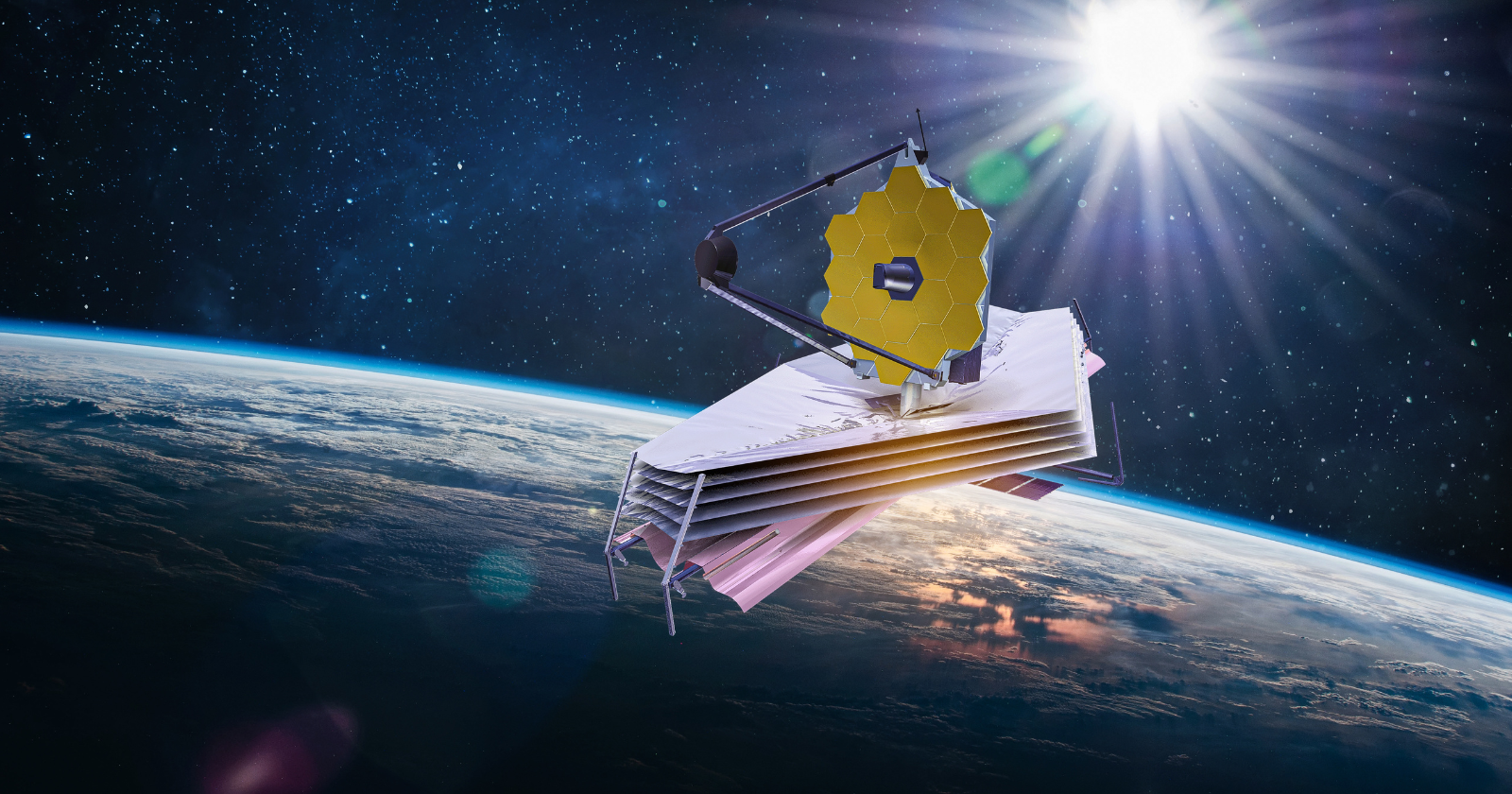
The James Webb Space Telescope may have picked up the faint chemical signature of a molecule that, on Earth, is made almost entirely by marine life. The molecule is dimethyl sulfide, and the planet is K2-18b, a world about 124 light-years away. If that reading held up, and if the molecule could only be made by living things, it would be one of the most consequential measurements in the history of astronomy.
Both of those conditions are in doubt.
The signal is tentative. It might be dimethyl sulfide, or a closely related sulfur compound, or a blend of ordinary gases mimicking one. Independent teams reanalysing the same observations have not found the evidence robust; in some reductions the signal weakens or disappears, and in others ordinary molecules fit the data about as well. And even if it is there, dimethyl sulfide has turned out to be a weaker sign of life than it once seemed.
The planet
K2-18b orbits a small red dwarf star in the constellation Leo, within the zone where a planet could in principle hold liquid water. It is what astronomers call a sub-Neptune, larger than Earth and smaller than Neptune, with a mass around eight and a half times Earth’s. Planets of this size are common in the galaxy and absent from our own solar system, so we have no nearby example to measure them against.
One reading of K2-18b, advanced by Nikku Madhusudhan of the University of Cambridge and colleagues, is that it is a Hycean world: a planet with a deep ocean of liquid water beneath a thick hydrogen atmosphere. That picture is attractive because such a world could be habitable. It is also contested. Other groups have modelled the same data and found it consistent with a gas-rich mini-Neptune, or with a magma ocean rather than a water one, neither of which would be friendly to life.
What Webb actually detected
The firmer part of the story is the ordinary chemistry. In 2023, Webb detected methane in K2-18b’s atmosphere at high confidence, along with carbon dioxide, in a setting rich in hydrogen. Those detections are not seriously disputed, though even methane can be produced without life.
The contested part came in April 2025. Using Webb’s mid-infrared instrument, Madhusudhan’s team reported spectral features consistent with dimethyl sulfide, or a cousin molecule called dimethyl disulfide, at what they put at three-sigma confidence. They presented it as independent support for sulfur-bearing gases that, on Earth, point to biology. The team was clear that this was a tentative result rather than a discovery, and that confirming it would take more observing time.
The three-sigma figure needs unpacking. It means roughly a one-in-several-hundred chance that the signal is a fluke of noise. That sounds strong, and in everyday terms it is. But the standard for a discovery claim in this kind of physics is five-sigma, a far higher bar, and three-sigma is the level at which results often appear and then dissolve as more data arrives.
Why other scientists are not convinced
The trouble began almost immediately, and it came from people working with the same observations.
The core problem is spectral overlap. The features that dimethyl sulfide would produce sit at wavelengths very close to those of methane, carbon dioxide and other hydrocarbons, so a model can often fit the data just as well by adjusting those common gases instead. Several reanalyses found exactly that. A group led by Luke Welbanks showed that the apparent dimethyl sulfide signal could be swapped for ethylene, an unremarkable hydrocarbon, with no loss of fit, and concluded that the data do not meet the standard of evidence for life. The same work found that the choice of how to bin the raw Webb data strongly affected whether the molecule appeared at all.
A separate team combined all of Webb’s observations of the planet, across its different instruments, and reported insufficient evidence for either sulfur molecule. Another independent analysis reached a similar place: it confirmed methane and carbon dioxide, but found no statistically significant evidence for biosignatures in the planet’s atmosphere.
None of this proves the molecule is absent. It means the claim that it is present does not yet hold up when other people run the numbers, which is the test any such claim has to pass.
Even if it were there
Suppose the signal is real, and the molecule is genuinely dimethyl sulfide. That still would not settle the question, because the molecule has lost its standing as a clean fingerprint of life.
In the years since the first K2-18b reports, dimethyl sulfide has been reported in cometary material and in interstellar space, places with no life and no oceans. Laboratory work has shown it can form through ordinary chemistry. So a confident detection would no longer mean what it was once assumed to mean. It would be a molecule that life makes on Earth, found somewhere life is not required to make it.
This is roughly the position NASA itself has taken. The agency, which has promoted Webb’s exoplanet work, was careful to note that detecting a single possible biosignature would not amount to finding life, and that a real claim would need several independent lines of evidence pointing the same way.
What it would take
The honest summary is that K2-18b is one of the more interesting planets Webb has studied, and that the case for life there is weak. The methane and carbon dioxide are real and worth understanding. The dimethyl sulfide is disputed at the level of whether it is present at all, uncertain in identity even if present, and ambiguous as a sign of life even if confirmed.
Three separate doubts, stacked.
What would move this forward is more of the same patient work: additional Webb observations to lift the signal above the noise, independent confirmation from other instruments, and a search for several biosignatures together rather than one in isolation, alongside the harder task of ruling out the abiotic chemistry that can imitate them. A single molecule, read at the edge of detection on a planet we cannot visit, is not going to carry a claim this large on its own. The data will keep coming. The bar, correctly, is high.
