
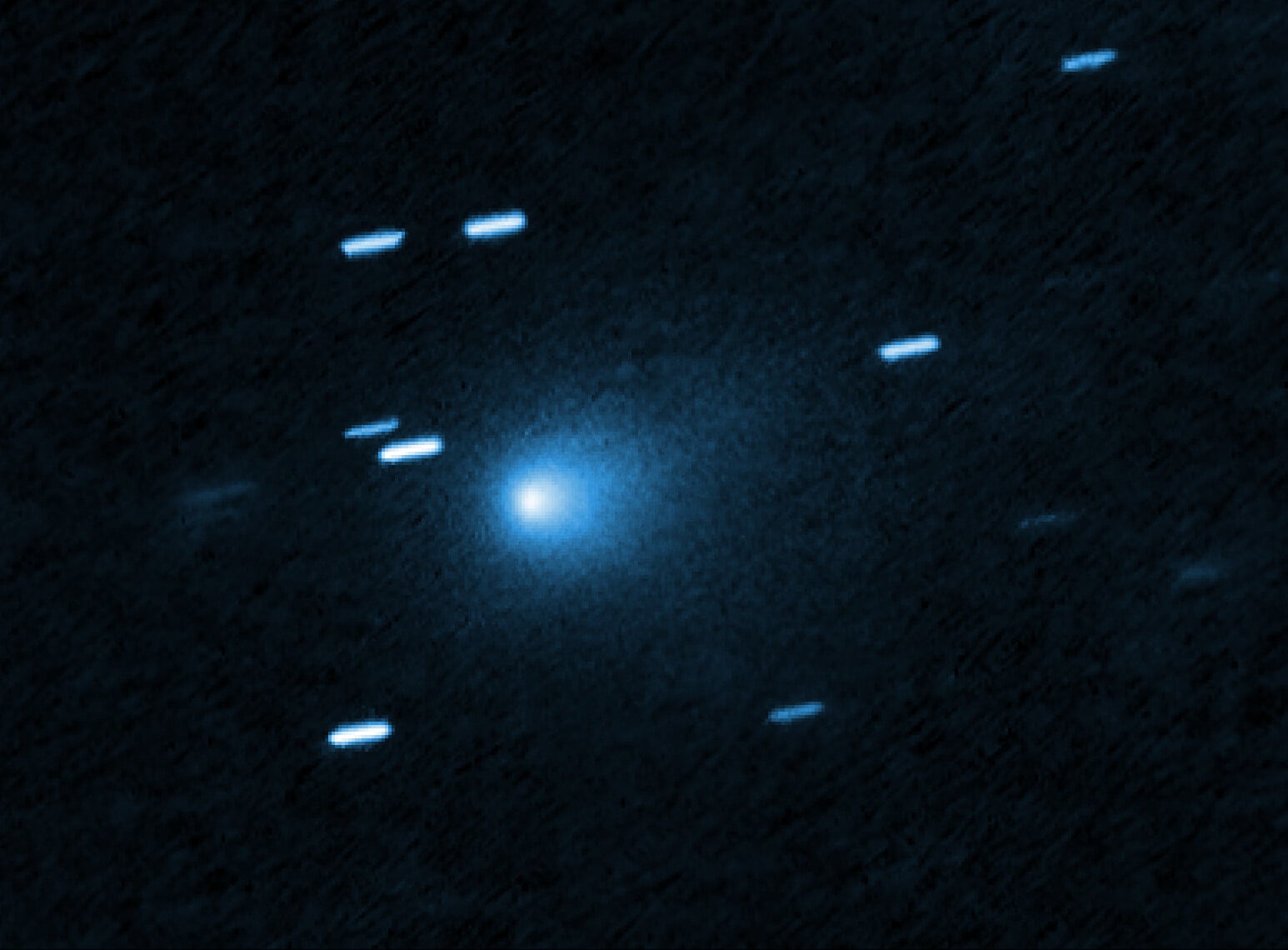
The newest estimate for interstellar comet 3I/ATLAS changes the scale of the object. It is not just older than the solar system. If the interpretation is right, it may be one of the oldest cometary bodies ever observed, a preserved fragment from the young Milky Way.
A March 2026 preprint led by Martin Cordiner and colleagues argues that 3I/ATLAS accreted roughly 10 to 12 billion years ago. The estimate comes from isotopic measurements of gases released by the comet and from comparing those measurements with models of how the Galaxy’s chemistry changed over time.
That age is not a direct birth certificate. It is an inference from chemistry. But it is a striking one: the Sun and planets are about 4.6 billion years old, so a 10 to 12 billion year old comet would be more than twice the age of our star and would have formed roughly 5 to 7 billion years before the solar system existed.
It also raises a subtle point. The age estimate says when the comet’s material accreted into an icy body. It does not prove the exact moment 3I/ATLAS was thrown out of its original planetary system. Still, an object that ancient could have spent billions of years travelling between stars before it briefly crossed our neighborhood.
A visitor from outside the Sun’s family
NASA identifies 3I/ATLAS as the third known object from outside our solar system to be found passing through the Sun’s neighborhood. The NASA-funded ATLAS survey telescope in Rio Hurtado, Chile, first reported it to the Minor Planet Center on July 1, 2025.
What made it interstellar was not simply speed or appearance. It was the shape of the orbit. NASA says astronomers categorized the comet as interstellar because its path is hyperbolic, meaning it does not follow a closed orbit around the Sun. When the path is traced backward, it leads outside the solar system.
3I/ATLAS posed no threat to Earth. NASA says its closest approach to our planet was about 1.8 astronomical units, or about 170 million miles. Its value came from a different kind of closeness: it passed near enough for observatories and spacecraft to study a piece of another planetary system while it was still active.
What Webb saw in the gases
Comets become readable when they warm. Sunlight causes ices near the surface to sublimate, releasing gas and dust into a coma. That escaping material carries chemical clues from the environment where the comet formed.
According to NASA’s 3I/ATLAS timeline, the James Webb Space Telescope observed the comet with its Near-Infrared Spectrograph instrument on Aug. 6, 2025. The Cordiner team’s paper reports isotopic measurements from 3I/ATLAS that look unlike any known solar-system body.
The water in the comet was enriched in deuterium, a heavy form of hydrogen, at a level more than an order of magnitude higher than in known comets. The paper also reports unusual carbon isotope ratios in carbon dioxide and carbon monoxide. Together, the authors argue, those signatures point to formation in a very cold environment, below about 30 kelvin, and in a relatively metal-poor region early in Galactic history.
Translated out of isotope language, the claim is that 3I/ATLAS may have formed far from its parent star, in a cold outer region of an ancient planetary system, when the Milky Way’s chemistry was still different from the chemistry that later produced the Sun.
Why 10 to 12 billion years matters
The solar system is young compared with the Galaxy. The Milky Way began forming more than 13 billion years ago, while the Sun condensed from a molecular cloud only about 4.6 billion years ago. A comet that accreted 10 to 12 billion years ago would belong to an earlier era of planet formation.
That matters because planets and comets require heavy elements. Hydrogen and helium dominated the early universe. The carbon, oxygen, silicon, iron and other materials needed for rocky worlds, ices and complex chemistry had to be made inside stars and spread by stellar deaths. If 3I/ATLAS really formed in a metal-poor ancient system, it suggests icy planetesimals could assemble efficiently even when the Galaxy had not yet been enriched to the Sun’s level.
In that sense, the comet is not merely old debris. It is a test particle from an early chapter of planetary formation. It gives astronomers a way to ask whether the building blocks of comet-like bodies were already common in systems born long before ours.
A preserved fragment, not a fossil in stone
The Cordiner paper describes 3I/ATLAS as a preserved fragment of an ancient planetary system. That wording is important. The comet is not preserved like a fossil in rock. It is preserved because small icy bodies can spend long stretches in cold, dark environments where much of their original volatile chemistry may survive.
Once such a body is ejected from its home system, it can drift through interstellar space. It may pass stars, molecular clouds and nebulae. Gravity can alter its velocity over time. ESA/Hubble noted in 2025 that 3I/ATLAS was travelling through the solar system at about 210,000 kilometres per hour, the highest velocity recorded for a solar-system visitor, and that its speed was consistent with a body that had been moving through interstellar space for many billions of years.
That long wandering also makes the comet’s origin hard to recover. After billions of years, it is unlikely astronomers can identify the exact parent star. Instead, they work backward from orbit, speed, composition and Galactic population models.
Why the claim is still provisional
The 10 to 12 billion year number should be treated as a scientific estimate, not a final label stamped onto the comet. It depends on the measured isotope ratios, the interpretation of those ratios, and models of Galactic chemical evolution. Other age estimates based on kinematics have been broader, with some analyses suggesting multi-billion-year ranges that overlap but do not exactly match the isotope-based claim.
That is normal for a newly observed interstellar object. Astronomers are trying to reconstruct a history that began before the Sun existed, using a small body that was visible for only a limited observing window. The fact that different methods can be compared is a strength, not a weakness.
What is already clear is that 3I/ATLAS is not a normal solar-system comet. NASA says it came from outside the solar system, passed through on an open trajectory, and will not remain bound to the Sun. Webb, Hubble, SPHEREx, TESS, Swift, Mars spacecraft and other assets all helped turn that fly-through into a chemical and dynamical record.
A comet older than the Sun’s story
Most comets known to astronomers are ancient by human standards but still local. They formed from the same solar nebula that made the planets. They preserve material from our own beginning.
3I/ATLAS appears to preserve something else: a body assembled around another star, perhaps before the Galaxy looked chemically like the one that later made the Sun. If the 10 to 12 billion year estimate holds, the comet was already an old object before Earth had oceans, before the Sun existed, and before the solar system had any history of its own.
For a few months, that object crossed the inner solar system and let astronomers read its escaping gases. Then it continued outward. The Sun did not capture it. We did not visit it. But we may have briefly watched one of the oldest pieces of planetary material ever to pass within reach of our instruments.
Sources
- Cordiner et al., “Isotopic Evidence for a Cold and Distant Origin of the Interstellar Object 3I/ATLAS,” arXiv, submitted March 6, 2026
- NASA Science: Comet 3I/ATLAS overview, discovery timeline, orbit and observations
- NASA Webb: clues to the ancient, distant origin of comet 3I/ATLAS
- ESA/Hubble: Hubble makes size estimate of interstellar comet 3I/ATLAS
