
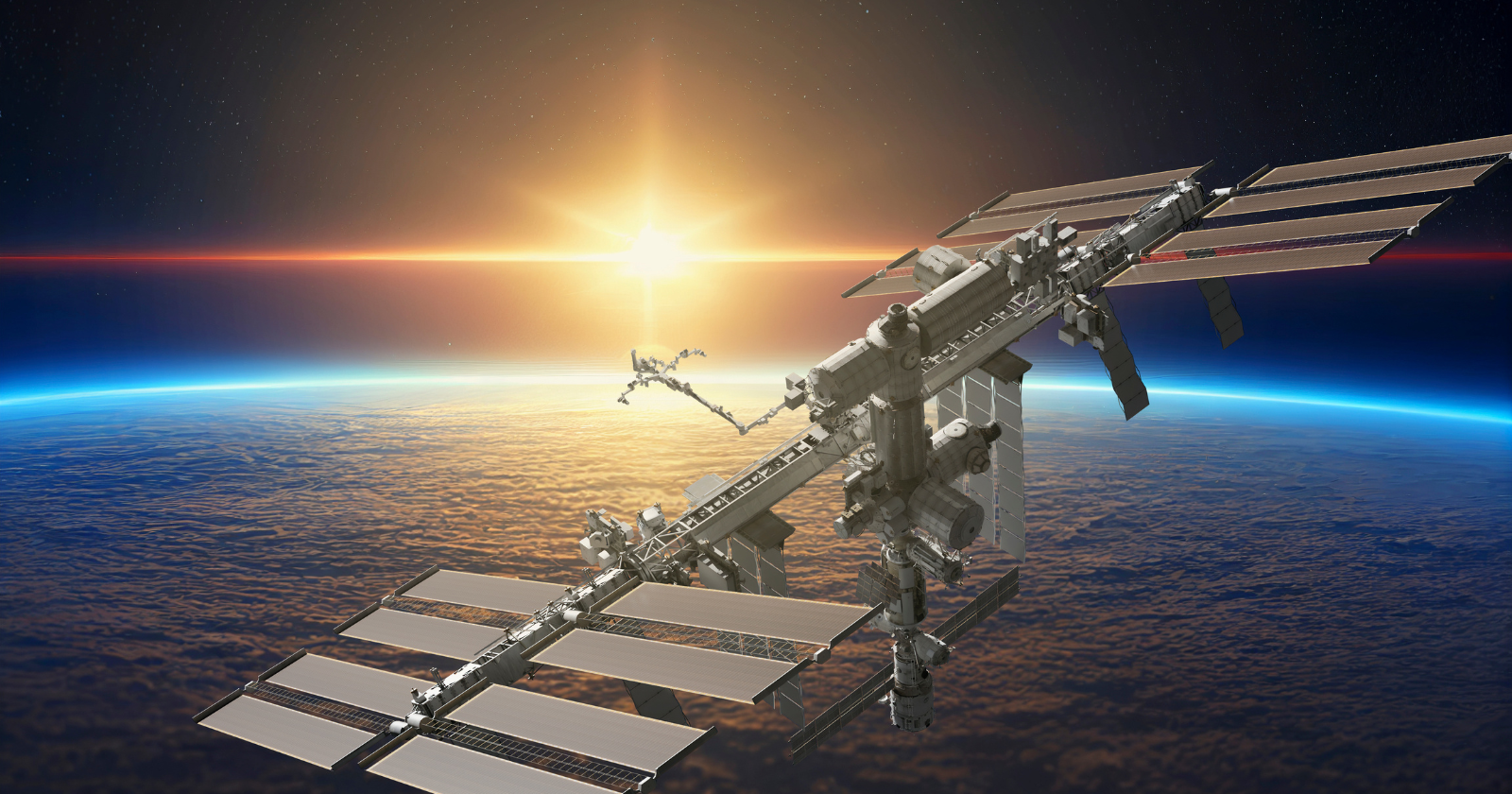
The International Space Station travels fast enough that its crew pass through sixteen sunrises and sixteen sunsets in the course of a single day. At an altitude of roughly 400 kilometres it moves at about 28,000 kilometres an hour, which works out to one full lap of Earth roughly every ninety minutes. NASA puts it at sixteen orbits, and sixteen sunrises and sunsets, in twenty-four hours.
The figure turns up in almost everything written about life in orbit, usually as a curiosity. It is accurate. It is also one of the more commonly misunderstood facts about the station, because those sixteen sunrises happen outside the windows, not on the crew’s clock.
Why ninety minutes
The orbital period is not a quirk of the station’s design. It follows from how high it flies. For any object circling Earth, the speed needed to stay in orbit, and the time taken to complete one lap, are set by altitude. Lower orbits are faster. Higher ones are slower.
A satellite in geostationary orbit, about 36,000 kilometres up, takes a full twenty-four hours to come around, which is why it appears to hang over one spot on the ground. The station sits far lower, so it has to move much faster to stay up, and it comes around far more often as a result. At its altitude the period lands at about ninety to ninety-three minutes; the European Space Agency gives 28,800 kilometres an hour and a ninety-two minute orbit.
Use the more precise figure of about ninety-two to ninety-three minutes and the arithmetic comes out closer to fifteen and a half orbits a day. The public version is rounded to sixteen. Each orbit carries the station from the sunlit side of the planet into Earth’s shadow and out again, and that crossing is where the sunrises and sunsets come from.
What the number leaves out
Calling it sixteen sunrises makes it sound as though the crew lives sixteen short days. They do not. Each sunrise lasts only seconds, and the full swing from daylight to darkness and back fills one ninety-minute orbit, not a day.
The count is also an average rather than a constant. During high-beta-angle periods, when the angle between the orbit and the Sun climbs above about 70 degrees, the station can go for days without passing into Earth’s shadow at all, and the orbital sunsets briefly stop. The Alpha Magnetic Spectrometer team, whose instrument rides on the station, puts this at about a week each summer and winter.
So the sixteen figure describes the view from the cupola, the station’s windowed observation module. It does not describe how time is organised on board.
How the crew actually keeps time
With no usable cue from the Sun, the station runs on a single clock. That clock is Coordinated Universal Time, also known as GMT, chosen as a neutral midpoint between the American and Russian control centres. The crew’s day is a normal twenty-four hours: a scheduled wake, a working day of experiments and maintenance, meals, exercise, and a sleep period of around eight and a half hours.
Holding to that schedule takes engineering. NASA has fitted the station with adjustable LED lighting meant to support the crew’s sleep cycle, shifting in brightness and colour across the day. Crew members sleep in individual compartments about the size of a telephone booth, where the light can be shut out, and eye masks and earplugs are standard issue. The purpose of all of it is to supply the day and night signal that the planet below is no longer providing on any schedule the body can use.
What the body is still tuned to
Human sleep, alertness, hormone release, and body temperature are tuned, over a very long stretch of evolution, to a single rotation of a single planet. The station removes that rotation as a reference and substitutes a manufactured one. The sixteen sunrises are the visible sign of the mismatch: the planet keeps offering its old signal, far too often to be of any use, and the crew has to set it aside and keep its own time instead.
The repeated fact is the count of sunrises. The quieter one is that the crew holds its schedule by ignoring all of them.
