
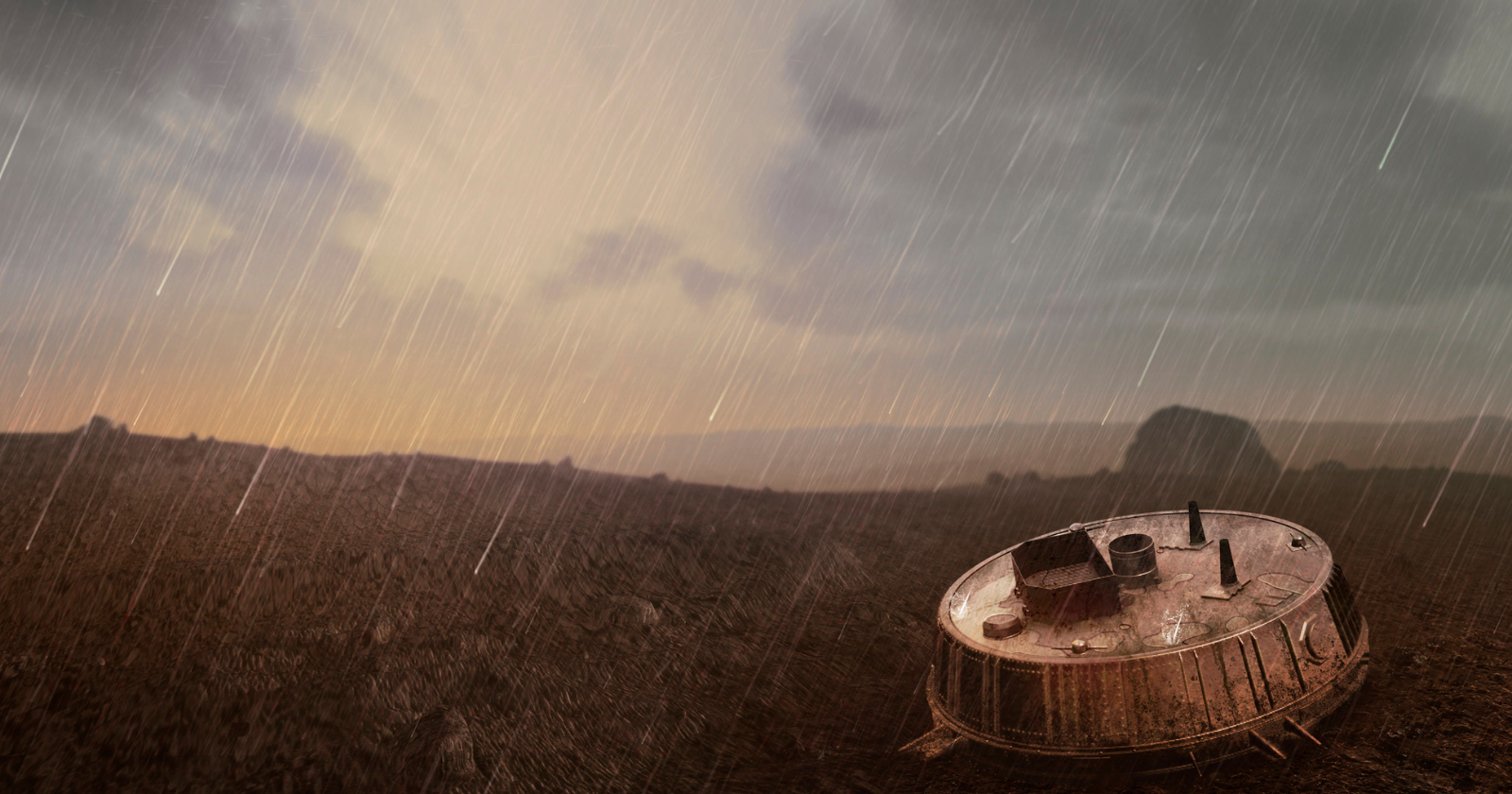
On 14 January 2005, the European Space Agency’s Huygens probe descended through the atmosphere of Titan, Saturn’s largest moon, and came to rest on the surface. The descent under parachute lasted about two and a half hours. The probe then transmitted from the surface for about another 72 minutes before contact was lost.
More than twenty years later, that remains the only time a spacecraft has landed anywhere in the outer solar system. Every other landing humans have achieved, on the Moon, on Mars, on Venus, on asteroids and a comet, has been in the inner solar system or on small bodies closer to the Sun than Saturn. Huygens is the single exception, and it has not been repeated.
How it got there
Huygens did not travel alone. It was the lander element of the Cassini-Huygens mission, a joint undertaking by NASA, ESA, and the Italian Space Agency. NASA supplied the Cassini orbiter. ESA supplied Huygens. The two launched together on 15 October 1997 and reached the Saturn system in mid-2004, after a seven-year cruise that included gravity-assist flybys of Venus, Earth, and Jupiter.
Huygens separated from Cassini on 25 December 2004 and coasted for 22 days with almost all its systems dormant, woken only by an onboard timer. It entered Titan’s upper atmosphere on 14 January 2005 at an altitude of about 1,270 kilometres, slowed first by a heat shield and then by a sequence of three parachutes. According to NASA’s account of the probe, the descent module carried six instruments and the parachutes were deployed in sequence to control the fall.
Cassini stayed in orbit and listened. It recorded the probe’s transmissions and relayed them to Earth. Once Cassini passed below Titan’s horizon as seen from the landing site, the link was over. Huygens had no way to talk to Earth directly.
What Titan is
Titan is the reason the mission was worth the trouble. It is the second-largest moon in the solar system, larger than the planet Mercury, and the only moon with a substantial atmosphere. That atmosphere is mostly nitrogen, with a few per cent methane, and it is thick enough that the surface pressure is about 1.5 times Earth’s at sea level.
The atmosphere is also hazy. Ultraviolet light breaking down methane high in the atmosphere produces a persistent orange smog of complex organic particles, which is why Titan appears as a featureless tan ball in images taken from outside. The haze is the reason a probe had to be sent down through it to see the surface at all.
The surface temperature is around minus 179 degrees Celsius. At that temperature, water ice is as hard as rock, and methane can exist as a liquid. Titan has what amounts to a methane cycle in place of a water cycle: methane rain, channels cut by flowing methane, and lakes and seas of liquid methane and ethane near the poles. The Huygens images showed rounded, pebble-sized lumps of water ice on a flat plain, the kind of rounding that flowing liquid produces.
Why it has not been repeated
The distance is the first answer. Titan sits about 1.4 billion kilometres from the Sun, roughly ten times Earth’s distance. A radio signal takes well over an hour to cross that gap one way. Sunlight at Saturn is only about one per cent of its strength at Earth, and Titan’s thick haze reduces usable light at the surface even further. That makes solar power difficult for a long-lived Titan lander or aircraft, which is why missions such as Dragonfly are built around nuclear power instead.
The cost and timescale follow from the distance. Cassini-Huygens was years in development, took nearly seven years to reach Saturn after launch, and NASA puts the full mission cost at about US$3.9 billion, including pre-launch work, launch, partner contributions, operations, and tracking. Missions on that scale are rare, and a lander is only one possible use of the budget.
That is changing, slowly. NASA’s Dragonfly mission, confirmed and in development, is a nuclear-powered rotorcraft designed to fly between sites on Titan rather than descend to a single one. It is scheduled to launch in 2028 and to reach Titan in the mid-2030s. The Huygens atmospheric data, including the temperature and pressure profile measured on the way down, is part of what Dragonfly’s planners are using to design that arrival.
Until Dragonfly arrives, the record stands where it has stood since 2005. One probe, one descent through the orange haze, about 72 minutes of data from the surface, and nothing since. The outer solar system has been visited many times by spacecraft flying past or in orbit. It has been landed on exactly once.
