
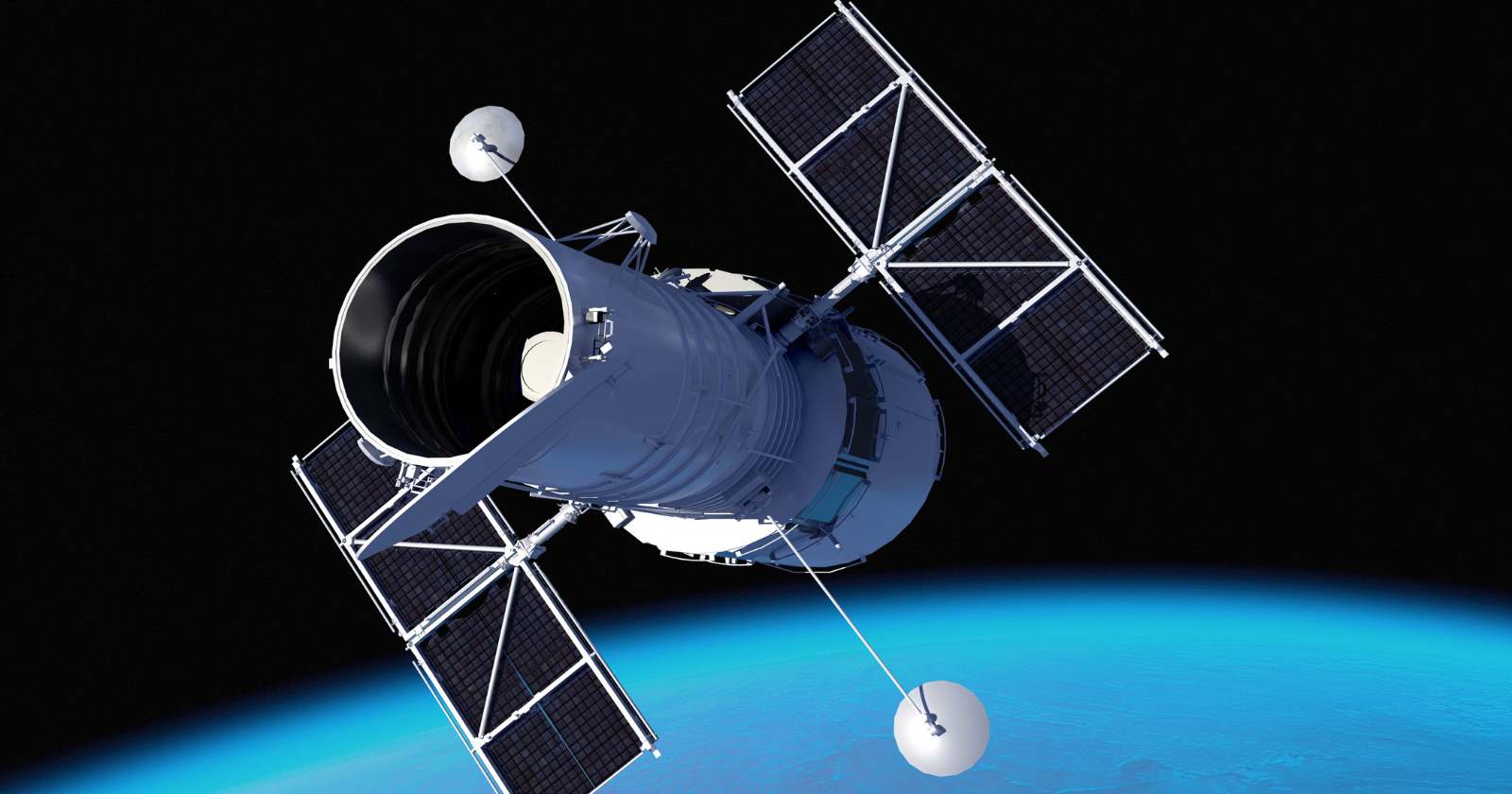
The Hubble Space Telescope returned to science operations on 14 June 2024 in a new pointing configuration that uses one of its three remaining gyroscopes instead of three. NASA announced the transition during a media teleconference on 4 June 2024, after the telescope entered safe mode on 24 May because of repeated faulty readings from one of the gyros. Mark Clampin, then director of NASA’s astrophysics division, framed the decision as a way to extend Hubble’s operating life into the mid-2030s by holding the two healthy gyros in reserve and observing with one.
This is not a last-gyro situation. It is a deliberate down-shift to preserve hardware that cannot be replaced.
Hubble has been in orbit since 24 April 1990. In 2026 that makes 36 years aloft, more than two decades past its original 15-year design lifetime. It launched eight years before Google was founded, 17 years before the iPhone, and in a period when consumer digital cameras were not yet a mass product.
What the gyros actually do
Gyros are not the only orientation system on Hubble, but they are the fastest. They report the rate at which the telescope is turning in three axes, which is what allows it to slew to a new target and lock onto it. Fine guidance sensors then acquire a guide star and hold the telescope steady through long exposures.
The full set of six gyros was last installed during the fifth servicing mission, STS-125, in May 2009. Three of those six are still working. Two are now held in reserve, and one is in active use.
The single-gyro mode itself is not new. It was developed as a contingency in the 2000s and tested in 2008. According to NASA, the configuration has no measurable effect on the quality of science data. It does carry two real operational costs. Slewing to a new target takes longer, and Hubble can no longer track objects closer than the orbit of Mars, which rules out planetary observations of Mercury, Venus, the Moon, and Earth-bound targets. Hubble project manager Patrick Crouse said in the 4 June teleconference that this restriction affects less than one per cent of Hubble’s historical observing targets.
NASA has given two figures for the cost of the slower operations, and they measure different things. Crouse put the reduction in scheduling efficiency, the share of observing time lost to longer slews, at roughly 12 per cent. NASA’s one-gyro explainer gives a broader figure, a decline of roughly 20 to 25 per cent in overall scientific productivity, drawn from a 2016 Space Telescope Science Institute study that also accounts for the reduced sky area and the restricted target types.
Why now
The trigger was a specific gyro returning increasingly faulty readings over the six months leading up to the May 2024 safe mode. NASA has identified the underlying issue as corrosion related to the fluid used inside the gyro for sensing rotation. Rather than continue cycling that unit in and out of service, Hubble’s operators retired it and stepped the telescope down to the more conservative configuration.
The decision was also shaped by what the agency chose not to do. In 2022, NASA and SpaceX began a feasibility study of a private servicing mission, in which a Crew Dragon would dock with Hubble, reboost it, and potentially install new gyros. NASA announced on 4 June 2024 that it was not pursuing that option for the time being. Clampin cited concerns about possible contamination of Hubble’s mirror from thruster plumes and other operational risks, and noted that the agency had not ruled out a future servicing concept.
What it means for the rest of the mission
Hubble’s orbit decays slowly. Without a reboost, atmospheric re-entry is currently projected for sometime in the mid-2030s, with the exact date depending on solar activity and drag. NASA’s working plan is to keep the telescope doing useful science until then.
There is no longer a shuttle to service Hubble, and there is no funded NASA mission to replace its gyros. The James Webb Space Telescope, in operation since 2022, observes at infrared wavelengths from a different orbit at the Sun-Earth L2 point, and does not duplicate Hubble’s ultraviolet capability. The Nancy Grace Roman Space Telescope, scheduled for launch later this decade, will share some of Hubble’s near-infrared range but again will not replicate its ultraviolet workload.
In our reading, one-gyro mode is what running a 36-year-old observatory on the gyros it had in 2009 looks like. The decision is conservative and reasonable. The next thing to watch is whether NASA returns to the private-servicing question before the remaining gyros run out, or whether Hubble’s working life is allowed to wind down on the hardware now aboard.
