
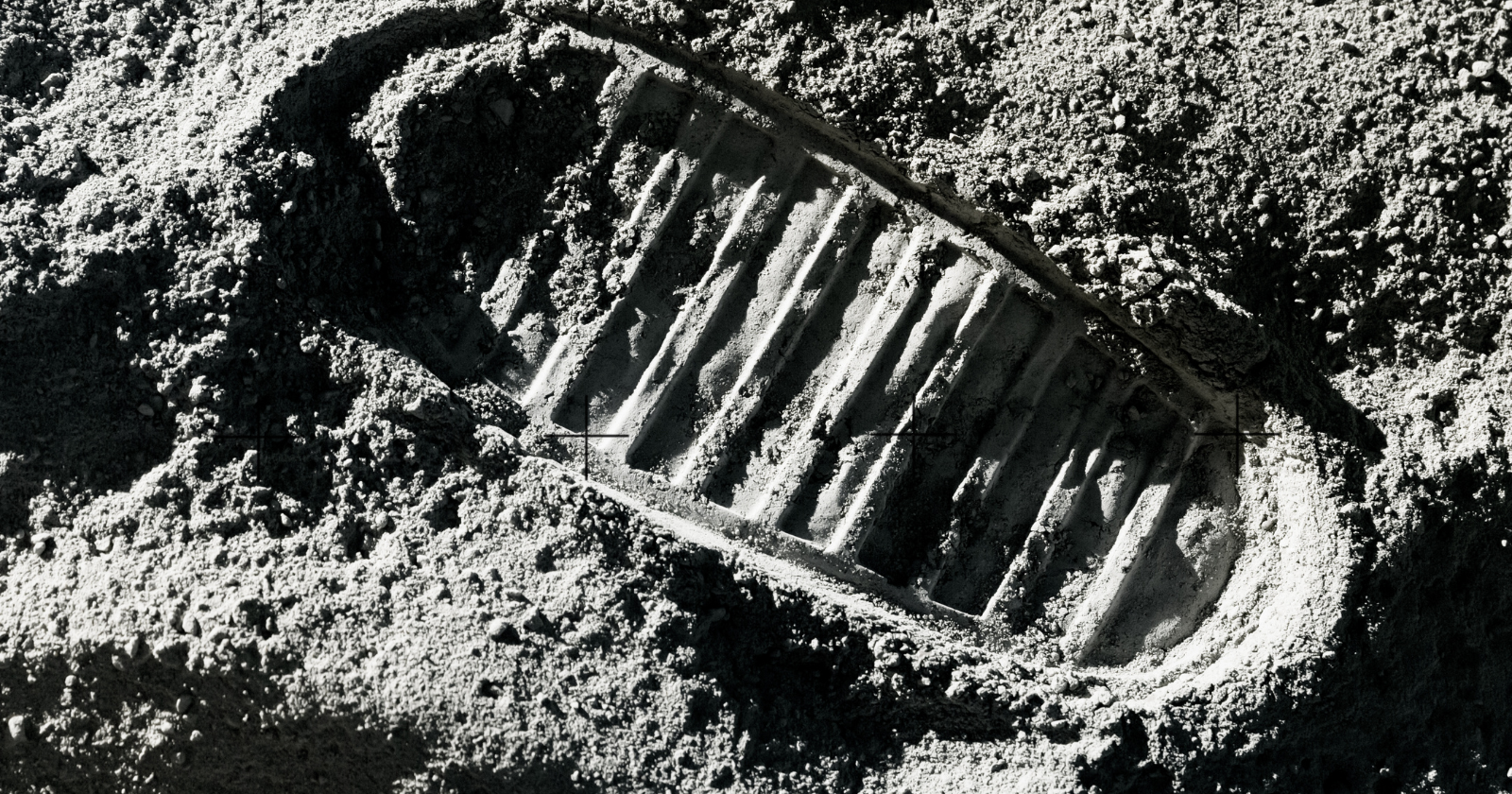
The Apollo tracks, first pressed into the lunar surface in 1969, will almost certainly still be visible in some form a million years from now. There is no wind on the Moon and no rain, so the forces that erase a footprint on a beach within hours do not operate at all.
What the tidy version leaves out is that the Moon is not free of erosion. It just runs on a different clock.
Why the prints last at all
A footprint on Earth is destroyed by moving air and water, by rain, by plant growth, by the constant traffic of living things. The Moon has none of that. It holds no meaningful atmosphere, no liquid water on its surface, and no biology. It is also geologically quiet, with no active volcanoes or shifting plates to disturb the ground.
The lunar surface helps as well. The regolith, the layer of crushed rock and dust the astronauts walked on, is dry and sharp-edged rather than rounded like beach sand. When compressed under a boot it holds its shape, which is why the prints came out so crisp and have stayed that way. Photographs from NASA’s Lunar Reconnaissance Orbiter, decades after the landings, still show the tracks the astronauts and their rovers left behind.
So the “no wind, no rain” reasoning is correct. It is just not the whole list of things that wear a surface down.
The erosion the Moon does have
The Moon is bombarded constantly by micrometeorites, specks of rock and dust striking the surface at tens of thousands of kilometres per hour. Each one is tiny. Together, over long enough, they grind the surface down and stir it up.
This stirring has a name: impact gardening. Small impacts continually turn over the topmost layer of regolith, burying some material and exposing more. Estimates of how fast vary widely. An older figure had the top of the surface overturned roughly every ten million years. A 2016 study in Nature, led by Emerson Speyerer and using before-and-after images from the Lunar Reconnaissance Orbiter, found a secondary cratering process churning the top two centimetres of regolith on a timescale closer to 81,000 years, more than a hundred times faster than the older estimate. This is a statistical estimate for how often the top few centimetres are disturbed across the surface, not a neat deadline by which any particular track vanishes. Either way the process is slow by human standards and relentless by geological ones.
Alongside it runs space weathering: the steady work of the solar wind and micrometeorite impacts altering the chemistry and appearance of the exposed surface over time. None of this is fast. All of it is happening.
How long the prints really last
The honest answer is that no one can put a precise expiry date on a single Apollo bootprint. The surface is not being wiped clean on a schedule. Some marks may be softened, buried, or damaged sooner than others by nearby impacts and ejecta. But the broader traces of the landing sites, the disturbed paths, rover tracks, and equipment scars, are expected to survive on timescales wildly beyond human history.
Mark Robinson, the principal investigator for the Lunar Reconnaissance Orbiter’s camera, has said plainly that the traces of Apollo will not be there forever, because the Moon is constantly hit by fast-moving micrometeorites that will gradually wear the tracks down and mix them into the soil. His estimate, reported by NBC News, is that there will probably be no trace of the Apollo exploration left in something like ten to a hundred million years. The lighter marks go first, the tracks and prints, then the smaller pieces of equipment, with the heavy descent stages lasting longest.
That estimate squares with measurements of Apollo Moon rocks, which erode at a rate of roughly a millimetre every million years or so. At that pace a shallow bootprint survives for a very long time, but not without limit.
So the original claim is safe. A million years is still plausible for traces of the prints and tracks, but the sharper point is simpler: they are not being erased on anything like a human timescale.
What to keep from the factoid
The marks left at the landing sites will outlast almost anything humans have built. With no wind and no rain, and on a world that is geologically still, the tracks and disturbed ground will survive for a span that dwarfs all of recorded history.
The single correction worth carrying is that “untouched forever” is not quite right. The Moon erodes its own surface, slowly, by impact rather than by weather. The marks are not permanent. They are simply being erased on a timescale long enough that, for any human purpose, the difference hardly registers.
