
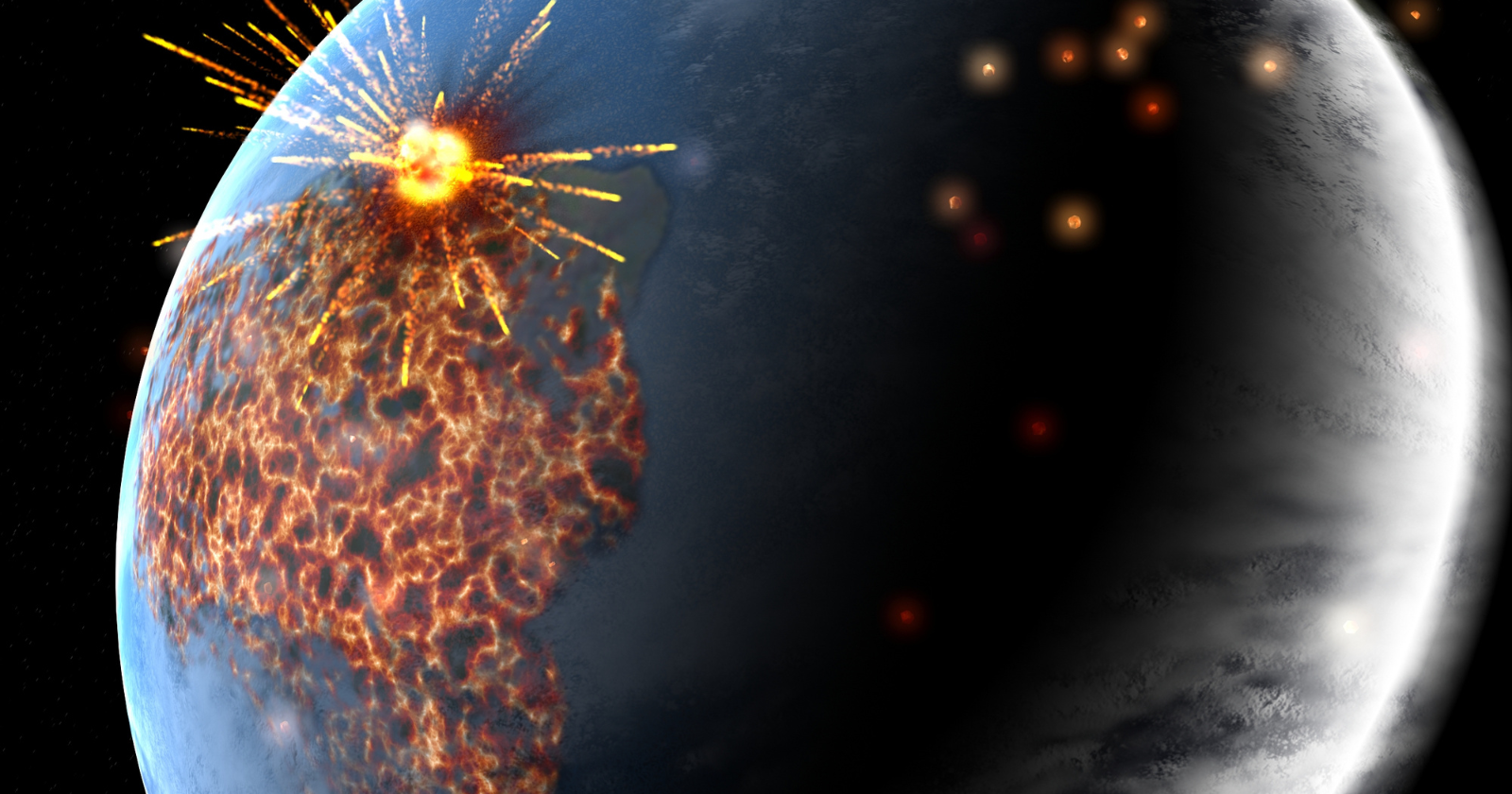
About 66 million years ago, an asteroid roughly 10 to 12 kilometres across struck a shallow, sulfur-rich carbonate platform near what is now Chicxulub, on Mexico’s Yucatán Peninsula. It opened a crater close to 180 kilometres wide and marks the boundary at which around three-quarters of species in the fossil record disappear, the non-avian dinosaurs among them.
The worst direct physical destruction was concentrated around the Gulf of Mexico and nearby regions. But that alone does not explain an extinction that reached the far side of the planet. For that, the more important story is what the impact did to the atmosphere, first within hours, then over the years that followed.
The crater was the wound. The atmosphere was the weapon.
The first hours: heat from above
The impact flung molten rock out of the atmosphere on ballistic paths. As those droplets, by then solidified into glassy spherules, fell back across the globe and decelerated, they heated the upper air. Models by Douglas Robertson and colleagues, set out in a 2013 paper in the Journal of Geophysical Research: Biogeosciences, estimated that this produced an infrared pulse at the ground comparable to an oven set to broil for a period after impact.
The heat, in other words, came down out of the sky, far from the crater itself.
Whether that pulse lit the whole world on fire is disputed. Tamara Goldin and Jay Melosh argued in a 2009 paper in Geology that the falling spherules would have shielded the surface from much of their own radiation, shortening the pulse below the threshold needed to ignite wood across the planet. A 2013 modelling study in the same journal found that fires ignited in some directions from the impact but not as a single uniform global firestorm. The heat pulse is well grounded. The claim that it burned the entire biosphere at once is not.
The years after: the sky stayed shut
The longer and, on the available evidence, more lethal effect was darkness and cold.
The rock at the impact site was rich in sulfate and carbonate. Vaporising it threw sulfur into the stratosphere, where it formed light-blocking aerosols, alongside soot from burning vegetation and fine rock dust. With sunlight cut, photosynthesis on land and at the sea surface fell away within weeks. Temperatures dropped for years. A 2014 study in PNAS, drawing on temperature proxies preserved in marine sediments, found evidence of rapid, severe cooling in the immediate aftermath, consistent with an impact winter rather than a slow decline.
This is the part that fits the survival record. The animals that came through tended to be small, able to shelter, burrow or live in water, and able to feed on detritus rather than fresh growth. A filter that spares the burrowers and the scavengers looks less like a blast wave and more like a world that went dark and stopped growing food.
What the newest modelling adds
The relative contributions of sulfur, soot and dust are still being weighed. The most recent reweighting came in 2023, when Cem Berk Senel and colleagues published palaeoclimate simulations in Nature Geoscience, constrained by grain-size measurements from the Tanis K-Pg boundary deposit in North Dakota. They found a larger share of very fine silicate dust, around 0.8 to 8 micrometres across, than earlier work had assumed.
In their simulations that dust lingered in the atmosphere for as long as 15 years, contributed surface cooling of up to about 15 degrees, and held photosynthesis near a standstill for close to two years. The authors are careful with the result. They present the dust as acting together with sulfur and soot, and they note plainly that the exact killing mechanisms remain poorly constrained. This is one study sharpening a debate, not closing it.
Why the distinction matters
The popular image folds a regional catastrophe and a global one into a single instant: the rock hits, the dinosaurs die. The chemical evidence that first tied the extinction to an impact, the iridium layer reported by Luis and Walter Alvarez and their co-workers in 1980, said nothing about how the dying actually happened. The crater told us where. The atmosphere is where the mechanism lives.
Read that way, the premise holds. The impact loaded the sky, with heat in the first hours and with sun-blocking particles for years afterward, and it was the sky that reached every continent.
What remains genuinely open is the accounting. How much of the cooling belongs to sulfur, how much to soot, how much to dust, and how lethal the early heat pulse really was, are questions that turn on fine measurements of boundary sediments like the ones at Tanis. The crater has been mapped for decades. The years that followed it are still being reconstructed.
