

The water was still rising inside Super-Kamiokande when the detector began to break. On 12 November 2001, after months of maintenance, a glass light sensor near the bottom apparently collapsed inward. Water rushed into its evacuated interior, generating a pressure pulse that neighbouring sensors could not withstand.
By the end of the cascade, 6,777 of the inner detector’s 11,146 photomultiplier tubes had been destroyed. That tally comes from physicist Yoichiro Suzuki’s 2019 review in the European Physical Journal C. The loss was roughly 61 per cent of the large tubes that allowed the experiment to see faint particle interactions.
Reconstruction would require a way to stop the same cascade happening again.
A water tank built to collect light
Super-Kamiokande sits a kilometre underground in Japan’s Kamioka mine. Its approximately 50,000 tonnes of water provide a target for neutrinos, particles that pass through ordinary matter with very little chance of interacting. The surrounding rock suppresses much of the unwanted background from particles arriving from the atmosphere.
When a neutrino does interact, it can produce a charged particle travelling faster than light travels through water. That particle emits Cherenkov light. Nothing exceeds the speed of light in a vacuum; light itself travels more slowly in water.
The observatory’s detector guide explains how sensors distributed around the tank record the light’s timing and intensity. Those measurements let researchers reconstruct a particle’s direction, energy and interaction position. Each large sensor has a photosensitive face about half a metre across. Thousands together turn brief, faint flashes into usable observations.
Thirty metres of water above the glass
Before the accident, workers had drained the detector and replaced faulty sensors. Eric Thrane’s doctoral account of the experiment describes the tank as about 80 per cent full at the time of the failure, with roughly 32 metres of water over the initiating tube.
That depth matters because water pressure increases down the tank. A photomultiplier is an evacuated glass vessel: substantial pressure acts on its outside while very little pushes back from within. If the glass gives way, the surrounding water accelerates into the space.
In Fermilab’s contemporary report, neutrino physicist Janet Conrad described how the inrushing water could generate a shock wave and damage nearby tubes. Their collapse would release further pulses into the same water. The detector’s many separate sensors were therefore connected mechanically through the liquid surrounding them.
A local failure had become a system-wide accident.
Two seconds of damage, longer echoes
Henry Sobel and Yoichiro Suzuki’s 2009 account of experiment leader Yoji Totsuka states that the 6,777 tubes were destroyed within two seconds. That description concerns the cascade. Witnesses recalled a longer interval of sound and shaking.
The initial investigation report, dated 22 November 2001, records a roaring noise lasting an estimated five to ten seconds. Staff in and near the detector felt shaking. Instrument readings and underwater camera inspections then helped establish what had happened.
The damage was concentrated deep underwater. Many tubes near the surface and above it survived, while the bottom array was devastated. Fermilab reported twisted metal components and torn plastic plates, although the main steel support structure appeared largely sound. Removing the shattered glass and damaged fittings was part of restoring an instrument designed to keep its water exceptionally clear.
Why the first tube failed remained a separate question
The early investigation considered several possible triggers, including stresses imposed during maintenance and weaknesses in individual tubes. Investigators also examined the tank, surrounding rock and equipment. Its preliminary discussion of possibilities should not be mistaken for a definitive finding of blame.
This is why “apparently imploded” is useful wording. The propagation mechanism and the initiating defect are different questions. Evidence can strongly support a cascade beginning near the bottom without establishing exactly why that particular glass vessel failed at that moment.
The engineering response had to account for the possibility that another tube might eventually break.
Protecting the neighbours
The replacement design enclosed the inner tubes in protective cases, with transparent acrylic fronts and fibre-reinforced plastic backs. Light could still reach the sensors. Small openings allowed water into the space between each tube and its cover.
Thrane’s account emphasises that these cases were not a guarantee against an individual tube imploding. Tests showed that they could contain the resulting shock wave and prevent a chain reaction. The protection addressed the consequence of a failure as well as the durability of the component itself.
That distinction guided the reconstruction: retaining the optical function while interrupting the route by which one broken sensor could destroy its neighbours.
Returning to observations in stages
According to the observatory’s research history, observations restarted in October 2002 with about 5,200 inner sensors, roughly half the original density. The reduced configuration, known as SK-II, allowed research to resume while additional tubes were manufactured.
Reduced light collection affected some measurements more than others, particularly work at lower energies. Analyses needed to account for the changed detector configuration rather than treating every operating period as identical.
A further shutdown began in 2005, and the full reconstruction was completed in 2006. The restored detector combined a nearly complete array of light sensors with the protective enclosures developed after the accident.
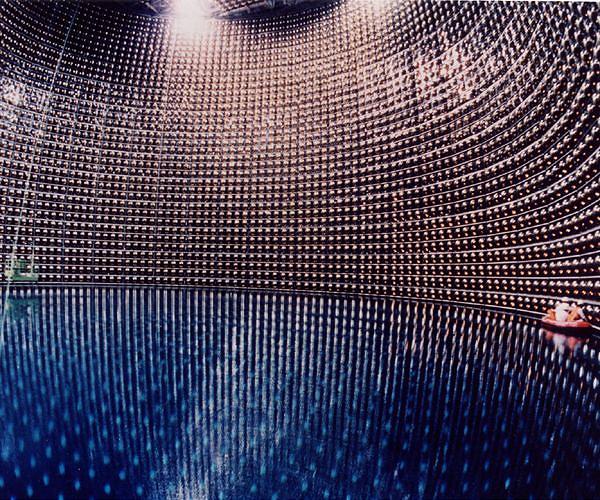
Featured image: Super-Kamiokande’s interior, from the Space Daily image archive. This photograph shows the detector’s sensor-lined walls, not the aftermath of the 2001 accident.