

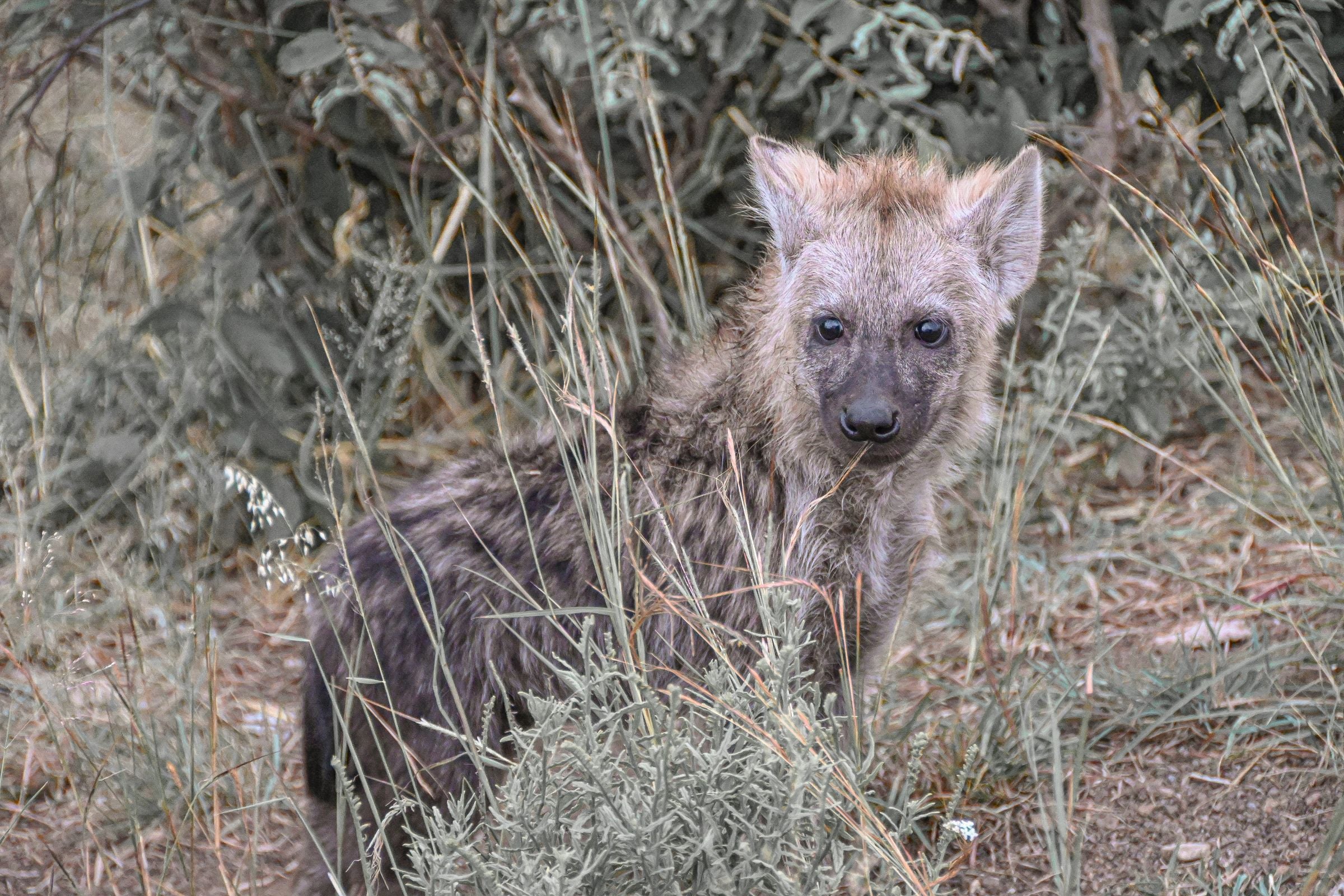
A spotted hyena crossing the savanna does not look remotely like a monkey. One is a bone-cracking carnivore with sloping shoulders; the other belongs to an order built around grasping hands and a long history in trees. Their evolutionary branches separated roughly 90 to 100 million years ago.
Put either animal inside a large, political society, however, and the problems begin to rhyme. Who outranks whom? Which voice belongs to which individual? Who is related to the animal that just lost a fight? Are enough allies present to challenge strangers without getting hurt?
After decades of field experiments and anatomical work, researchers argue that spotted hyenas and Old World monkeys independently evolved strikingly similar social abilities. Hyenas recognise individuals, learn inherited rank systems, track relationships and weigh allies against opponents. Within their own family, they also possess unusually large brains and expanded frontal regions.
It is a persuasive case for convergent evolution, but not the cartoon version in which evolution builds the same brain twice. The anatomy was reconstructed from skulls, the cognitive overlap is strongest in the social domain, and broader carnivore comparisons make the cause less tidy than a slogan about big groups producing big brains.
The comparison begins with society, not skulls
Spotted hyenas live in clans that can reach roughly 90 animals. These are fission-fusion societies: members share a territory, identity and dominance order, yet repeatedly break into smaller parties and reunite. The social cast around an individual may change several times in a day.
A clan contains multiple generations and matrilines. Females usually remain where they were born, males disperse, and adult females outrank immigrant males. Access to food depends on rank and support, while neighbouring clans and lions create dangerous collective contests.
That combination closely resembles the societies of cercopithecine primates, the Old World monkey group containing baboons, macaques and vervets. A major review of spotted-hyena social intelligence describes parallels in group size, hierarchy, kinship, coalition building, competition and cooperation.
The resemblance matters because carnivores and primates occupy distant mammalian branches. Their last common ancestor lived approximately 90 to 100 million years ago, far too early to have carried a baboon’s social repertoire. Comparable abilities that appeared later are candidates for convergence.
What the CT reconstructions actually found
In 2011, Sharleen Sakai and colleagues compared all four living hyaenids: the spotted, brown and striped hyenas, plus the insect-eating aardwolf. The family provides a compact natural experiment. Aardwolves are largely solitary outside breeding, striped hyenas usually live alone or in small groups, brown hyenas form modest clans, and spotted hyenas manage the largest and most fluid societies.
The team used computed tomography to build three-dimensional virtual endocasts from adult skulls. An endocast estimates brain volume and broad contours from the cavity it occupied. It cannot show neurons firing, identify a social-cognition circuit or establish how efficiently tissue operates.
Even with that boundary, the result was clear. As the brain-volume study reports, spotted hyenas had the largest brain volume relative to body size. Their anterior cerebrum was also larger relative to total brain volume than in the other hyaenids. This gross region consists mainly of frontal cortex, tissue broadly associated with behavioural planning, inhibition and complex social action.
The researchers did not claim that carnivore and primate frontal cortices are interchangeable. Brains differ in landmarks and organisation. The narrower observation is safer: within Hyaenidae, the species facing the richest social environment devotes the greatest proportion of its brain to the anterior cerebrum.
A hyena carries a map of clan politics
Brain measurements become more meaningful when paired with behaviour. In playback experiments with long-distance whoops, mothers reacted more vigorously to calls from their own cubs than other females did. Related animals also responded more strongly than unrelated listeners, showing that those rising calls carry socially useful identity information.
Recognition goes beyond a familiar voice. Hyenas use sound and smell to distinguish individuals, kin, sex, reproductive condition and clan membership. Whoop bouts contain individual signatures that remain useful when a group is scattered across a large territory.
Young hyenas must then learn where those individuals fit. Rank is acquired through a process called maternal rank inheritance. A daughter usually settles just below her mother, while younger sisters commonly outrank older sisters. Mothers and allies support juveniles in conflicts, reinforcing which challenges succeed and which do not. The same peculiar combination of maternal support, learning and youngest-sister advantage occurs in several Old World monkey societies.
Adults appear to recognise third-party relationships. When joining a fight, hyenas tend to support the higher-ranking animal even when it did not initiate the attack or seems to be losing. Afterward, aggressors disproportionately target an opponent’s relatives. The observer is acting on a relationship between other animals.
Long-term evidence makes the political stakes concrete. A 27-year study of four wild clans found that repeated coalitions with strong allies helped females improve rank. In a society where rank influences access to food and reproductive success, remembering who reliably stands beside whom is not social trivia. It is survival information.
When a whoop becomes rough arithmetic
One of the neatest demonstrations came from speakers hidden in Kenya’s Maasai Mara. Researchers played one, two or three unfamiliar whoopers, simulating intruders. The listening hyenas compared the number of distinct voices with the allies currently beside them, approaching more readily when their side held the advantage and becoming more cautious when it did not.
The 2011 numerical-assessment experiment did not show that hyenas possess number words or an abstract symbol for three. It showed that most subjects could discriminate as many as three individual callers and combine that information with their own party size before accepting a dangerous contest.
This is cognition fitted to a fission-fusion life. A clan may contain 70 animals on paper, but if only two are within fighting distance, the useful number is two. Chimpanzees and lions make comparable judgements during territorial conflict.
The wider social-brain idea is not restricted to hyenas. SpaceDaily has previously covered research finding that lemurs from larger social networks performed better on a social-cognition task without gaining the same advantage on a nonsocial problem. The recurring lesson is that intelligence can be specialised around the problems an animal repeatedly has to solve.
Convergent does not mean identical
Convergent evolution produces similar answers, not carbon copies. Wings arose separately in birds, bats and insects, but no one would mistake their construction. The same caution belongs here. Hyenas and monkeys may have independently acquired comparable skills for managing rank, kin and coalitions without using identical neural circuits or identical mental processes.
Nor does “rival monkeys” mean that a spotted hyena matches every primate ability. The 2007 review noted no evidence of true imitation in hyenas and suggested they rely more heavily on social facilitation and simple rules of thumb. Some monkey capacities have never been tested in hyenas. Tool use, causal reasoning and performance in nonsocial puzzles are separate questions.
Even within social cognition, the evidence has matured by correction. An early cub-call playback failed to show third-party relationship recognition, unlike the comparable vervet-monkey experiment. Later observations of real conflicts provided stronger evidence. That progression is how comparative cognition should work: a species is not declared clever or dull from one apparatus.
The frontal-region result does not turn a brain part into an intelligence gauge. More volume can reflect several demands, and similar behaviour can emerge from different neural arrangements. “Frontal” is a broad anatomical label here, not a hyena version of a human executive office.
The complication makes the result more useful
If complex society alone enlarged carnivore brains, species should line up neatly from solitary and small-brained to social and large-brained. They do not. The three less social hyaenids did not form a clean anatomical staircase, and a wider analysis of 36 terrestrial carnivores found that social complexity did not reliably predict total brain or frontal-cortex volume.
A later review of intelligence across mammalian carnivores concluded that the need to cope with novel or changing environments may explain general cognitive ability better than sociality alone. Foraging ecology could also matter. Spotted hyenas hunt mobile prey, compete intensely and exploit changing opportunities, all of which place demands on a brain.
That does not erase convergence. It locates it more precisely. Within the hyena family, spotted hyenas combine the most elaborate society with the largest relative brain and anterior cerebrum. In behaviour, they solve many rank, recognition, alliance and numerical problems also solved by monkeys. The anatomy is consistent with the social-brain hypothesis; it does not prove a single evolutionary cause.
The spotted hyena matters because it breaks an old habit of treating primate intelligence as evolution’s only route to social sophistication. A carnivore with a completely different body and ancestry arrived at a recognisably similar need to remember voices, family, alliances and power. Evolution did not repeat the monkey. It encountered the politics of group living again and built another mind capable of surviving them.