

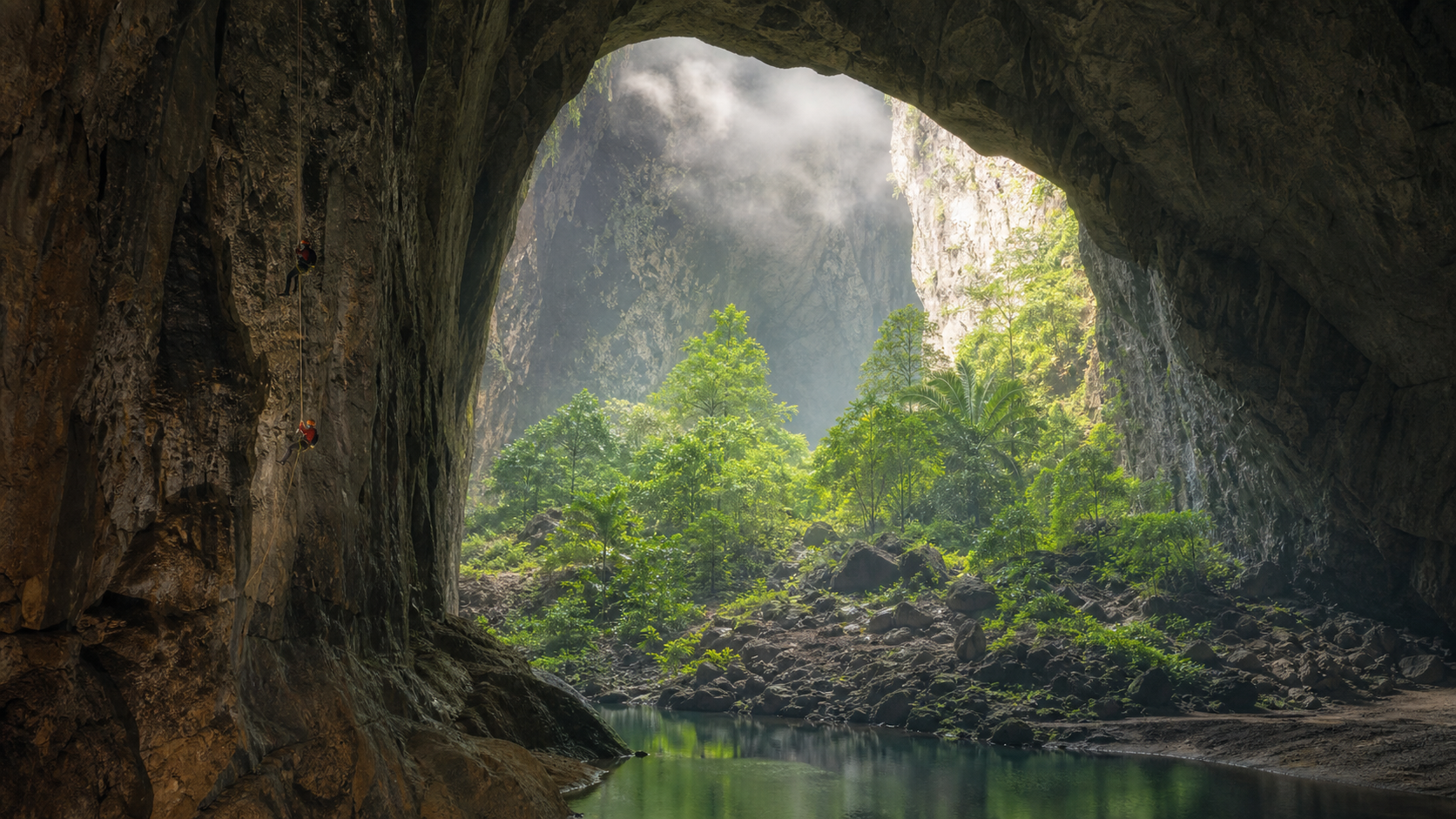
In the early 1990s, Hồ Khanh found a dark opening while moving through the forest of central Vietnam. Wind pushed out of it. Somewhere below, water roared. The entrance dropped too steeply for him to continue without ropes, and after leaving the area he could not immediately find it again.
Years later, Khanh guided a British-Vietnamese team back through Phong Nha-Kẻ Bàng National Park. In 2009, equipped explorers descended into the opening and began surveying what lay beyond. The passage did not simply widen. It expanded until headlamps could no longer reveal the opposite wall or the roof.
The cave was Sơn Đoòng, or “cave of the mountain river.” What the team mapped was the largest known single cave passage on Earth.
A descent into a space 200 metres high
Khanh’s part in the discovery matters. The National Geographic account of Sơn Đoòng records that he found the entrance in 1991 and later helped the expedition relocate it. Without his memory of an opening concealed in dense forest, the survey would not have happened when it did.
The approach ends at an intimidating drop. Modern expedition accounts describe an entrance descent measured at about 80 metres. Beyond it, explorers encountered a passage on a different scale from an ordinary cavern.
Guinness World Records lists Sơn Đoòng as the world’s largest cave passage by overall dimensions, with sections around 200 metres high and 150 metres wide. Its documented length is at least 6.5 kilometres. A tower of roughly 50 storeys could stand inside its tallest sections without touching the roof.
That does not make Sơn Đoòng the longest cave system. Mammoth Cave in Kentucky extends for hundreds of kilometres. Sơn Đoòng holds the size record because of the volume and cross-section of its main passage, not because it reaches farthest.
An underground river carved the passage
The cave sits within one of Asia’s oldest large karst regions. UNESCO describes Phong Nha-Kẻ Bàng as a roughly 400-million-year-old limestone landscape containing more than 220 kilometres of documented caves and subterranean waterways.
Sơn Đoòng itself is much younger. Geologists estimate that it began forming about two to five million years ago, when a river followed weaknesses and faults in the limestone. Slightly acidic rain and river water dissolved calcium carbonate, while flowing water carried loosened material away. Over long periods, a fracture became a tunnel and the tunnel became a chamber.
The river is still active. It runs through darkness, crosses parts of the route and disappears deeper underground. During the wet season, rising water makes exploration unsafe. National Geographic’s early expedition report describes how the monsoon swells nearby underground rivers and floods passages, showing that this system is still being altered rather than preserved as a dry geological shell.
Two roof collapses let a jungle grow
At two points, sections of the enormous roof failed and fell to the floor. These openings are dolines, or collapse sinkholes. Daylight, rain, seeds and animals can enter through them.
The first supports grasses and smaller plants. The second, called the Garden of Edam, is wider and holds a thicker stand of trees, palms and ferns. A survey report from the 2010 expedition measured the Garden of Edam at more than 163 metres across.
The result looks like a jungle sealed underground, but the ecosystem is not isolated from the surface. Sunlight arrives directly through the broken roof, rain falls in and organisms move between the cave and the forest above. The dense vegetation is concentrated around the openings; most of the passage remains too dark for green plants.
Even with that qualification, the setting is unusual. A person can move from a black river passage into mist and full-grown vegetation without leaving the cave system.
The cave can make mist and low cloud
Descriptions of Sơn Đoòng often say it has its own weather. The visible evidence is real: mist and cloud can gather inside the passage, while strong currents of air move through the entrances and dolines.
The physics is familiar. Cave air is humid, and the river provides a continuing source of moisture. When parcels of moist air at different temperatures mix, or air rises and cools, water vapour can condense into tiny droplets. A technical review by Giovanni Badino explains that clouds in caves can form through mixing, pressure changes, rising air and fragmented water flow.
Airflow comes from the cave’s shape and its connection to the outside. Research on cave ventilation shows that temperature and density differences can drive a chimney effect, pulling air between openings at different elevations. In Sơn Đoòng, the huge volume makes those currents and condensation visible on a scale that resembles outdoor weather.
“Own weather” is therefore useful shorthand, not a claim that the cave has an independent climate system. Its clouds depend on the same surface atmosphere, seasonal temperatures and water cycle as the forest above.
A large cave is still a vulnerable place
Sơn Đoòng’s dimensions can create an impression of indestructibility. Cave surfaces, however, change slowly, and plants and animals around the dolines occupy narrow environmental zones. Mud, calcite formations and microbial communities can be altered by repeated human contact.
UNESCO has previously raised concerns about proposals for easier access, including a cable-car project, and called for environmental assessment before any development that could affect the protected site’s value. The warning is recorded in the World Heritage Committee’s 2015 decision on Phong Nha-Kẻ Bàng.
The hidden world is large enough to hold a river, patches of forest and drifting cloud. It is also specific to one limestone passage whose full shape became known only after a local forest worker remembered where the wind came out of the ground.