

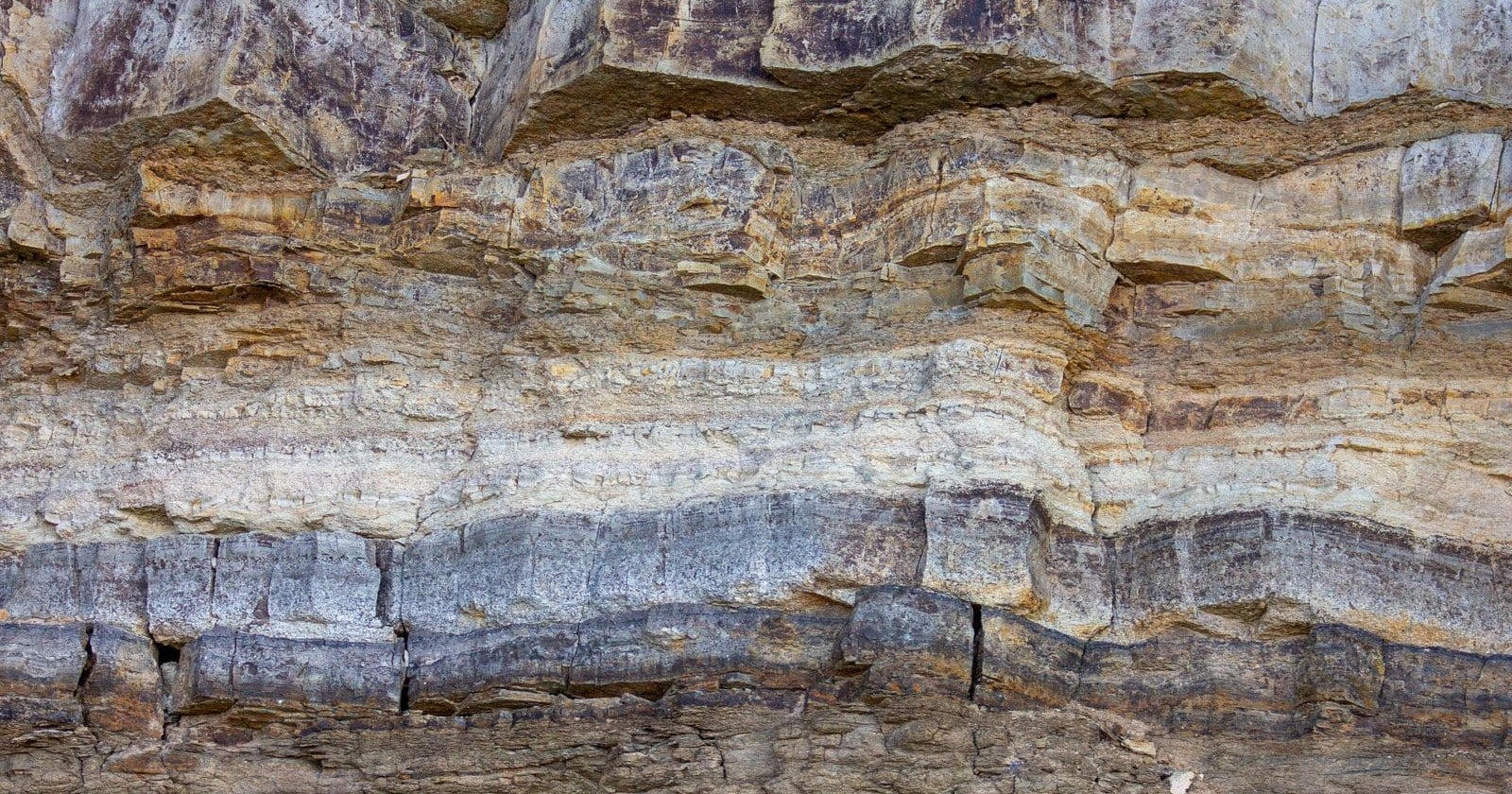
The claim rests inside a rock patterned like a geological barcode. Dark, carbon-rich bands alternate with pale silica in a folded black-and-white chert from eastern India. Some of the layers are thinner than a millimetre. Within them, researchers see the remains of a microbial mat that lived 3.497 billion years ago.
Ancient carbon by itself is not enough to establish ancient life. Carbon can be made and moved without biology. A life-like texture can be sculpted by minerals. Even a convincing organic residue can be younger than the rock holding it, introduced through a crack long after the original sediment formed.
The new case is unusual because it tries to close those escape routes in one specimen. In an August 2026 Proceedings of the National Academy of Sciences paper, Trisrota Chaudhuri of the Geological Survey of India and seven colleagues combine zircon geochronology, field relationships, carbon isotopes and Raman spectroscopy. They describe the Bhitardari chert as, to their knowledge, the oldest directly dated rock with a confirmed biosignature.
That wording is the discoverers’ conclusion, not a declaration that every older claim has vanished. The evidence is chemical and geological rather than a photograph of a cell. Its importance comes from several independent clues pointing toward the same history.
The rock is an archive written in alternating layers
The sample comes from the Eastern Iron Ore greenstone belt of the Singhbhum Craton, an ancient block of continental crust spanning parts of present-day Jharkhand and Odisha. The specific unit is the Bhitardari black-and-white banded chert.
Chert is a hard, fine-grained rock made mostly of microcrystalline quartz. Silica can entomb carbonaceous material and protect portions of it through enormous spans of geological time. In Bhitardari, the researchers found micron-scale alternations between siliceous material and carbon-rich laminae. They interpret that repeated fabric as a remnant of a microbial mat.
A microbial mat is a layered community of microorganisms living together on a surface, often where sediment, water and chemical gradients meet. Modern mats can bind particles and leave laminated structures behind. Yet lamination alone cannot certify biology. Physical sedimentation and mineral growth can also make repeated bands.
The team places the chert in a marine setting influenced by volcanism and hydrothermal activity. Iron, silica, heat and chemical gradients would have made such an environment geologically active and potentially rich in energy for microbes. The chert was later folded and metamorphosed under lower-greenschist conditions, so the researchers had to separate original sedimentary features from younger alteration.
Zircons turn nearby volcanic ash into a clock
The central dating problem is that the quartz making up chert does not provide a straightforward radiometric clock for the moment of deposition. Many very old biosignatures are therefore bracketed indirectly. Geologists may date volcanic units above and below them, or igneous rocks that cut across the sediment later.
Bhitardari contained tiny zircon crystals. Zircon is exceptionally useful because uranium can enter its crystal structure when it forms, while lead is largely excluded. Over time, uranium isotopes decay to lead at known rates. Measuring the parent and daughter isotopes turns the grain into a clock that can survive conditions that erase many other records.
The researchers interpreted the relevant grains as syn-volcanic, or tuffaceous: crystals delivered in volcanic ash while the silica-rich sediment was accumulating. Four concordant zircons yielded a uranium-lead result expressed through the 207Pb/206Pb system of 3,497 ± 5 million years. The reported mean square of weighted deviates was 1.2, indicating that those four ages were statistically coherent within their stated uncertainties.
This is what “directly dated rock” means in the paper. The carbon itself was not radiometrically dated. Instead, datable volcanic crystals interpreted as contemporaneous with deposition were recovered from the same carbon-bearing chert. That is a much tighter association than borrowing an age from a distant unit, but it still depends on the geological interpretation that the zircons arrived with the sediment rather than being inherited older grains or introduced later.
The carbon carries an isotopic preference associated with life
Carbon occurs naturally as isotopes, principally carbon-12 and carbon-13. They behave almost identically chemically, but the small mass difference matters to enzymes. During carbon fixation, living systems generally use the lighter carbon-12 slightly more readily. Biomass and the organic residue made from it can therefore become depleted in carbon-13 compared with an agreed standard.
Scientists write that difference as δ13C and report it in parts per thousand, or per mil. The bulk carbonaceous matter in the Bhitardari chert measured −30.9‰. The minus sign means it is carbon-13-poor relative to the standard. The authors interpret that value as the fingerprint of biological carbon fixation.
It is important not to translate −30.9‰ into “30.9 per cent.” It is roughly 3.09 per cent on that delta scale. More importantly, no carbon-isotope number proves life in isolation. Abiotic reactions can also favour one isotope, particularly in hydrothermal systems where water, rock and carbon-bearing fluids interact.
This is why earlier SpaceDaily coverage of Archaean biosignatures stressed the value of locating carbon and nitrogen at very small scales and interpreting isotopes inside their mineral context. For Bhitardari, the isotope value gains force from where the carbon sits, how it is layered and what spectroscopy says happened to it.
Two forms of carbon record two geological histories
The study identified carbonaceous matter in two textural modes. The first is made of ultrafine laminae distributed through the original chert matrix. The second consists of coarser graphite flakes inside quartz veins that cut the rock later.
Those modes cannot simply be treated as one untouched archive. The veins record fluids moving through fractures after the chert had formed. Carbon there was affected by hydrothermal alteration associated with regional shearing. If all of the light carbon had arrived through those veins, it would not establish a 3.497-billion-year-old ecosystem.
Raman spectroscopy helped the team distinguish the histories. Raman measurements probe the way a material’s molecular bonds scatter laser light. In ancient carbon, the spectra reveal how ordered or graphitic the material has become under heat and pressure.
The finely laminated matrix carbon was consistent with relatively disordered kerogen, the insoluble residue produced as buried organic matter changes through time. The vein-hosted carbon was more strongly transformed. In its archived description of the paper, the team reports the same bulk δ13C value of −30.9‰ for both textural modes, which it interprets as a shared biological source even though their later geological histories differed.
Raman spectroscopy does not identify life on its own. It shows carbon’s structural state and thermal history. Here it supports the more limited but essential proposition that ancient sedimentary carbon survives in the matrix and can be distinguished from the visibly later graphite-bearing veins.
Carbon fixation is a strong conclusion, not an organism’s name
If the team’s interpretation holds, life in this marine basin was doing something fundamental by 3.5 billion years ago: converting inorganic carbon, probably carbon dioxide or bicarbonate, into organic material that cells could use to grow.
The isotope value is consistent with relatively sophisticated pathways, and the authors give the Calvin cycle as an example. That does not mean the rock demonstrates modern plants, algae or oxygen-producing cyanobacteria. The Calvin cycle occurs across diverse microbes, and other fixation pathways can produce overlapping isotopic effects.
Carbon fixation can also be powered by sunlight or by chemical energy. The volcanic and hydrothermal setting would have offered redox gradients that chemosynthetic organisms could exploit. Without cell morphology, diagnostic molecules or additional metabolic isotope systems, the rock cannot choose a species, a domain of life or a particular energy source.
The secure level of inference is therefore broader. The carbon pattern is consistent with an established microbial ecosystem drawing inorganic carbon into biomass. It does not locate the origin of life at Bhitardari, because any community capable of building a mat and operating a fixation pathway must already have had an evolutionary history.
“Oldest directly dated” is narrower than “oldest evidence”
Proposed signs of life older than 3.497 billion years are already in the literature. Carbon inside a 4.1-billion-year-old zircon from Western Australia has an isotopic composition compatible with biology, for example. Researchers who reported it called the carbon potentially biogenic and acknowledged that an abiotic origin could not be ruled out.
Claims from roughly 3.7- to 3.8-billion-year-old rocks in Greenland, as well as still older material in Canada, have prompted long arguments about metamorphism, contamination, rock ages and whether non-biological chemistry can reproduce the observations. An older date does not automatically make a claim stronger.
The Bhitardari team’s superlative is constructed to address that problem. It is not claiming the oldest proposed life, the oldest carbon or the oldest dated mineral containing carbon. It claims the oldest directly dated rock in which the authors consider the biosignature confirmed through converging evidence.
Even that carefully bounded claim remains open to normal scientific testing. Independent researchers can examine whether the zircons truly date deposition, reproduce the isotope measurements, sample nearby layers and test alternative abiotic pathways. The Nature India assessment described the result as likely microbial and said further research would be needed to confirm the metabolic interpretation.
A nearby comparison shows why categories matter. SpaceDaily previously reported 3.48-billion-year-old evidence for life on land in Australian hot-spring deposits. That claim concerns a particular environment and fossil structures. Bhitardari is slightly older, marine and centred on the unusually close bond between its chemical biosignature and its zircon date.
The microbes lived while stable continental crust was still growing
Earth formed about 4.54 billion years ago, so the chert was deposited only around one billion years into the planet’s history. Oceans already existed. Volcanism was vigorous. Small ancient continental nuclei were forming and being reworked, but today’s large, stable continents did not yet exist.
A 2024 study of Archaean crust notes that large volumes of juvenile continental material were added from about 3.5 billion years ago. The exact tectonic processes remain debated. The Singhbhum Craton itself records prolonged episodes of crustal growth, intrusion, deformation and stabilisation.
The headline’s image of life working while continental crust was still assembling is therefore literal in geological time, but it should not imply that microbes waited on a finished continent. The Bhitardari mat was probably living in a marine basin associated with an evolving volcanic-greenstone terrain. Its world was water, silica, iron, hydrothermal chemistry and newly organised crust.
That setting also gives the find an astrobiological value. A convincing biosignature is rarely one spectacular object. It is an agreement among time, texture, chemistry and geological context, combined with a serious effort to identify later alteration. The same logic governs the search for ancient life in Martian rocks returned or analysed in place.
The Bhitardari chert does not show what the organisms looked like or how life began. It preserves something more basic and, for such an old rock, unusually well anchored: a carbon cycle that appears to have included biology while Earth’s first durable continental foundations were still taking shape.