
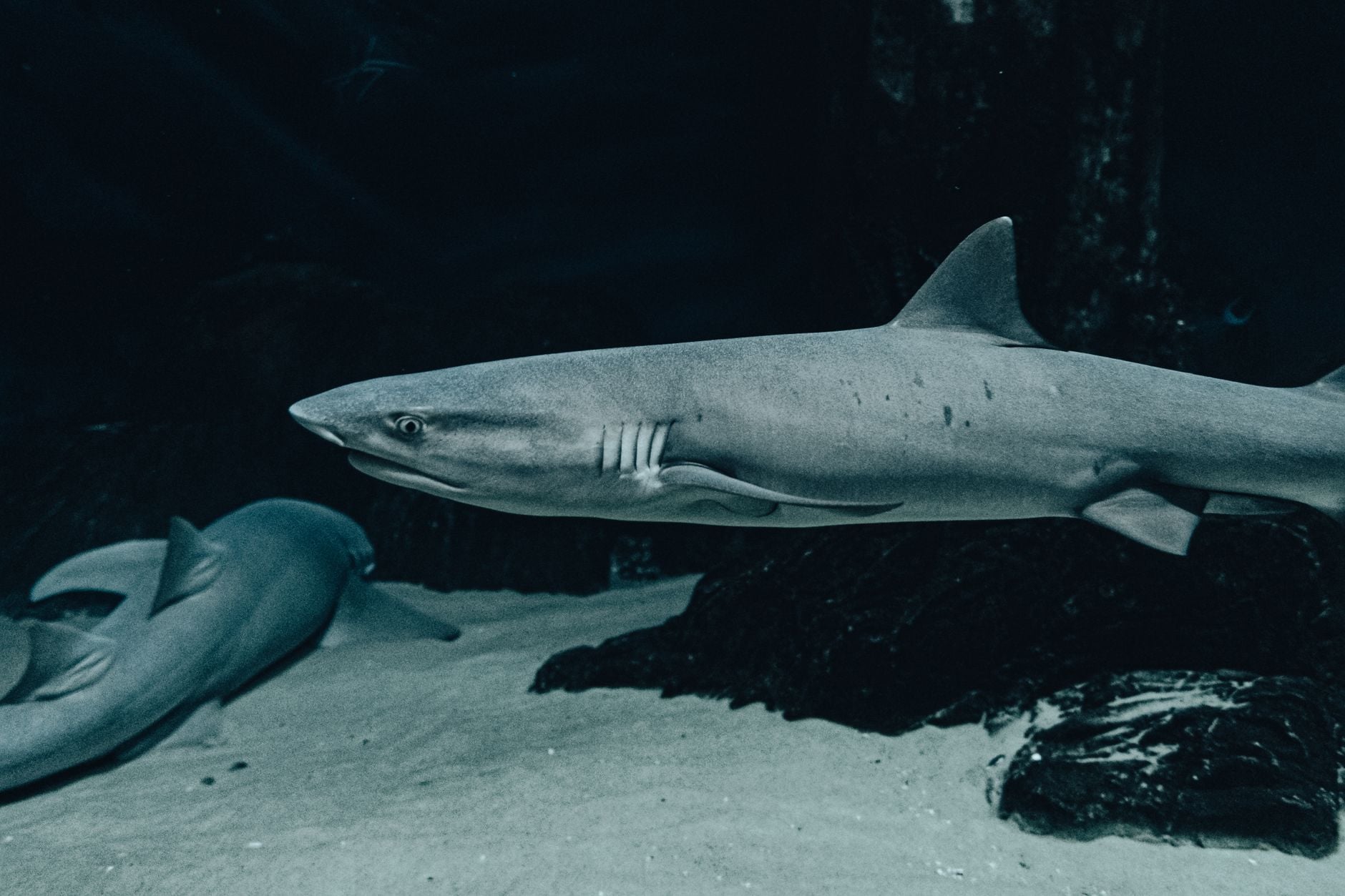
To say that sharks are older than trees sounds like one of those comparisons made for effect. In this case, the comparison is not empty. The shark line reaches back into a version of Earth where the land had not yet become the vertical, shaded, root-bound world we now recognise.
The careful wording matters. Modern sharks are not 450-million-year-old animals preserved unchanged from the Ordovician. Living sharks are the products of long evolution, extinction and replacement. But fossil evidence from early cartilaginous-fish relatives, including chondrichthyan-like scales from the Middle Ordovician, places the deeper shark lineage roughly 450 million years in the past.
That pushes the story of sharks into a time before forests, before true trees, and before broad leaves became a familiar part of terrestrial life. When early members of the shark line were already leaving traces in ancient seas, the continents were still only beginning to acquire plant cover.
A sea-born lineage
In a 2012 paper in Palaeontology, Ivan J. Sansom and colleagues described chondrichthyan-like scales from Middle Ordovician rocks in Australia. Chondrichthyans are the group that includes sharks, rays and chimaeras. The fossils are not a complete shark skeleton. They are tiny pieces of evidence, but they matter because early cartilaginous fish rarely fossilise as neatly as bony animals do.
The same general picture has been strengthened by later finds. A 2022 Nature paper by Plamen S. Andreev and colleagues described a spiny chondrichthyan from the lower Silurian of South China. That fossil is younger than the Middle Ordovician scales, but it adds anatomical detail to the early history of the group.
The useful point is not that the first recognisable modern shark cruised an Ordovician reef exactly as a reef shark does now. The useful point is that the cartilaginous-fish branch had already begun before the land had anything like a forest.
What land looked like then
At around 450 million years ago, life on land was still in an early and low phase. The first evidence for land plants comes mostly from microscopic spores, not trunks, canopies or fallen leaves.
A 1996 Geology paper by Paul K. Strother, Said Al-Hajri and Alfred Traverse reported evidence for land plants from the lower Middle Ordovician of Saudi Arabia. Later work, including Patricia G. Gensel’s 2008 review in the Annual Review of Ecology, Evolution, and Systematics, places the earliest land plants in a world of small, simple organisms rather than forests.
That is the scale shift the shark comparison makes vivid. The oceans already contained active, predatory vertebrate lineages while the land was still being colonised by plants that hugged the surface. There were no towering trunks. There was no leaf litter deep enough to become a forest floor. The biological complexity of land had not yet risen into height.
Calling those earliest land plants “mats” is a simplification, but a useful one if it does not erase the science. They were not forests in miniature. They were closer to low, simple vegetation and spore-producing forms, part of the long transition from bare rock and microbial surfaces toward soils, roots and terrestrial ecosystems.
Before forests existed
The first forests appear much later, in the Devonian. That is tens of millions of years after the early chondrichthyan evidence. Trees required more than the presence of plants on land. They required bodies that could grow tall, transport water, anchor themselves and reshape sediment around them.
One recent marker of that transition is a 2024 paper in the Journal of the Geological Society by Neil S. Davies, William J. McMahon and Christopher M. Berry. The authors described fossilised trees and vegetation-induced sedimentary structures from the Middle Devonian Hangman Sandstone Formation in southwest England, identifying evidence for one of Earth’s earliest known forests.
Other Devonian forest sites, including the famous fossil forests of New York state, show a similar broad transformation: plants were no longer simply present on land. They were beginning to engineer landscapes. Roots stabilised sediment. Taller vegetation altered light, water and erosion. Forests changed the behaviour of rivers and the movement of carbon.
Sharks, or at least their deeper cartilaginous-fish lineage, predate that world. They belong to an older Earth in which the major drama of life was still overwhelmingly marine.
Older than leaves
The line about broad leaves also needs care. Plants had photosynthetic surfaces early on, but the large, flat leaves familiar from many modern plants were not there at the beginning. The evolution of leaves is a drawn-out story, involving different structures in different plant groups.
Large leaves became more important as land plants became more architecturally complex through the Devonian and later Palaeozoic. In other words, the ordinary image of a leafy plant is younger than the first land plants and much younger than the earliest evidence from the shark line.
This is one reason deep time is hard to hold in the mind. The categories we use casually today, ocean animal, tree, leaf, forest, do not all enter Earth history together. They arrive in sequence. They overlap only after long intervals. A shark is not merely an old animal in a modern world. It is a descendant of a lineage that began when major parts of the modern terrestrial scene did not yet exist.
Not unchanged, but persistent
The tempting overstatement is that sharks are living fossils, survivors from a finished design. That is too simple. Sharks have changed. The oceans have changed. Mass extinctions, climate shifts, reef collapses, sea-level changes and ecological turnover have repeatedly remade the environments in which cartilaginous fishes lived.
Still, there is something striking about the persistence of the line. Sharks cross geological boundaries that make most familiar human timelines feel almost meaningless. They are older than dinosaurs by a wide margin. Older than flowering plants. Older than forests. Older than the first vertebrates to walk extensively on land.
That persistence does not make them invincible. Ancient lineages can still be vulnerable in modern ecosystems. Age is not armour. A group can survive hundreds of millions of years of natural change and still be placed under pressure by rapid human-driven shifts in fishing, habitat and ocean conditions.
But the comparison with trees does what good deep-time comparisons should do. It rearranges the order of the familiar. Forests feel ancient to us because they stand taller than a human life and outlast generations. Sharks belong to a deeper register. Their story begins before land had learned to become forest at all.
When the first traces of the shark line appeared, Earth was not yet a green planet in the way we imagine it now. The seas were already alive with vertebrate experimentation. The continents were still waiting for height, shade, roots and leaves. Nothing had yet grown into a forest.
