

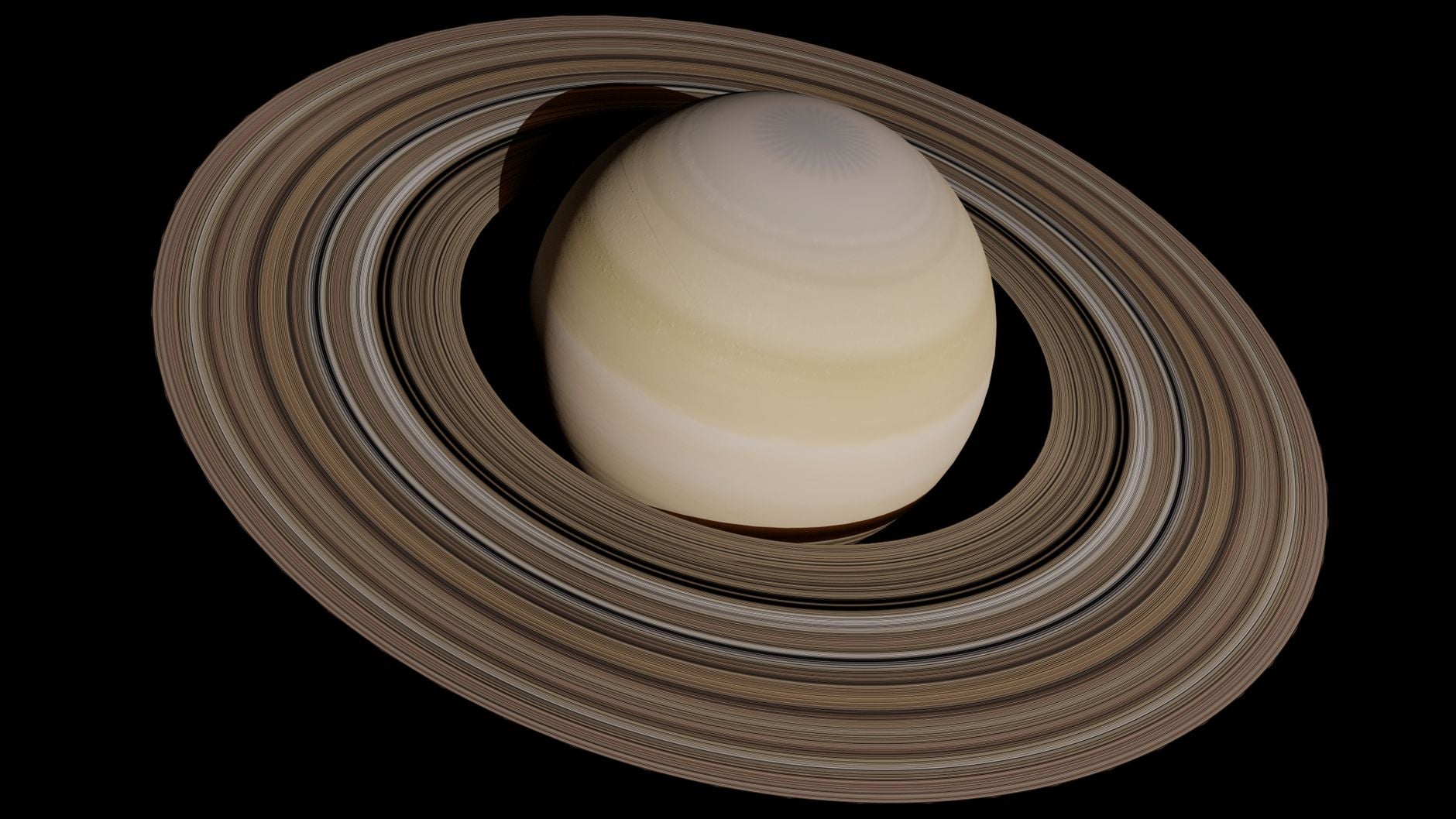
The idea that it rains diamonds inside Saturn is a model of an inaccessible planetary interior, not an observation. No camera has seen the gems and no probe has sampled the depths at which they might form.
The model begins with something Cassini did observe: powerful lightning and unusually dark storm clouds. It then combines atmospheric chemistry with laboratory measurements and calculations of how carbon behaves under rising pressure and temperature. The often-repeated estimate of about 1,000 tons of diamond a year came from researchers discussing that model in 2013. It was not a spacecraft measurement.
This is one model, not settled consensus. The route from methane to carbon soot is plausible. Whether enough carbon remains separate long enough to become diamond, and what happens to it farther down, are much less certain.
Lightning could provide the first carbon grains
Saturn is mostly hydrogen and helium, with methane present in much smaller quantities. Deep thunderstorms rise from water-cloud regions where lightning can heat nearby material abruptly enough to break molecules apart. Methane contains one carbon atom bound to four hydrogen atoms, so its dissociation provides a possible source of elemental carbon.
A 2009 paper in Planetary and Space Science, led by Kevin Baines, examined storm clouds observed by Cassini’s Visual and Infrared Mapping Spectrometer. The clouds were about 20 per cent darker than neighbouring clouds across the measured near-infrared range. The authors proposed that small particles of elemental carbon, produced through lightning chemistry and carried upwards from deeper layers, could account for much of that darkness.
That spectral match did not identify soot directly. Other dark materials may contribute, and the carbon interpretation remains an inference. It does, however, supply an observational starting point for the diamond-rain proposal.
Falling carbon would cross a sequence of pressure zones
Mona Delitsky and Baines presented the next part of the argument at the American Astronomical Society’s Division for Planetary Sciences meeting in 2013. Carbon particles created by storms would sink because they are denser than the surrounding hydrogen-helium fluid. With depth, the pressure and temperature rise.
In their proposed sequence, disordered soot first reorganises into graphite. Deeper still, the pressure moves carbon into a region where diamond should be the stable crystal structure. The word “rain” is convenient but visually misleading. These particles would not fall through a clear sky. They would settle through increasingly dense, hot fluid.
The researchers returned to the model in an official 2024 conference abstract. Using possible pressure-temperature profiles for the giant planets, they calculated a diamond-stability zone extending for thousands of kilometres inside Saturn. Such calculations identify where diamond may be thermodynamically favoured. They do not show that crystals actually nucleate there at the predicted rate.
The 1,000-ton figure is an estimate, not a count
The familiar annual total traces to Baines’s public description of the 2013 work. A later NASA Astrobiology article quoted his estimate that Saturn could create about 1,000 tons of diamonds each year. The proposed pieces were generally small, although some could conceivably reach about a centimetre across.
The number sounds exact because it carries a unit and a yearly rate. It is better read as an order-of-magnitude result built from uncertain inputs, including how much methane lightning processes, how much elemental carbon survives, and how frequently the relevant storms occur.
There is also a larger proposed inventory of diamond inside the planet. That should not be confused with the yearly production rate. Even 1,000 tons per year would be negligible beside Saturn’s total mass.
A liquid diamond ocean is the most speculative step
If solid diamonds continued sinking, conditions would eventually become too hot for the crystal structure to survive. The 2013 model proposed that the material could melt into liquid carbon at greater depth, creating the image of an ocean of liquid diamond.
“Liquid diamond” is loose shorthand. Diamond describes a particular solid crystal arrangement. Once melted, the material is liquid carbon. Whether it would collect as a distinct layer, dissolve into surrounding metallic hydrogen or react with other material depends on Saturn’s composition and an interior profile that remains imperfectly known.
Calling this layer an ocean “at the core” also gives Saturn too tidy an anatomy. A 2021 Nature Astronomy analysis of waves in Saturn’s rings inferred a diffuse, stably stratified core-envelope transition extending to about 60 per cent of the planet’s radius. The deep interior may be a broad compositional gradient rather than a compact core with a clean surface on which carbon collects.
The chemistry has not been checked inside Saturn
Contemporary discussions still treat diamond rain on Saturn as possible rather than established. An American Chemical Society review in 2025 noted that the Saturn proposal was conference work rather than a peer-reviewed demonstration and that some specialists questioned whether the available carbon was sufficient.
Hydrogen is not an inert background. At extreme conditions it can alter carbon chemistry, while carbon may dissolve instead of assembling into crystals. Laboratory experiments provide useful pieces of the phase diagram, but reproducing Saturn’s changing mixture, pressure and temperature across thousands of kilometres is a different problem.
A dedicated atmospheric probe would still reach only a shallow fraction of the relevant depth. For now, diamond rain remains a physically argued forecast for a place beyond direct inspection: grounded in observed storms, extended by high-pressure chemistry, and increasingly uncertain with every kilometre towards Saturn’s interior.