

The Sahara has not always been the dry barrier familiar today. During its most recent humid interval, grasslands, wooded savanna, wetlands and lakes spread across large parts of North Africa. People settled beside the water, while fish, crocodiles and hippopotamuses occupied places that are now among the most arid on Earth.
These “Green Sahara” episodes recur in step with slow changes in Earth’s orbit, especially a cycle of precession lasting about 19,000 to 23,000 years. Calling it a 20,000-year cycle is reasonable shorthand. It is not a perfectly regular timer that turns an entire desert green at fixed intervals.
The distinction makes the story more interesting, not less. The orbital rhythm supplies the pacing, but oceans, ice sheets, vegetation and dust help decide how strongly North Africa responds.
A slow wobble can move a continental rain belt
Earth’s rotational axis slowly changes orientation, rather like the axis of a spinning top. This motion, called axial precession, combines with the gradual rotation of Earth’s elliptical orbit. Together they change where the planet sits in its orbit during each season.
At favourable points in the cycle, Northern Hemisphere summer occurs when Earth is closer to the Sun. More intense summer sunlight heats the North African land surface. The land warms faster than the neighbouring Atlantic, strengthening the pressure contrast that helps draw moist monsoon air inland and northwards.
Rain falling farther into the Sahara supports plants and fills low basins. The newly vegetated surface reflects less sunlight than bare desert, soils retain more water, and lower dust emissions allow more sunlight to reach the land. Lakes and wetlands add further moisture. These feedbacks can amplify the initial orbital push.
A 2023 study in Nature Communications used a coupled climate model to reproduce 20 North African humid periods over the past 800,000 years. The simulations agreed well with humid phases identified in geological records. Precession set the broad pace, while orbital eccentricity and high-latitude ice sheets strongly affected the amplitude.
That qualification is essential. During some glacial intervals, large ice sheets and their cooling influence suppressed rainfall even when precession would otherwise have favoured a wetter Sahara. A cycle can create an opportunity without guaranteeing the same outcome every time.
The wet and dry rhythm extends far beyond human history
The evidence is not confined to one recent episode. For a 2022 Nature Geoscience study, researchers examined terrestrial material carried from Africa into North Atlantic deep-sea sediments. The record showed astronomically paced alternation between humid and arid Saharan conditions extending back more than 11 million years.
Sediment cores provide several kinds of evidence. Wind delivers mineral dust from a dry, sparsely vegetated Sahara to the ocean. Rivers deliver finer terrestrial material during wet intervals. Organic molecules derived from plant waxes retain isotopic information about rainfall. In the eastern Mediterranean, dark organic-rich layers called sapropels record periods when stronger African runoff altered the sea.
These records do not describe identical green periods repeating like copies. The Sahara’s sensitivity changed over millions of years, and the scale of each humid phase depended on the wider climate state. They do show that shifts between desert and vegetated landscapes are a persistent feature of North African climate.
The last Green Sahara was a mosaic, not a rainforest
A broad recent definition places the last African Humid Period between about 14,500 and 5,000 years ago. Some records put its strongest widespread Holocene phase between roughly 11,700 and 5,000 years ago. The difference reflects geography as well as dating: rainfall advanced and retreated at different times across a region larger than the continental United States.
“Green” should not be read as continuous dense forest. Reconstructions indicate a varied landscape of grasslands, savanna, shrubs, scattered woodland, marshes, rivers and open water. Some northern or central districts remained relatively dry, while lake margins and drainage corridors supported rich ecosystems.
At the humid period’s height, stronger summer monsoons carried rainfall far north of their modern limit. Former river channels are still visible from space or buried beneath later deposits. A 2015 Nature Communications paper combined satellite radar, sediment and marine-core evidence to reconstruct the Tamanrasset, a large river system that once crossed Western Sahara and discharged into the Atlantic.
Ancient shorelines supply another scale marker. Lake Mega-Chad spread across more than 350,000 square kilometres in the southern Sahara during the Holocene, approaching the area of the modern Caspian Sea. In today’s northwestern Sudan, the West Nubian Palaeolake covered as much as 5,330 square kilometres. Numerous smaller lakes occupied interdune depressions across the desert.
Hippos and crocodiles are in the physical record
Rock engravings and paintings across the Sahara depict animals associated with savanna and water, including giraffes, elephants and hippopotamuses. Art is valuable cultural evidence, but excavated bones and lake sediments provide an independent environmental record.
At Gobero, on the western edge of Niger’s hyperarid Ténéré Desert, archaeologists found roughly 200 human burials beside a former lake. The published study of the site describes occupations spanning about 5,000 years and catalogues hippopotamus material among the animal remains. Fish, turtles and other aquatic fauna show that this was not simply a damp patch in an otherwise unchanged desert.
Farther north at the Takarkori rock shelter in southwestern Libya, researchers analysed a collection of 17,551 animal remains. A 2020 PLOS One paper reported that fish dominated the early and middle Holocene assemblage. It also identified crocodile dermal scutes and cranial fragments, as well as turtles and water-associated mammals.
The Takarkori record changed as the environment dried. Fish became less important through time, while people increasingly relied on livestock. The sequence captures ecological change at human scale: water bodies contracted, aquatic resources diminished and communities adjusted their way of living.
The Sahara did not become “only sand”
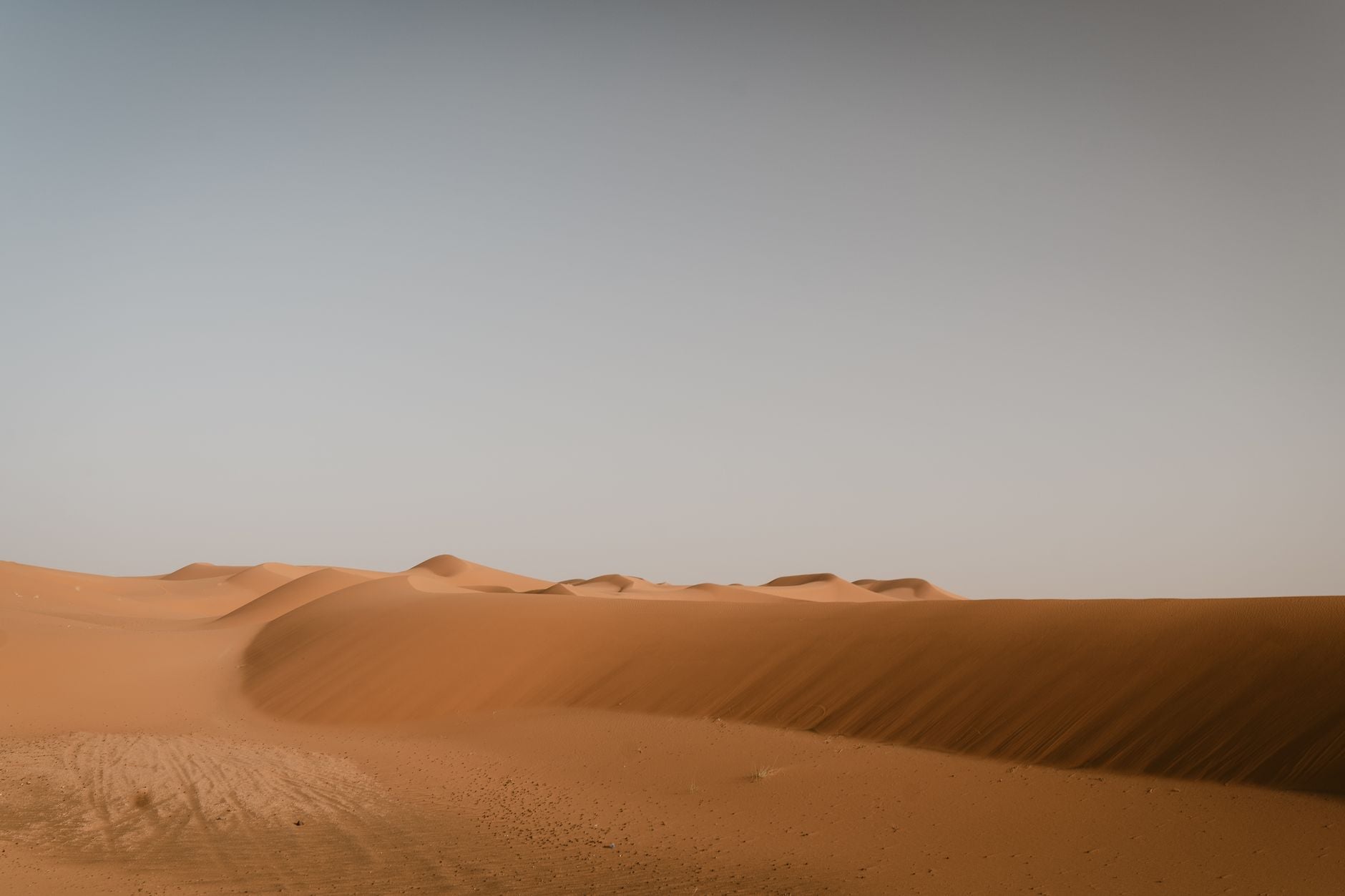
The headline’s image is recognisable, but literal sand seas cover only about a quarter of the Sahara. Much of the region consists of rocky plateaux, gravel plains, mountains, dry valleys, exposed lake beds and salt flats. Some former lakes now lie beneath or among dunes; others survive as pale sediments and shorelines on bare ground.
The end of the African Humid Period was also not one instantaneous collapse. A 2024 Nature Communications study described the shift from wet to dry conditions as a roughly thousand-year transition in a high-resolution Ethiopian record, including repeated shorter droughts. Other sites show earlier or later changes.
As the monsoon weakened, vegetation retreated, lakes shrank and dust emissions increased. These changes reinforced aridity. Human groups moved towards dependable water, altered subsistence strategies or left districts that could no longer support them. The Nile Valley and the remaining lakes became increasingly important, but there was no single migration event shared by everyone across North Africa.
Orbital mechanics do not provide a date for the next green Sahara
Precession will continue, and Northern Hemisphere summer insolation will eventually rise again. It is tempting to add half a cycle to the present and predict the return of lakes. The palaeoclimate record warns against that precision.
Orbital eccentricity, glacial ice, Atlantic circulation, sea-surface temperatures, atmospheric carbon dioxide, vegetation and dust all influence how far the monsoon moves. Human-driven warming has also changed the background climate against which future orbital forcing will operate. The next favourable alignment will not recreate the early Holocene automatically.
The Sahara’s past still overturns the idea of a permanent, timeless desert. Beneath and between its dunes, gravel plains and rock plateaux lies evidence of repeated monsoon expansions strong enough to build rivers, fill immense lakes and sustain animals that now seem entirely out of place. The hippo remains and crocodile scutes are not curiosities. They are pieces of a climate system paced from space and expressed on the ground.