

The Milky Way contains no bar, no bottles and no air through which an aroma could drift. Yet two of its enormous star-forming clouds have earned a place in astronomy’s unofficial drinks cabinet.
Sagittarius B2, close to the galactic centre, contains ethyl formate. On Earth, that compound has a fruity, rum-like odour and contributes to flavour descriptions associated with raspberries. G34.3+0.15, a hot molecular core in the direction of Aquila, contains ethanol, the same molecular species present in beer, wine and spirits.
Both statements are true. Neither means what the first mental picture suggests.
No astronomer smelled Sagittarius B2. No telescope photographed a lake of alcohol in G34.3. The compounds were identified from radio and submillimetre fingerprints, present at trace abundance in regions made overwhelmingly of hydrogen, dust and many other molecules.
First, these are two different chemicals
Ethanol and ethyl formate share part of a name, but they are not interchangeable. Ethanol is C2H5OH, a simple alcohol. Ethyl formate is C2H5OCHO, an ester with three carbon atoms and two oxygen atoms.
At ordinary terrestrial temperatures, pure ethyl formate is a volatile liquid. The American Chemical Society describes its odour as rum-like and its flavour as raspberry-like. The US National Institute for Occupational Safety and Health more conservatively calls the odour fruity. A raspberry’s actual flavour comes from a mixture of many compounds, not ethyl formate alone.
That terrestrial sensory description cannot simply be scaled up to a cloud in space. Smell requires molecules to reach receptors in a nose through a breathable medium. Taste requires a molecule to dissolve and interact with receptors in the mouth. Sagittarius B2 provides neither condition.
It is more accurate to say that the cloud contains one molecule which, under Earth conditions and at sufficient concentration, participates in familiar rum and raspberry sensory profiles.
How a molecule leaves a fingerprint without leaving a smell
Molecules are not rigid little objects. They rotate, vibrate and change energy states. When a molecule moves between allowed rotational states, it can emit or absorb radiation at precise frequencies. The resulting collection of spectral lines acts like a fingerprint.
Astronomers first measure the same molecule in a laboratory, where its transition frequencies can be catalogued. They then point a radio telescope at a cloud and search for the corresponding pattern. One coincident line is rarely persuasive in a crowded source. Several correctly spaced lines with compatible strengths are much harder to explain by chance.
This is especially important in Sagittarius B2. It is one of the most molecule-rich regions known, which means its spectrum is a thicket of overlapping emissions. Greater chemical richness makes the cloud scientifically rewarding and identification more difficult at the same time.
The 3,700-line search in Sagittarius B2
In 2009, Arnaud Belloche and colleagues reported the detection of ethyl formate and n-propyl cyanide in Sagittarius B2(N), a hot, dense core within the larger complex. They used the IRAM 30-metre telescope in Spain.
The survey contained about 3,700 spectral lines. The team assigned 36 lines to the two newly reported molecules. As the Max Planck Institute explained at the time, the radiation from larger molecules is spread across more transitions, making each individual feature weaker and the complete pattern harder to disentangle.
The peer-reviewed Astronomy & Astrophysics paper estimated ethyl formate’s abundance at about 3.6 parts per billion relative to molecular hydrogen. That is not a cloud made of ester. It is a tiny fraction inside an immense reservoir.
A previous SpaceDaily feature examined why the durable claim that “space tastes like raspberries and smells like rum” is too broad. The molecule was detected in one particular region, not throughout space, and Sagittarius B2 contains a far more complicated mixture than that phrase allows.
What the Webb image does and does not show
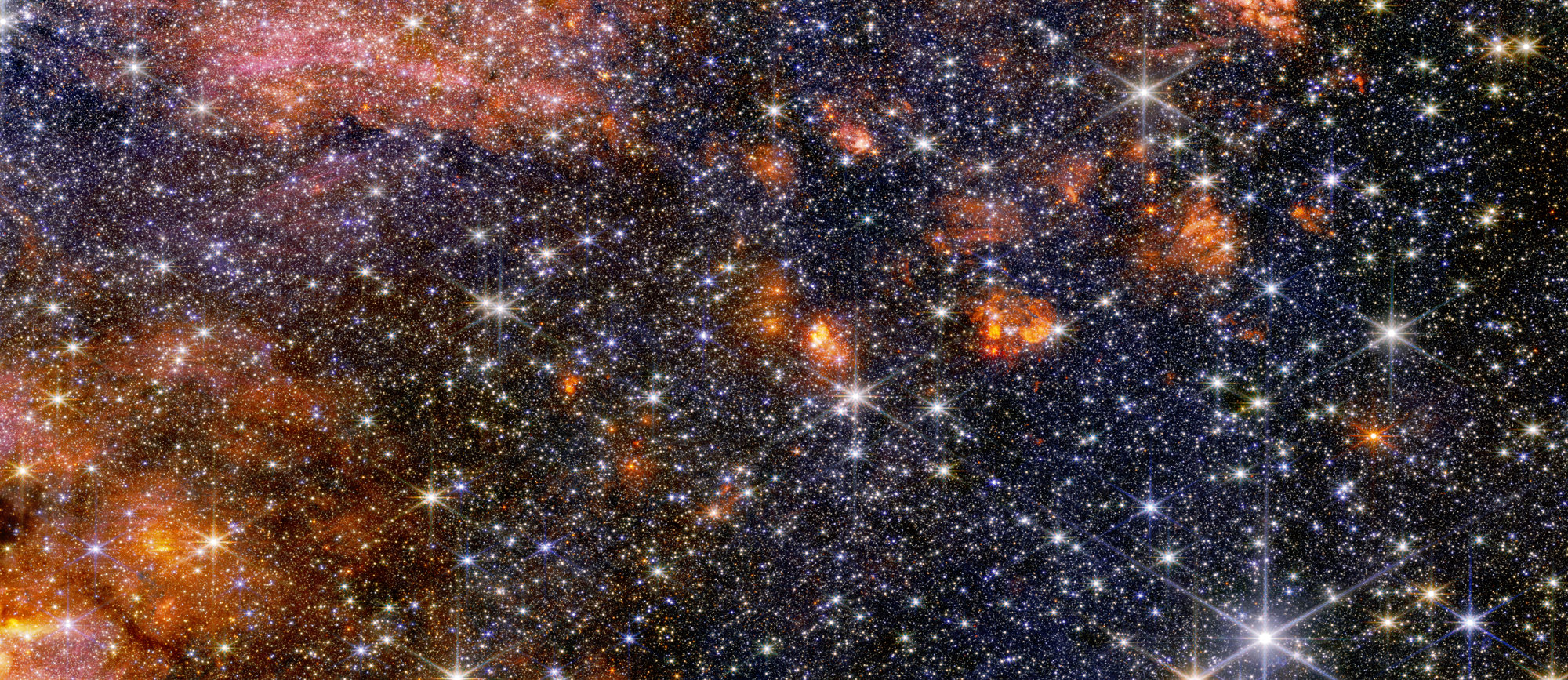
The featured image is a modern James Webb Space Telescope view of Sagittarius B2. Webb’s NIRCam observed the cloud on 7 September 2024, and NASA released the image in September 2025. The view spans roughly 42 light-years.
It is not the image from which ethyl formate was identified. Webb recorded near-infrared light, translated into visible colours for the composite. The 2009 molecular identification came from millimetre-wavelength spectroscopy with the IRAM telescope.
The distinction matters. The glowing stars and orange clouds make the region tangible, but an image pixel does not carry a label saying “ethyl formate.” Spectra separate the light by frequency and reveal the chemistry.
NASA’s Webb account of Sagittarius B2 calls it the Milky Way’s most massive and active star-forming region. It lies about 26,000 light-years away, only a few hundred light-years from the central black hole Sagittarius A*. The cloud holds about 10 percent of the galactic centre’s gas but produces roughly half of its stars.
The G34.3 ethanol result was a different experiment
The second shelf in the drinks-cabinet metaphor sits far from Sagittarius B2, in the direction of the constellation Aquila. In 1995, Tom Millar, G.H. Macdonald and R.J. Habing reported ethanol in the hot molecular core G34.3+0.15.
The researchers found 14 rotational transitions in a submillimetre spectral survey. Their Monthly Notices of the Royal Astronomical Society study derived a rotational temperature of about 125 kelvin and a beam-averaged column density of 2 × 10¹⁵ ethanol molecules per square centimetre.
The corresponding abundance was about 4 × 10⁻⁹ relative to molecular hydrogen, again only a few parts per billion. The estimate was subject to beam dilution because the emitting hot core was smaller than the telescope beam. In plain terms, the observation blurred a compact source across a wider patch of sky.
G34.3 is therefore not a pure cloud of alcohol. It is a massive star-forming environment containing hydrogen, dust, water, methanol, ammonia, carbon-bearing molecules and many other constituents. Ethanol is the ingredient that supplied the irresistible comparison.
Where 400 trillion trillion pints came from
Four hundred trillion trillion is 4 × 1026. Contemporary newspaper reports converted the inferred ethanol inventory into enough alcohol to make that many pints of beer.
The figure was not a direct telescope reading, nor was it the main quantitative result tabulated in the paper. It was an order-of-magnitude translation of a molecular inventory. To make it, someone must adopt a size for the emitting region, integrate the measured column density across that area, convert molecules into a mass or volume of ethanol, and assume how much ethanol goes into a pint of beer.
Change the source geometry, distance, beam correction, beer strength or pint definition and the final count moves. The phrase “an estimated 400 trillion trillion pints” is defensible as the historic scale comparison. It should not be mistaken for a precision measurement to the nearest pint.
SpaceDaily previously followed the G34.3 alcohol calculation on its own. Pairing it with Sagittarius B2 makes a different point: two memorable food-and-drink metaphors grew from the same patient method of molecular spectroscopy.
How a few parts per billion become an absurd total
There is no contradiction between “trace abundance” and “enough for 4 × 1026 pints.” The total number of hydrogen molecules in a hot molecular core is enormous. A few ethanol molecules for every billion hydrogen molecules can still add up to a formidable inventory when integrated across an astronomical area.
Earth offers smaller analogies. Gold is scarce in seawater, yet the total ocean contains a large mass because the ocean is vast. Interstellar clouds extend the same arithmetic across volumes that are hard to picture.
The analogy should stop there. G34.3 contains ethanol molecules in rarefied gas, mixed with other chemicals. Beer is liquid water, dissolved ethanol, carbon dioxide and a carefully produced set of flavour compounds. The cloud has enough of one ingredient for the stated conversion, not 4 × 1026 ready-made drinks.
The chemistry was more important than the quantity
The 1995 team concluded that G34.3 contained too much ethanol to explain through the gas-phase reaction routes then available. Its likely birthplace was the surface of interstellar dust grains.
A dust grain offers a meeting place. Atoms and simple molecules land on its cold surface and become trapped in an icy mantle. They can acquire hydrogen, encounter molecular fragments and assemble products that would have little chance of meeting in the sparse gas.
When a young star warms the surrounding core, the ices evaporate or desorb. Molecules built during the cold phase enter the gas, begin further reactions and become accessible to radio telescopes.
The Sagittarius B2 analysis likewise used grain-surface chemistry to explain how larger molecular sections could assemble from pre-existing building blocks. The path is not fermentation. It is surface chemistry followed by heating.
Organic is a chemistry word, not evidence of organisms
Ethanol on Earth is strongly associated with biology because yeast makes it during fermentation. That association does not mean every ethanol molecule requires life. A molecule records an arrangement of atoms, not the biography of the reaction that made it.
Likewise, “organic molecule” in astrochemistry usually means a carbon-bearing compound of a certain chemical class. It does not mean certified organic food, a living organism or a biosignature.
Neither cloud is evidence of extraterrestrial brewing, raspberries or life. What the detections show is that non-biological environments can reach meaningful molecular complexity before planets form.
That pre-planetary inheritance is now an active field. A recent SpaceDaily report described 17 complex organic molecules around the young star V883 Orionis, supporting the possibility that at least some interstellar chemistry survives into planet-forming discs.
Why the joke survives
“Rotational transitions of C3H6O2 at parts-per-billion abundance” is precise but not memorable. Raspberry rum and 400 trillion trillion pints are memorable but imprecise. Good science writing has to carry both without letting either displace the other.
The drinks-cabinet image works because it connects remote molecular arrangements with direct human experience. Its limits are equally instructive. Scent depends on concentration and environment. Flavour is a mixture. Beer is a manufactured liquid. A molecular match is not a matching object.
Stripped of the barroom imagery, the result is still remarkable. Icy grains in dark clouds can act as chemical workbenches. Young stars can warm those grains and release their products. Radio telescopes can recognise the faint rotational signatures across thousands of light-years.
The Milky Way has not brewed a drink. It has shown that some of the chemistry we associate most intimately with fruit and fermentation can begin in the raw material from which stars and planets are made.