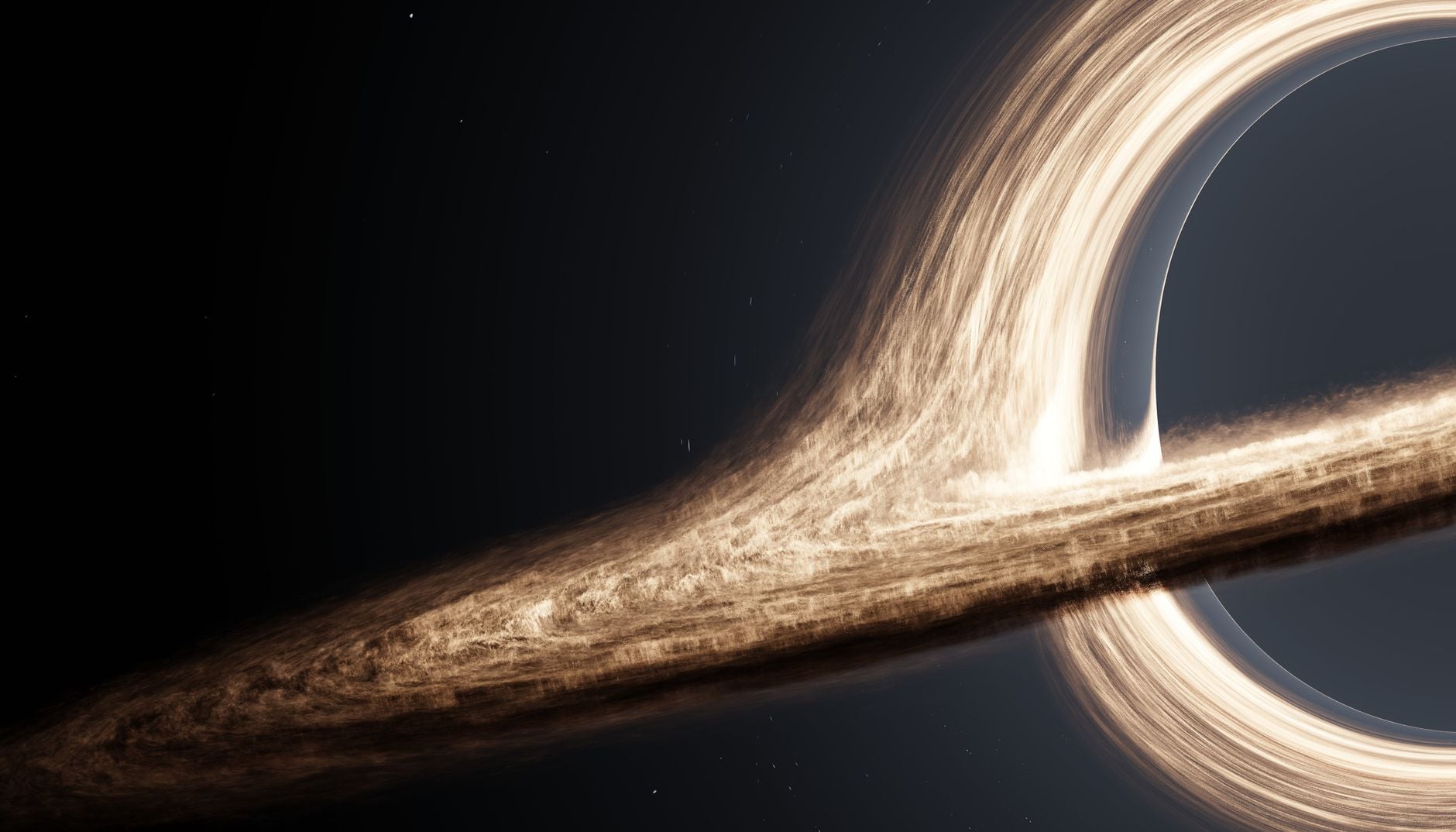
Near the centre of the Milky Way, about 26,000 light-years from Earth, a young blue star repeatedly performs what looks like an impossible turn.
It falls towards an object that cannot be seen, accelerates to about 7,650 kilometres per second and then swings away again. At that speed it could cross the distance from Earth to the Moon in under a minute. It is moving at roughly 2.55 per cent of the speed of light, close enough to 3 per cent that the effects predicted by Einstein become measurable.
The star is called S2 by European astronomers and S0-2 by the team at the Keck Observatory. The invisible object controlling it is Sagittarius A*, the supermassive black hole at the heart of our galaxy.
For nearly three decades, two independent observing programmes led by Reinhard Genzel and Andrea Ghez watched S2 and its neighbouring stars trace paths around that dark point. Those orbits did something a photograph initially could not: they weighed the unseen object, measured how tightly its mass was packed and steadily eliminated every plausible explanation except a black hole.
The centre of the galaxy is hidden from ordinary sight
Sagittarius A* lies in the direction of the constellation Sagittarius, but pointing a visible-light telescope there does not reveal the centre of the Milky Way. Dust between us and the galactic core absorbs visible light, hiding the crowded region behind it.
Infrared radiation passes through much of that dust. Beginning in the 1990s, Genzel’s team used telescopes operated by the European Southern Observatory in Chile, while Ghez’s team used the Keck telescopes in Hawaii. Both groups also had to overcome the blurring caused by Earth’s atmosphere.
Early observations used a technique called speckle imaging, combining many very short exposures to recover detail. Adaptive optics later allowed telescopes to measure atmospheric distortion and correct for it in real time. The GRAVITY instrument went further by combining light from four telescopes of ESO’s Very Large Telescope Interferometer.
As the Nobel Prize scientific background explains, these improvements increased the achievable image resolution by more than a thousandfold. A confused blur of infrared light became individual moving stars whose positions could be measured night after night.
An orbit can weigh something that emits no light
Astronomers did not need to see the central object itself to measure its gravity. An orbit records the pull acting on the body that follows it. If researchers know the size of the orbit, its shape, the star’s speed and the time required to complete one circuit, they can calculate the mass responsible.
S2 is unusually valuable because its orbit takes just under 16 years. That is extremely short by galactic standards. Our Sun needs more than 200 million years to complete one trip around the Milky Way, but astronomers could watch S2 finish an entire orbit within a working career.
The orbit is also highly elongated. At its furthest point S2 travels much more slowly. At its closest approach, called pericentre, it comes within about 120 times the distance from Earth to the Sun. That sounds large until the mass inside it is considered.
Measurements of S2 and other nearby stars show that roughly 4.3 million times the mass of the Sun is concentrated inside S2’s pericentre distance. A multi-star orbital analysis by the GRAVITY Collaboration found that the central gravitational field is dominated by this compact mass inside S2’s closest distance of roughly 120 astronomical units from the centre.
A cluster of faint neutron stars, stellar black holes or other remnants could in principle be dark and heavy. But packing enough of them into such a small volume would make the arrangement unstable. The cluster would collide, evaporate or collapse on timescales too short to explain what is observed. A single supermassive black hole is the explanation that survives.
Why S2 reaches almost 3 per cent of light speed
S2 does not travel at one constant speed. As it falls towards Sagittarius A*, gravitational potential energy becomes kinetic energy. Its highly elliptical orbit makes that change particularly dramatic.
Near pericentre in May 2018, the star reached about 7,650 kilometres per second, more than 25 million kilometres per hour. The GRAVITY Collaboration’s 2018 analysis placed it roughly 120 astronomical units from the black hole at that moment.
The percentage can sound modest because science fiction has trained us to treat the speed of light as the only impressive benchmark. It is not modest. S2 is a star many times the mass of the Sun moving fast enough to cover Earth’s diameter in under two seconds.
In a previous article, I looked at the single cosmic-ray particle detected in 1991 with the energy of a fast-bowled cricket ball. That particle travelled vastly closer to light speed than S2 does. The contrast is what makes S2 astonishing: this is not one proton but an entire star being accelerated through the strongest gravitational field we can track in detail around a supermassive black hole.
The orbit became a test of Einstein
Newtonian gravity can describe most of S2’s path very well. The most revealing deviations appear around its closest approach, where gravity is strongest and the star is fastest.
In 2018, astronomers detected the combined effect of gravitational redshift and the transverse Doppler effect in S2’s light. As the star climbed out of the black hole’s gravitational field, its light lost energy and shifted towards longer wavelengths. Its rapid sideways motion added another relativistic shift. Together, the signal departed from the purely Newtonian prediction in the way general relativity required.
The long observing baseline then exposed a second effect. S2 does not return along a perfectly closed ellipse. The point of closest approach advances, rotating the orbit into a slow rosette. In 2020, the GRAVITY team reported the first detection of this Schwarzschild precession in a star moving around a supermassive black hole. The predicted rotation is about 12 arcminutes per orbit, roughly one fifth of a degree.
Neither measurement means S2 is close to the event horizon. At pericentre it remains about 1,400 times the black hole’s Schwarzschild radius. But the observations are precise enough to detect relativity in a regime far stronger than the gravitational field available in the Solar System.
What the Nobel Prize actually recognised
The 2020 Nobel Prize in Physics was divided between three laureates. Roger Penrose received half for showing that black hole formation is a robust prediction of general relativity. Genzel and Ghez each received one quarter “for the discovery of a supermassive compact object at the centre of our galaxy”.
The wording matters. S2 was the most informative single star, but the discovery rested on independent teams, decades of measurements, numerous nearby stellar orbits and generations of instruments and researchers.
Genzel’s programme began systematic observations with ESO facilities in 1992. Ghez’s team began its Keck campaign in 1995. By comparing positions on the sky with velocities measured from shifts in stellar spectra, the teams reconstructed three-dimensional orbits. Their agreement made the conclusion much harder to dismiss as an instrumental error or a peculiarity of one data set.
An ESO account of the Nobel-winning work describes a programme that ran for nearly 30 years. That duration was not an incidental detail. A small arc can fit many possible orbits; following S2 through pericentre, apocentre and a complete circuit turned a promising inference into a measurement.
We saw the orbit before we saw the black hole
The phrase “emits no light of its own” needs one qualification. The black hole itself does not send light back across its event horizon. Sagittarius A* is nevertheless the name of a bright radio source because hot gas and magnetic fields around the black hole emit radiation before material falls in.
For years, the stellar orbits were the clearest evidence for the object at the centre. Then, in 2022, the Event Horizon Telescope linked radio observatories around Earth and produced the first horizon-scale image of Sagittarius A*. The glowing ring in that image is radiation from surrounding plasma, bent by gravity. The dark central region is the black hole’s shadow.
The image did not replace S2’s orbit. It confirmed the story at a radically different scale. S2 traces gravity across tens of billions of kilometres, while the Event Horizon Telescope probes the immediate neighbourhood of the event horizon.
That connection also reaches into the history of galaxies. In my article on Webb finding unexpectedly mature-looking galaxies in the young universe, one of the central questions was how quickly galaxies assembled their stars and massive central objects. Sagittarius A* gives astronomers the nearest laboratory for studying the black hole side of that relationship.
S2’s story is ultimately about the power of patient measurement. Astronomers could not see the object they were trying to prove was there. They watched a point of starlight move, waited through a 16-year circuit and kept improving the precision.
The star became the pointer on a cosmic scale. Its path revealed four million Suns’ worth of darkness, and the tiny relativistic imperfections in that path showed that the darkness bends spacetime just as Einstein said it should.