
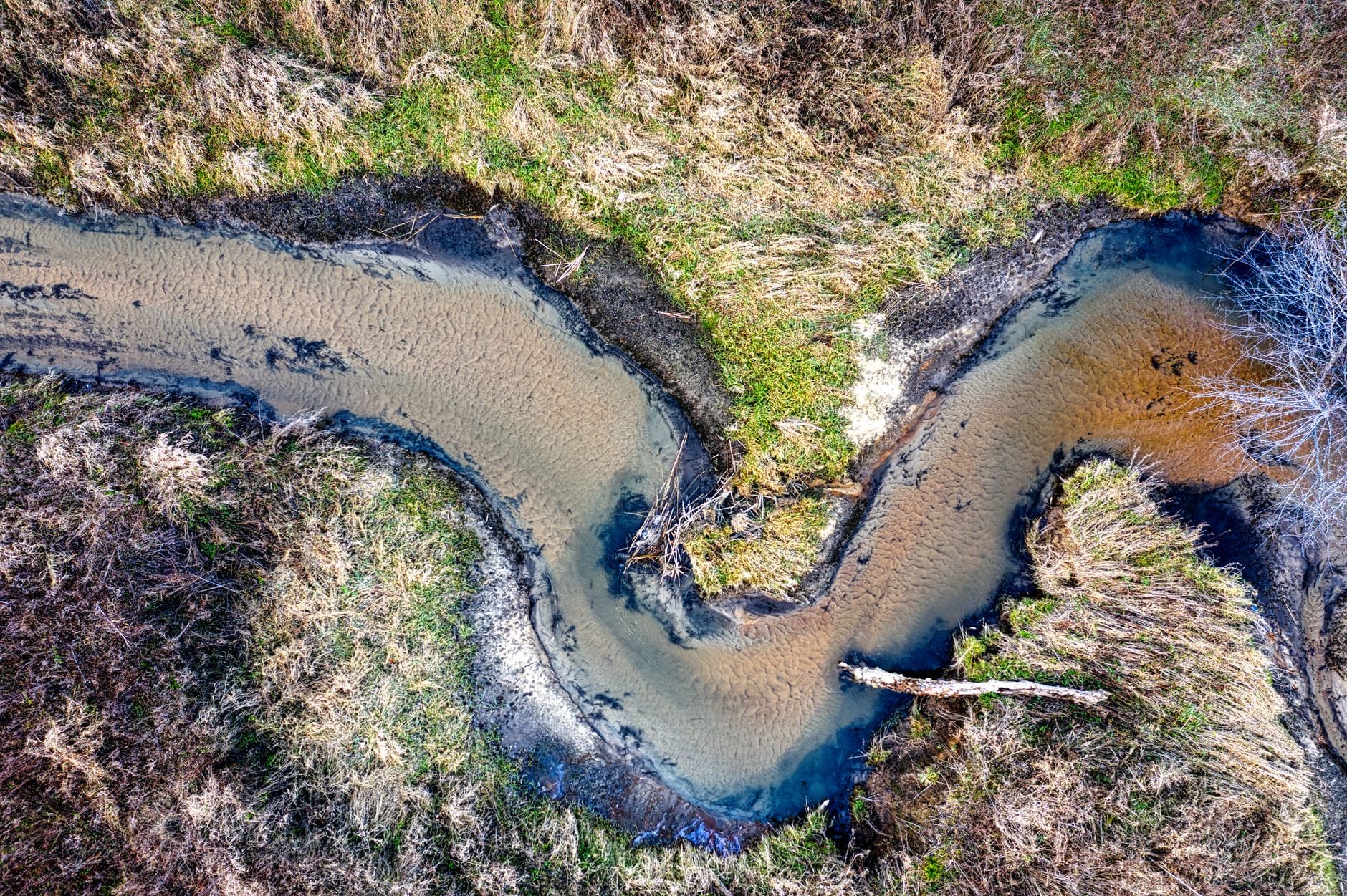
For most of Earth’s history, no trees, grasses or roots held riverbanks together. The familiar geological picture has been that these barren continents were crossed mainly by braided rivers, networks of shallow channels shifting around exposed sand bars. The looping, single-channel meanders familiar today were thought to have become common only after plants colonised the land.
A peer-reviewed study published in Science on 21 August 2025 argues that part of this history rests on a misleading geological test. Michael Hasson of Stanford University and colleagues found that modern meandering rivers without bank vegetation can leave deposits that resemble those of braided rivers.
This is one study, not settled consensus. It did not excavate and date a particular ancient S-shaped channel. Its contribution is to show, using modern rivers, why meanders may have been under-recognised in rocks deposited before land plants evolved.
The old model joined a good observation to a plausible mechanism
Rivers are commonly grouped by the shape of their channels. A braided river divides into several shifting threads that pass around bars in the middle of the flow. A meandering river generally has one main channel, with water eroding the outside of each bend while sand accumulates on a point bar along the inside.
Stable banks help a river preserve a single winding course. Where banks collapse readily, the channel can widen, split and reorganise instead. Roots bind grains, stems slow water and vegetation traps mud. It therefore made physical sense to connect the spread of rooted land plants roughly 425 million years ago with the apparent increase in meandering rivers in the rock record.
The traditional claim needs stating carefully. Geologists did not believe water was incapable of following any curve until a plant appeared. The influential interpretation was that sustained meandering rivers had been rare or absent because barren banks lacked the strength needed to confine them. Plants appeared to provide that missing stability.
By 2025, however, several lines of evidence were already weakening the strict version of that view. Meandering streams had been documented in modern deserts, and ancient rocks contained signs of deep, single-thread rivers from long before vegetation. The new paper addresses why those rivers could remain so difficult to recognise in the broader geological record.
More than 4,400 modern bends supplied the test
Hasson, Alvise Finotello, Alessandro Ielpi and Mathieu Lapôtre examined satellite imagery of more than 4,400 bends in 49 present-day rivers. About half of the rivers were unvegetated, while the remainder were partly or densely vegetated.
The sample crossed climates and regions rather than relying on one convenient waterway. Barren examples included rivers in the Great Basin of the western United States and the Altiplano-Puna Plateau of South America. The comparison group included vegetated rivers in Alaska, the eastern United States and Oceania.
Images captured at different times allowed the team to measure how channels migrated. The critical feature was the point bar, the deposit of sand and gravel that builds on the inner bank of a meander. As the outer bank erodes and the inner bar grows, a bend can change its position across a floodplain.
Vegetated and barren bends did not move in the same way. With plants along their banks, bends tended to expand outward. Without vegetation, bends were more likely to translate downstream while retaining a recognisably curved channel.
In the team’s analysis, vegetation produced a 62 per cent increase in the inferred variance of flow direction. That number is easy to misread. The paper does not say plants make a river 62 per cent more curved. It says plants changed the directions in which point bars accumulated sediment, increasing a measurement that geologists use as a proxy for ancient river sinuosity.
A meander can leave a braided-looking signature
No satellite image survives from a river that flowed a billion years ago. Geologists instead inspect layers exposed in sandstone and mudstone. Inclined beds preserve the directions in which bars grew, allowing researchers to reconstruct the movement of water and sediment.
A broad spread of bar-accretion directions has usually been read as the product of a meandering channel migrating sideways. If the directions show little variation and bars appear to have moved mainly downstream, the deposit is more likely to be classified as braided.
The modern comparison reveals the trap. A plant-free meandering river can carry its bends downstream. Its inner point bars then grow in directions similar to the mid-channel bars of a braided river. If the traditional criterion were applied to those known modern meanders without the overhead view, some would be put in the wrong category.
This distinction can explain a long-standing pattern. Rocks appear to record a sharp increase in river sinuosity near the time plants spread over the continents. Part of that signal may represent a change in the trajectory and preservation of meanders, not the moment when rivers first began to bend.
Geomorphologist Jim Pizzuto of the University of Delaware, writing independently in a Science Perspective, described the result as a way to reconcile conflicting readings of early Palaeozoic river deposits. Vegetation steered bends outward, while barren bends tended to move downstream.
Mud could hold a channel together before roots
The 2025 study explains a bias in interpretation. Separate field evidence helps explain the physical rivers themselves. In a 2023 Geophysical Research Letters paper, Jeffery Valenza and colleagues reconstructed rivers preserved in the roughly 1.2-billion-year-old Stoer Group of north-west Scotland.
Their measurements indicated channels four to seven metres deep with low slopes and characteristics consistent with high-sinuosity, single-thread rivers rather than uniformly shallow braided systems. The bank material supplied a possible stabiliser.
Valenza’s team calculated that sand-mud mixtures containing about 30 to 45 per cent mud could withstand the reconstructed forces from flowing water. The Stoer floodplain deposits contained about 40 per cent mud in relevant layers. Cohesive fine sediment, without assistance from roots, could therefore have supported deep and relatively stable channels.
That does not turn every river on the early continents into a meander. Channel form also depends on water discharge, sediment size and supply, valley slope, bank composition and the sequence of floods. Ancient deposits are incomplete and later erosion selectively removes evidence. The Scottish rocks nevertheless provide an independent, physically plausible route to stable rivers more than 700 million years before rooted vegetation spread.
Plants changed rivers even if they did not invent the curve
Rejecting vegetation as an absolute prerequisite is not the same as declaring it irrelevant. A 2022 review in Nature Reviews Earth & Environment concluded that meandering streams can arise without land plants, while vegetation created stable meandering settings across a wider variety of landscapes.
Plants retain floodplain mud, obstruct and trap moving sediment, and mechanically strengthen banks. The review estimated that these processes slowed typical rates of meander growth and floodplain-soil reworking by as much as an order of magnitude. In other words, early plant-free meanders may have moved across the landscape far faster than their vegetated successors.
The August paper adds a geometrical effect. Plants did not merely slow erosion. They altered the direction in which bends grew, encouraging lateral expansion and leaving a wider range of sediment-accretion directions in the rock.
The revised account is therefore more interesting than either simple extreme. Plants need not have created the first river curves, yet their evolution still transformed how those curves travelled, how long floodplain material remained in place and how river deposits were preserved.
Why the argument reaches beyond the shape of rivers
River classification affects reconstructions of ancient environments. Meandering channels repeatedly erode, deposit and revisit their floodplains, influencing how long mud, nutrients and organic carbon remain stored before they are carried elsewhere. If meandering floodplains existed earlier and more widely than the familiar record suggests, estimates of early sediment movement and carbon storage may need to be revisited.
The findings also matter to planetary geology. Mars preserves sinuous channels and river deposits despite having no history of rooted land plants. Mud, chemical cement, ice or other sources of cohesion can help confine a channel, and the Earth study shows that the geometry preserved in rock also depends on how an unvegetated bend migrated.
There is a modern caution as well. Nothing in the paper implies that removing riverside vegetation is harmless. Plants still strengthen many banks, slow channel movement and affect flooding, habitat and sediment storage. A conclusion about whether ancient meanders could exist without roots is not a prescription for managing a living river.
The 2025 result changes how geologists read the archive, rather than identifying one first river bend. Early continents may have carried many more meanders than their surviving rocks seemed to contain. The curves were there; their plant-free movement made them look like something else.
