
A deep radio image is built by combining hours of observation. That makes faint, steady objects visible, but it can erase a different kind of source. If a star emits for 45 minutes and is quiet for the rest of an eight-hour scan, its burst is diluted into the average. A signal can therefore exist in the underlying measurements without appearing in the finished map.
That blind spot is what Radio Interferometric Multiplexed Spectroscopy, or RIMS, was designed to remove. In a 2026 Nature Astronomy study, Cyril Tasse and an international team reapplied the method to observations from the Low-Frequency Array, LOFAR. They recovered eight circularly polarised bursts from low-mass stars whose intermittent emission had been too weak to register in conventional survey images.
Some of the bursts have properties compatible with magnetic interactions between a star and an orbiting planet. That is the exciting interpretation, but not a confirmed origin. The same kind of coherent radio emission can be generated by activity within a star’s own magnetic environment.
The information lost when hours become one image
The LOFAR Two-metre Sky Survey, known as LoTSS, observes between 120 and 165 megahertz. A typical pointing integrates for eight hours, or 12 hours in part of the sky. Its main products are exceptionally deep images used to study radio galaxies, black-hole jets and millions of other sources.
Creating those images requires calibrating signals from thousands of antennas, correcting for the ionosphere and station beams, and subtracting a model of the steady radio sky. Short bursts pose a problem because the normal image averages both time and frequency. A source emitting only briefly may contribute too little to the final average to cross the detection threshold.
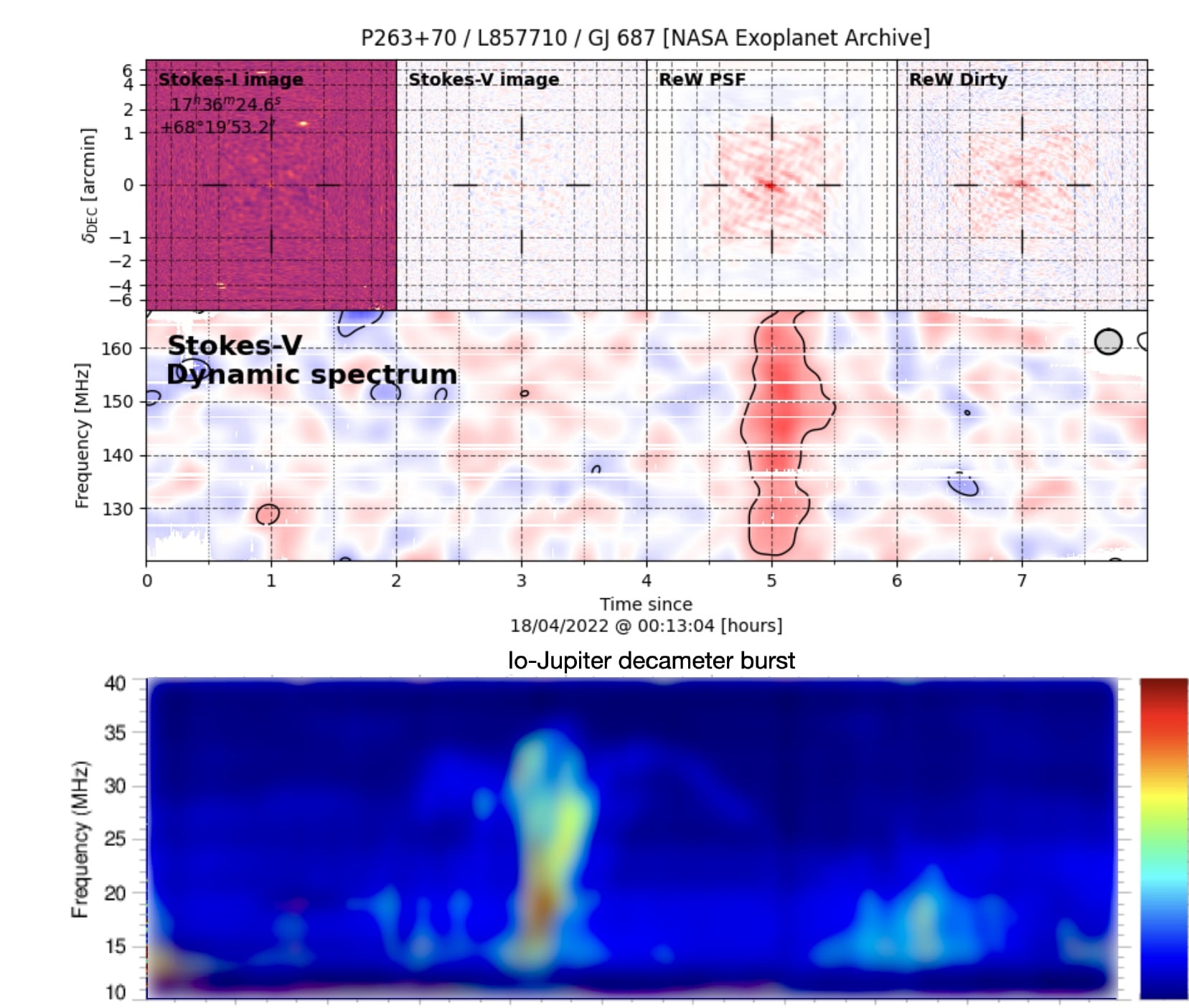
RIMS goes back to the calibrated interferometric measurements called visibilities. After the constant sky model is removed, it coherently phases the residual measurements in selected directions and preserves their native time-frequency structure. The output is a dynamic spectrum showing how flux changes with time and frequency in all four Stokes parameters, including Stokes V, which measures circular polarisation.
A search across 1,522 LOFAR pointings
The scale of the reprocessing matters. The study analysed 1,522 LoTSS pointings containing about 154 petabytes of raw data and 12.5 petabytes after averaging. The team produced 217,941 dynamic spectra in physical target directions and 264,673 more in blank-sky control directions. The approximately 200,000 figure used in the abstract and public account refers to the stellar and exoplanetary targets, not the controls.
This was not literally a spectrum of every catalogue star in every pointing. The implementation selected foreground stellar sources within 100 parsecs and predefined blank positions. RIMS can work in an arbitrary number of chosen directions, so “every star in view” captures the opportunity created by the method, while the actual first run was a large, defined nearby-star sample.
The paper says this multiplexing increased observational efficiency by roughly 150 times. Reprocessing required about one million CPU-hours, but it reused telescope time already spent on other questions. A Cornell account of the project estimated that matching the result with one-target-at-a-time observations would have required nearly 180 years.
Eight bursts that ordinary images missed
An automated search found significant circularly polarised variability in 27 dynamic spectra, representing 25 targets because two were detected twice. Seventeen sources had already appeared in LOFAR’s circularly polarised images. The increased instantaneous sensitivity revealed eight additional M dwarfs whose emission was too sporadic to survive the long image integration. Five had never previously been detected at radio wavelengths.
Seven of the eight new bursts lasted between about 30 and 90 minutes. The exception, from the active M dwarf StKM 1-1262, lasted only one to two minutes and swept rapidly towards lower frequencies. SpaceDaily previously covered the follow-up in which LOFAR and XMM-Newton provided evidence for a stellar coronal mass ejection. That case illustrates one non-planetary engine capable of producing dramatic radio structure.
The newly recovered bursts reached flux densities of only a few millijanskys, yet their inferred brightness temperatures were enormous: about 1013 kelvin if the source covered the stellar disc and 1014 kelvin for a Jupiter-sized source. Their circular polarisation fractions were compatible with nearly 100 per cent. Those values indicate a coherent process in which many electrons radiate in step, rather than ordinary heat emission.
Why the shapes resemble a magnetic interaction
The leading mechanism is electron cyclotron maser emission. Electrons moving through a magnetic field can amplify radio waves near the local cyclotron frequency. The process is highly directional and often strongly circularly polarised. As a rotating star, planet or magnetic flux tube sweeps its narrow beam across Earth, the signal draws a structure through the time-frequency plane.
In a simplified dipole field, emission from different heights along one flux tube can form an arch with two steep legs joined by a flatter top. Similar arcs occur in the Jupiter-Io system, where Io’s motion through Jupiter’s magnetosphere drives currents and intense decametric radio emission. The LOFAR bursts could be classified as legs or tops rather than appearing randomly in the middle of the dynamic spectra.
This does not make every arch a planet signature. A flux tube rooted in a star can produce the same basic electron cyclotron maser physics. Time-frequency shape, circular polarisation, maximum frequency, duration and repetition must be combined before an external driver can be distinguished from a stellar flare.
GJ 687 is the most suggestive system
GJ 687 is an M3.5V dwarf only 4.5 parsecs, or about 15 light-years, away. Its confirmed planet GJ 687 b has a minimum mass close to Neptune’s, or 0.054 Jupiter masses, and orbits at 0.16 astronomical units every 38 days. The system’s current planetary record is available through the NASA Exoplanet Archive.
LOFAR recorded a 5.6-millijansky burst lasting roughly 45 minutes. If the emitting region were no larger than the planet, its brightness temperature would be about 1.7 × 10¹⁴ kelvin. The burst shape and duration resembled an Io-Jupiter event, while its inferred radio power of approximately 2.6 × 10¹³ watts was compatible with the authors’ model of a planet disturbing the stellar magnetic environment.
The modelling does not uniquely locate the source. If the burst were an aurora from the planet itself, emission reaching roughly 170 megahertz would require a planetary polar field of about 60 gauss. If it were generated along the star-planet connection, a much weaker planetary field could suffice. The observation constrains possible magnetic configurations; it does not measure the planet’s field directly.
Another detected star, EQ Peg A, also hosts a reported planet, but the paper found the energetics less favourable for a star-planet interpretation. The contrast matters because proximity to a known planet is not evidence that the planet caused a burst.
No exoplanet radio detection has been confirmed
The authors state the boundary plainly: no star-planet interaction or exoplanetary radio emission has yet been confirmed. Active M dwarfs can flare and accelerate particles without an orbiting body. A single event, even one with a familiar shape and plausible energy budget, cannot establish which engine operated.
SpaceDaily reported an earlier LOFAR result that proposed coherent radio emission as a probe of exoplanet environments. Subsequent work has shown why the field remains cautious: several candidate systems have admitted stellar explanations, and predicted planet-linked emission can be intermittent and narrowly beamed.
The decisive evidence would be repetition tied to a physical clock. Multiple bursts could be tested against the planet’s orbital period, the star’s rotation or their synodic period. More precise orbital ephemerides would show where a planet was when each event occurred, while simultaneous optical and X-ray measurements could reveal whether the star was flaring independently.
Radio archives can become time-domain observatories
RIMS is valuable even if none of these eight events ultimately proves planetary. Foreground stars are present in radio fields observed for entirely different reasons. The public RIMS code allows those stored measurements to be revisited as simultaneous monitoring campaigns rather than one static image per pointing.
The first search covered about 27 per cent of the northern sky available to LoTSS at the time. Longer observations could reveal periodicity, and the team estimates that the Square Kilometre Array’s much higher instantaneous sensitivity could raise the number of stellar and exoplanetary burst detections by two to three orders of magnitude. That is a projection, not a guaranteed yield, but it shows why preserving time-frequency information matters.
Radio telescopes had already recorded these eight bursts. The discovery came from changing the question asked of the archive, from “what is steadily bright here?” to “what happened in each direction while the image was being made?”