

The experiment sounds almost designed to fail. Take glycine, the simplest amino acid used by life on Earth. Cool it to nearly minus 260°C, colder than almost anywhere humans can casually imagine. Put it under space-like vacuum. Then hit it with energetic particles standing in for cosmic rays.
Instead of simply destroying the molecule, the radiation helped it take a step toward biological complexity. In a Nature Astronomy study published on 20 January 2026, Alfred Thomas Hopkinson, Sergio Ioppolo and colleagues reported that proton irradiation of cryogenic glycine produced glycylglycine, the simplest dipeptide. A dipeptide is what forms when two amino acids are joined by a peptide bond, the same kind of chemical link that lets longer chains become proteins.
That does not mean the team made life in a freezer, or even a protein. Glycylglycine is a very small molecule. But the result matters because it shows that one of chemistry’s most important biological links can form under conditions resembling cold interstellar ice, before stars and planets have finished assembling.
Amino acids before planets
Glycine is already a familiar molecule in space chemistry. The new paper notes that simple alpha-amino acids, including glycine, have been detected in extraterrestrial material such as meteorites and comets. One earlier analysis of NASA Stardust comet samples reported cometary glycine, while Rosetta mission work found distributed glycine in the coma of comet 67P/Churyumov-Gerasimenko.
Those detections raised a harder question. If amino acids can exist in space, can they also link together there? On Earth, peptide bonds are central to proteins, enzymes and cellular machinery. But the early steps toward those links have often been imagined in warmer, wetter environments: ponds, vents, mineral surfaces, or other settings where liquid water can move molecules around.
The 2026 Nature Astronomy experiment points to a colder route. The researchers worked with isotopically labelled glycine so they could track which atoms moved during the reactions. They irradiated the material with protons at cryogenic temperatures, then used infrared spectroscopy and high-resolution mass spectrometry to identify products. The paper reports glycylglycine, water by-products and other complex organic species, all without liquid water being present.
Why radiation can build as well as break
Cosmic rays are usually described as destructive, and for good reason. Energetic particles can smash chemical bonds and damage biological material. But in a frozen interstellar grain, that same violence can create reactive fragments. If the fragments are trapped close together in ice, they may recombine in new ways.
That is the key idea behind the experiment. Space.com, summarising the study, described the setup as glycine cooled to about minus 436°F, or roughly minus 260°C, and bombarded with high-energy protons. Live Science reported additional laboratory details, including glycine-coated icy crystals irradiated at 20 kelvins, equal to about minus 253°C, under extremely low pressure. The exact laboratory numbers differ slightly in how they are rounded and described, but the point is the same: this chemistry was tested in conditions meant to resemble the cold, thin environment of interstellar space.
The result is counterintuitive because peptide-bond formation is often treated as a dehydration problem. Joining two amino acids releases water, and in ordinary chemistry that can make the reaction difficult in wet environments. The interstellar route is different. The Nature Astronomy paper argues for an energetic, non-aqueous pathway in which ionizing radiation supplies the energy needed for amino acids trapped in ice to form peptide bonds.
Before stars and planets are born
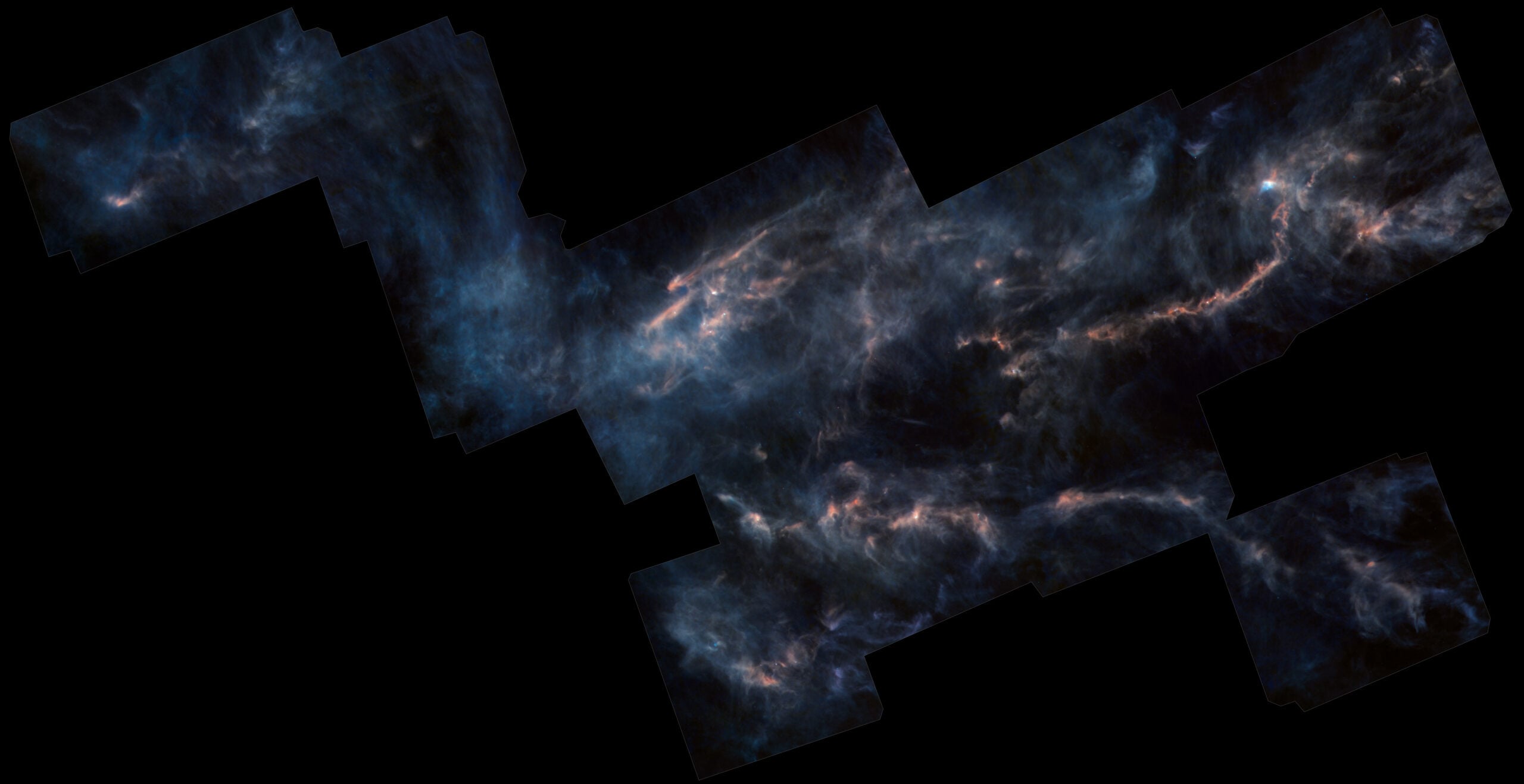
The setting matters as much as the molecule. Dense molecular clouds are cold places where dust grains can acquire icy mantles. These clouds can later collapse into star-forming regions, then into disks where planets, comets and asteroids take shape. If peptide-like molecules can form on icy grains before that collapse is complete, the chemistry available to newborn planetary systems may already be more complex than once assumed.
Earlier work had already pushed glycine itself into very early cosmic settings. In 2021, Ioppolo and colleagues reported a non-energetic mechanism for forming glycine in interstellar ice analogues, suggesting that the simplest amino acid could arise before planets exist. The new experiment moves one step further along the chain: not just making an amino acid, but linking amino acids into a peptide bond.
There are other proposed routes as well. A 2022 Nature Astronomy study described a pathway to peptides in space through atomic carbon chemistry, without first requiring ordinary amino acids to be assembled in the usual way. Taken together, these studies do not point to one tidy recipe. They point to a broader possibility: prebiotic chemistry may have several ways to get started in environments that look inhospitable from a human perspective.
What the experiment does not prove
The careful reading is important. The team did not show that proteins are forming everywhere in space. They did not show that interstellar peptides seeded life on Earth. They did not detect glycylglycine in a comet, asteroid or molecular cloud. They showed, in a laboratory analogue, that a basic peptide bond can form when glycine ice is exposed to radiation under space-like conditions.
That distinction is where the science becomes interesting rather than overblown. A laboratory analogue is not the universe itself, but it is a way to test whether a proposed reaction is physically plausible. The next questions are whether other amino acids behave similarly, how efficiently such products form over astronomical timescales, how well they survive later heating and irradiation, and whether telescopes or sample-return missions can find matching molecules in real extraterrestrial material.
The result also does not settle where life began. Earth may have made many of its own prebiotic molecules. Meteorites, comets and dust may have supplied others. Warm ponds, hydrothermal vents, mineral surfaces and impact environments all remain part of the debate. What this experiment changes is the starting inventory. If peptides can begin forming before stars and planets are born, then rocky worlds may inherit not only simple organic molecules, but some molecules already nudged toward biological architecture.
A colder origin story
Origin-of-life chemistry often feels tied to warmth: sunlight on water, volcanic heat, shallow pools drying and refilling. The glycine experiment adds a stranger image. In the dark between stars, on tiny ice-coated grains, radiation may be doing chemistry that looks less like destruction and more like preparation.
That is why the discovery is compelling even in its modest form. Glycylglycine is not life. It is not a cell, a gene or a protein. But it is a peptide, and peptides belong to the molecular language of life. Finding a plausible way to form them in interstellar ice means the first steps toward that language may not have waited for planets at all.