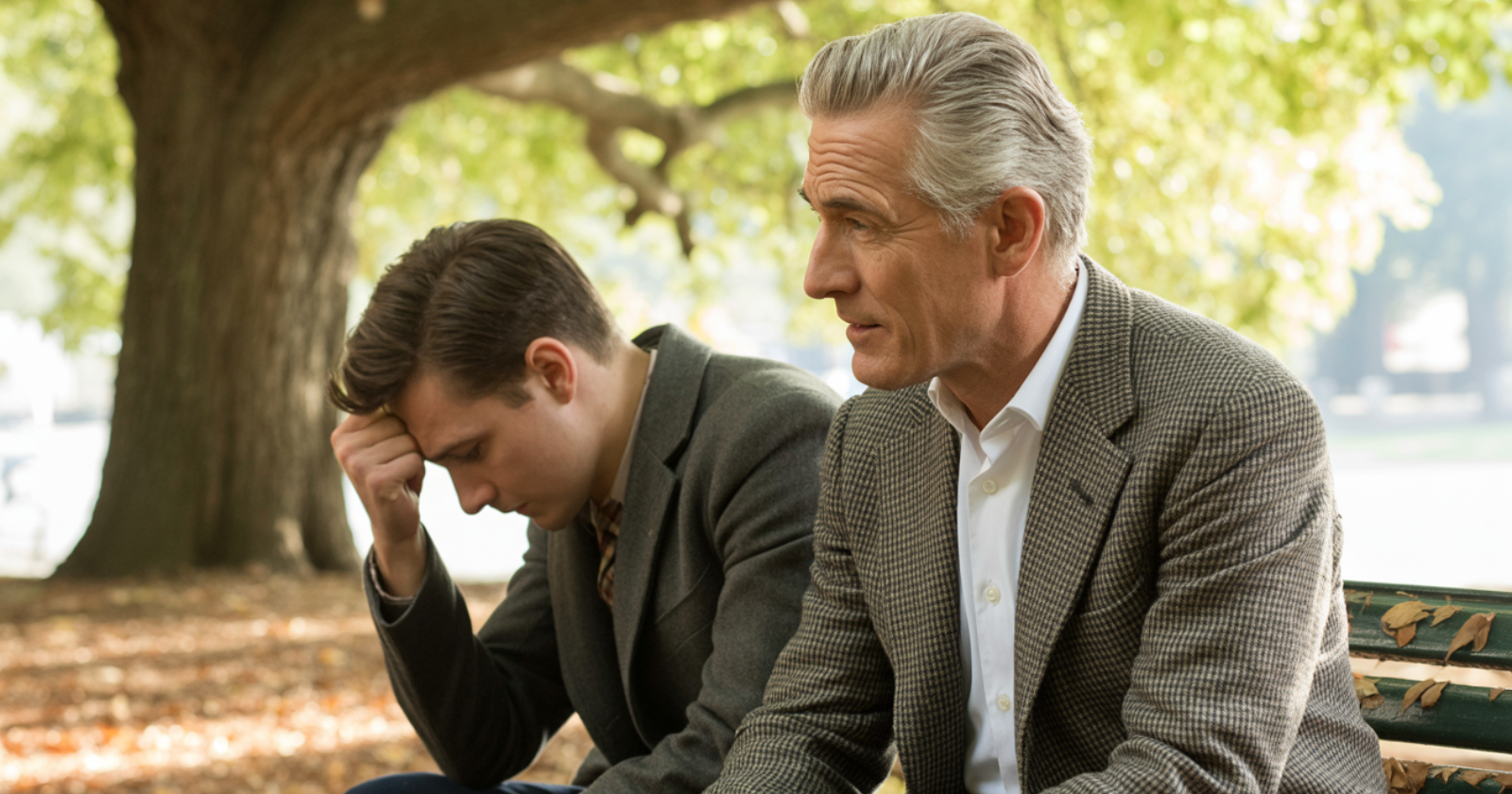
There’s a pattern almost everyone has noticed in older relatives or colleagues. Someone who used to be “easy” gets, over the course of their fifties and sixties, quietly less accommodating. They stop taking on the emotional weight they used to carry for other people. They don’t smooth over the awkward moments anymore. They say no more often, and they say it without an apology stapled to the end of the sentence. Their company becomes, for certain people, less comfortable.
The people around them call this getting bitter, getting grumpy, or getting difficult. I’d argue, and I think the psychology research argues, that most of the time they’re getting something else entirely. They’re getting done.
Done with absorbing other people’s discomfort at the expense of their own. That’s not bitterness. That’s a skill that took them decades to develop, and the people who benefited from the old version don’t like the new version one bit.
The research on why older adults get more selective
Stanford psychologist Laura Carstensen has spent decades developing socioemotional selectivity theory, one of the most replicated findings in the psychology of aging. The core claim is that as time horizons shrink with age, people become increasingly selective. They invest greater resources in emotionally meaningful relationships and goals and let the peripheral ones go.
Research drawing on the theory has documented that social networks actually shrink with age, with older adults keeping fewer peripheral social partners and more close, emotionally meaningful ones. The effect isn’t random loss. It’s curation. Older people are editing.
And the editing isn’t just about who they see. It’s about what they’re willing to do in the interactions they keep. The emotional labour that younger adults perform automatically, smoothing every conversation, softening every disagreement, taking responsibility for how everyone in the room is feeling, starts to look, from the older vantage point, like a tax they no longer want to pay.
The thing they spent decades doing
To see why this is a skill rather than a decline, you have to look at what the older version of them was doing for all those years.
Most people, especially women and anyone raised in a family where peace was priority, spend their adult lives quietly absorbing other people’s discomfort. Your mother-in-law is anxious about the dinner, so you manage her. Your boss is stressed, so you carry some of it for him. Your partner had a hard day, so you don’t bring up the thing that’s been bothering you. Your friend is going through something, so you don’t mention the favour she promised three weeks ago. Your sibling is sensitive about the money issue, so you change the subject every time.
Multiply this by thirty years, and it’s a full-time unpaid job. Psychologists now have a specific name for a pathological version of this pattern, the fawn response, a trauma adaptation in which a person’s nervous system learns that appeasing others is the safest strategy available. But even people who aren’t clinically in the fawn pattern have often spent decades running a milder version of the same programme. They’ve been trained, by family or culture or gender or workplace, to absorb.
The absorption costs something. It just pays the bill in invisible currency, so nobody notices it for a long time.
What actually happens in the fifties and sixties
At some point, usually between the late forties and the early sixties, a specific realisation lands.
It lands differently for different people. For some, it arrives after an illness, when their own body finally demands a share of the energy they’ve been spending on everyone else. For some, it lands after a parent dies and they realise how much of their life was organised around managing that relationship. For some, it lands after a divorce. For some, it just lands quietly on a Tuesday.
The realisation is this. I don’t have infinite time. I don’t have infinite energy. And the amount of my life I’ve been spending on smoothing other people’s discomfort has been, objectively, larger than the amount I’ve been spending on my own.
What happens next is not bitterness. What happens is a quiet editorial decision. They stop volunteering for the job. They don’t announce this. They don’t give a speech. They just, in small ways, stop doing the free emotional labour they used to do automatically.
What it looks like from the outside
From the outside, it looks like the person has changed for the worse. They used to be so easy. Now they say no. They used to laugh off awkward comments. Now they just let the awkward silence sit. They used to take the phone call and listen for an hour. Now they call back when they have time. They used to apologise for things they didn’t do. Now they don’t apologise until they mean it.
The people who benefited most from the old version are, unsurprisingly, the ones most vocal about how much she’s changed. The sibling who got used to venting for free. The colleague who got used to being covered for. The adult child who got used to mom managing all the feelings in the family. The friend who got used to being the taker in an uneven friendship.
They’re not wrong that she’s changed. They’re wrong about what the change is. She hasn’t gotten meaner. She’s gotten honest about what her time and energy actually cost her, and she’s stopped pretending they were free.
Why this gets read as bitterness
In a culture that rewards women and quiet men specifically for being accommodating, the withdrawal of accommodation looks, to everyone on the receiving end, like hostility. This is the quiet trap older women especially walk into.
The twenty-year-old woman who holds a firm boundary is called confident. The forty-year-old woman who holds the same boundary is called assertive. The sixty-five-year-old woman holding exactly the same boundary is often called bitter.
Nothing has changed about the behaviour. What has changed is the audience’s expectation that she’ll keep performing the absorption they got used to. When she stops, they experience her stopping as an attack, even though she’s simply recovering resources that were always hers.
The men who go through the equivalent shift get labelled as grumpy old men. Same mechanism. They’ve just stopped supplying something their environment had come to assume they’d always supply.
What the inside of the shift actually feels like
I’ve talked to enough people on the far side of this shift to know what it feels like from inside.
It does not feel like anger. It does not feel like wanting to hurt anyone. It mostly feels like a quiet, almost physical tiredness that has finally become legible. For years it was just background fatigue. Now it has a shape, and the shape is specifically the sensation of being repeatedly asked to carry someone else’s weather when the day is already hot enough.
The decision to stop is often not dramatic. It’s a small internal sentence that goes something like, “I’m not doing this one anymore.” The next time the phone rings, they let it go to voicemail. The next time a family member starts the usual cycle, they don’t rush to soothe it. The next time someone at work dumps emotional labour on them, they quietly don’t catch it.
What they notice is that nothing terrible happens. The family member manages. The colleague finds another route. The relationships that were only being held together by their absorption dissolve, which turns out to be information, not loss. And the relationships that were actually mutual get, if anything, closer, because the older person is now actually present rather than performing presence while quietly burning out.
What the Buddhists understood about this
When I wrote Hidden Secrets of Buddhism, one of the teachings I kept circling was the concept of compassion as distinct from what the Buddhist tradition calls idiot compassion.
Real compassion notices suffering and responds to it thoughtfully. Idiot compassion absorbs everyone’s suffering automatically, regardless of whether absorbing it actually helps anyone or just exhausts you while enabling patterns that should probably change. Idiot compassion looks virtuous from the outside for a long time. It’s what most of us were taught was kindness.
The older people who have dropped this pattern haven’t become less compassionate. They’ve become more accurate. They give their care to the people and situations that actually benefit from it, and they stop giving it to the ones that were just using it.
On the cushion in the morning along the Saigon River, I’ve been noticing how often my own discomfort, when someone else is unhappy, pushes me toward fixing them rather than being with them. The practice of sitting with that discomfort, instead of leaping to neutralise it, is the same practice the graceful older people seem to have mastered.
The reframe worth carrying
The next time you notice an older person in your life becoming “harder,” ask a quiet question before you settle into the bitterness story.
Are they actually being unkind? Or have they simply stopped absorbing something you’d gotten used to them absorbing?
If it’s the second one, what you’re watching isn’t bitterness. It’s a skill. A late-developed, quietly radical skill of refusing to spend your last decades paying a tax you never should have agreed to in the first place.
The people who mind this change the most are almost always the people who were getting the free service. That’s worth noticing too.