

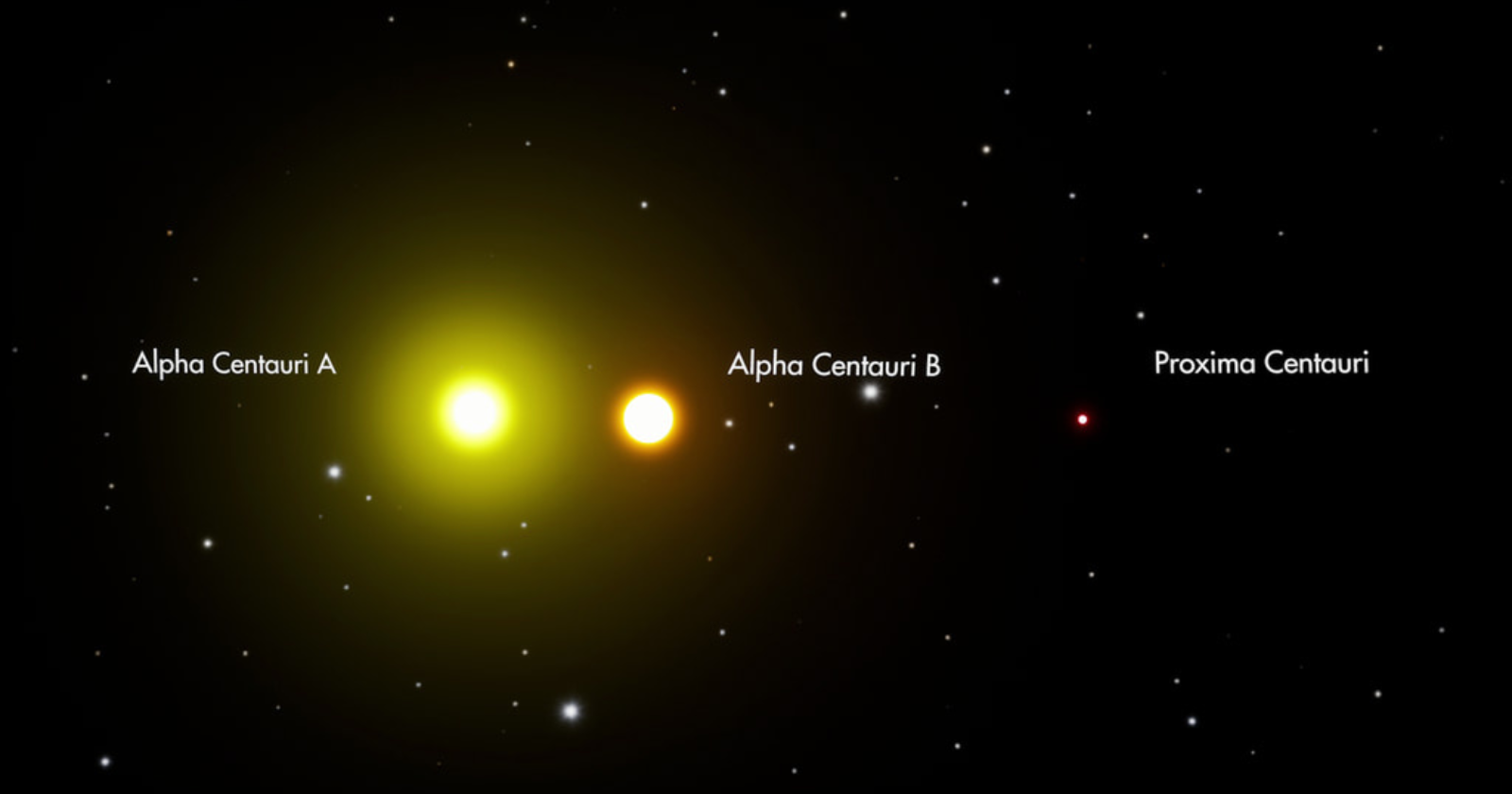
Proxima Centauri is the nearest known star beyond the Sun, only about 4.25 light-years from Earth. Yet no matter how dark the night becomes, it is normally far too faint to see without a telescope.
The apparent contradiction is a reminder that distance is only one part of how bright a star looks. Proxima is a small, cool red dwarf that releases roughly one-thousandth as much energy as the Sun. Being our nearest stellar neighbour cannot compensate for such a low output.
There is one qualification. An exceptional flare briefly pushed Proxima close to naked-eye brightness in 2016, although no observer was reported to have seen it directly.
Nearest means nearest beyond the Sun
The Sun is Earth’s nearest star, about eight light-minutes away. Proxima is the next one. The SIMBAD astronomical database places it 1.3019 parsecs away, equivalent to approximately 4.246 light-years or 40 trillion kilometres.
Proxima belongs to the Alpha Centauri triple system. The brighter Alpha Centauri A and B form a close pair and appear to the unaided eye as one conspicuous point in the southern constellation Centaurus. They are slightly farther from us than Proxima.
Its faintness also explains why the nearest star remained unrecognised until the photographic era. Robert Innes found it at Johannesburg’s Union Observatory in 1915 by identifying its large motion across the sky, an episode recorded by the South African Astronomical Observatory.
That is why the closest visible main-sequence star is Alpha Centauri rather than Proxima. The nearest individual member of the system is hidden from ordinary sight.
Magnitude 11 is well below the eye’s limit
Proxima’s usual visual magnitude is about 11.13. On astronomy’s magnitude scale, larger numbers describe fainter objects. Under rare, exceptionally dark conditions, a person may see stars down to about magnitude 6.5, according to NASA’s guide to measuring night-sky quality.
The scale is logarithmic. A difference of five magnitudes corresponds to a factor of 100 in apparent brightness. Proxima therefore delivers only about one-seventieth of the visible light needed to meet even the generous magnitude 6.5 threshold.
A small telescope can collect far more light than a pupil and reveal it as a point. Even the Hubble Space Telescope cannot resolve the star into a disc in ordinary images. The bright object in a published Hubble view of Proxima remains a point spread across detector pixels by the telescope’s optics.
Proximity cannot make up for a weak star
Proxima has about 12 per cent of the Sun’s mass and roughly 14 per cent of its radius. A detailed analysis of its radiation in Astronomy & Astrophysics measured the energy arriving across wavelengths from X-rays to the infrared and found a bolometric luminosity close to 0.15 per cent of the Sun’s.
Bolometric luminosity counts the star’s total output. Proxima looks still less impressive to human vision because its surface temperature is only about 3,000 kelvin and much of its radiation emerges at infrared wavelengths the eye cannot detect.
This is characteristic of red dwarfs. They are the smallest and coolest hydrogen-fusing stars, but they are not rare failures. NASA estimates that red dwarfs make up about 75 per cent of the Milky Way’s stars. Their low fuel-consumption rate also allows the least massive examples to remain on the main sequence for trillions of years.
A flare once brought it close to visibility
Red dwarfs can be optically faint while remaining magnetically active. Proxima produces frequent flares that release sudden bursts of radiation.
On 18 March 2016, the Evryscope array recorded a superflare that increased Proxima’s optical flux by a factor of about 68. Ward Howard and colleagues reported in The Astrophysical Journal Letters that the star briefly reached at least magnitude 6.8.
That sits at the edge of naked-eye visibility from an extremely dark site, not within the dependable range of ordinary human sight. The event was found in automated survey data rather than through a person noticing a new star. It lasted only minutes.
So “invisible to the naked eye” is accurate for Proxima’s normal state, but “never visible” would be too strong.
The faint neighbour remains an unusually valuable target
Proxima’s nearness makes tiny effects easier to measure even though it does not make the star visibly bright. Its motion against distant background stars produces a comparatively large parallax, which is how its distance can be measured so precisely.
The star also hosts at least one confirmed planet. ESO announced Proxima b in 2016 after instruments detected the small gravitational wobble produced by the planet’s 11.2-day orbit. Its location near the star’s habitable zone has made Proxima’s ultraviolet and X-ray flares a central part of assessing the planet’s environment.
Proxima Centauri therefore offers two different lessons about nearness. It is close enough for unusually detailed measurements, but four light-years is still an enormous physical separation. And among stars, the nearest object is not necessarily one the human eye can see.