
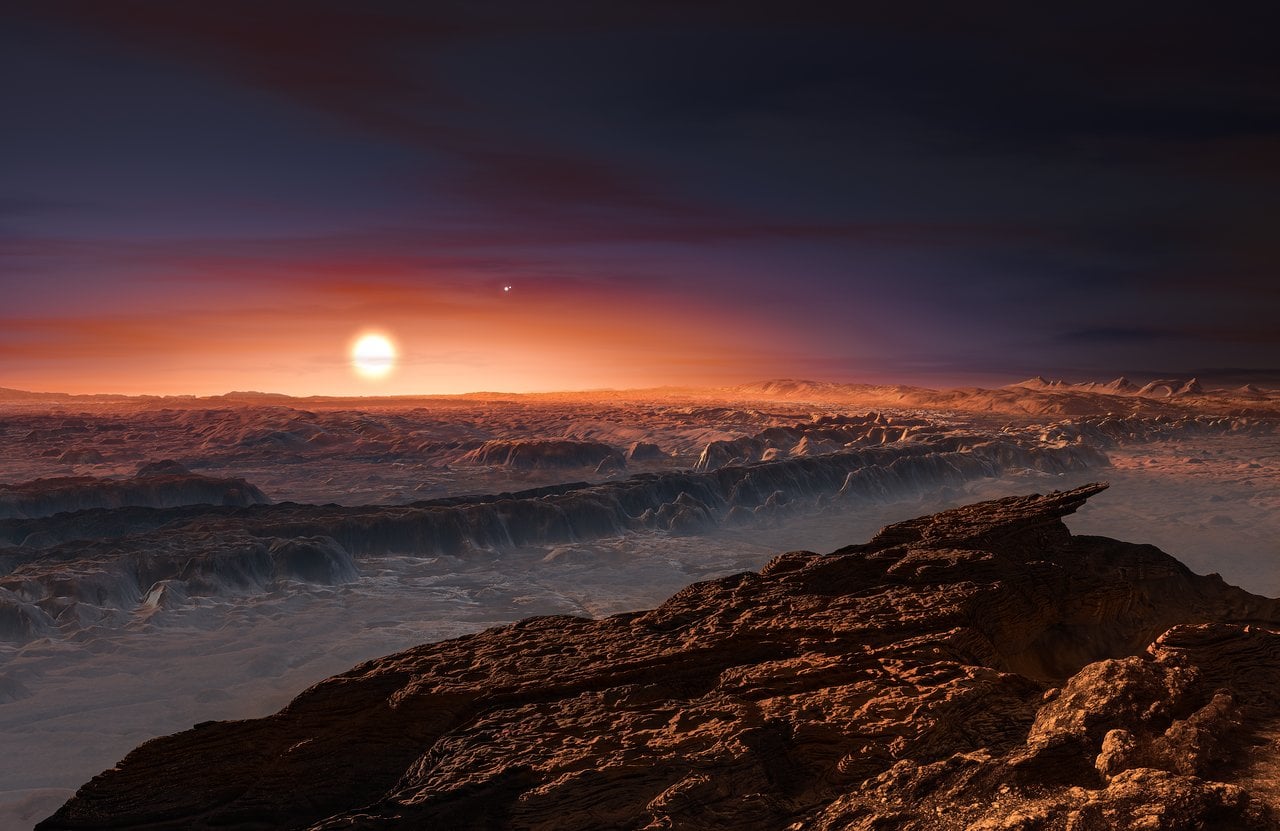
Proxima Centauri b has a claim no other known exoplanet can match. It orbits the nearest star to the Sun, just over four light-years away, and it sits in the kind of orbit where liquid water could exist on a rocky surface.
That is the hopeful version. The harder version is that almost everything important about its habitability depends on an atmosphere no one has yet seen.
When astronomers announced Proxima b in 2016, the discovery was immediately compelling because of where the planet was found. Proxima Centauri is the Sun’s closest stellar neighbour, a small red dwarf in the Alpha Centauri system. The planet was detected not by an image, but by the tiny gravitational tug it exerts on its star, causing Proxima Centauri to wobble toward and away from Earth.
The signal showed a planet with at least about Earth-like mass, completing an orbit every 11.2 days. NASA’s current exoplanet catalogue lists Proxima Centauri b as a super-Earth with a mass close to Earth’s, orbiting at about 0.048 astronomical units from its star. That sounds dangerously close until the star itself is considered. Proxima Centauri is far smaller, cooler and dimmer than the Sun, so its habitable zone lies much nearer in.
In temperature terms, Proxima b is in the right neighbourhood. The original discovery paper reported an equilibrium temperature range in which water could be liquid, and ESO described the planet as orbiting in a zone where surface conditions might allow liquid water.
But a habitable zone is not a certificate of habitability. It is a rough energy budget. A planet still needs the right surface pressure, atmospheric composition, greenhouse effect, clouds, rotation state, geology and history. Mars also receives sunlight in a way that once allowed liquid water, but today its thin atmosphere leaves most of its surface cold and dry. Venus sits near the inner edge of the Sun’s habitable region in some definitions, yet its atmosphere turned it into the hottest planetary surface in the Solar System.
For Proxima b, the atmosphere is the decisive unknown.
The closest Earth-sized target is not an easy Earth
The planet’s proximity makes it one of the most important worlds in exoplanet science. At a little more than four light-years away, it is close enough that future telescopes may have a better chance of separating its light from its star and searching for signs of an atmosphere.
Yet being close to us does not mean being gentle. Proxima Centauri is a red dwarf, and red dwarfs are complicated homes for planets. They can live for trillions of years, giving planets enormous spans of time in stable orbits. They are also magnetically active, especially when young, and can expose nearby planets to intense X-rays, ultraviolet radiation, flares and charged particles.
Because Proxima b orbits so close to its star, the planet may receive far more high-energy radiation than Earth receives from the Sun. The 2016 discovery paper noted that Proxima b could experience an X-ray flux roughly hundreds of times greater than Earth’s. A detailed habitability study led by Ignasi Ribas estimated that the planet currently receives about 30 times Earth’s extreme ultraviolet flux and about 250 times Earth’s X-ray flux.
Those numbers matter because X-ray and ultraviolet radiation can heat the upper atmosphere of a planet and help gas escape into space. Stellar winds can then erode the outer layers further, especially if the planet has a weak magnetic field or none at all.
One modelling study of Proxima b’s space weather found that the planet could be exposed to stellar wind pressures more than 2,000 times those experienced by Earth. Another study of atmospheric loss estimated that, for an unmagnetised Earth-like atmosphere, ion escape rates could be roughly two orders of magnitude higher than those of terrestrial planets in the Solar System.
In plain language, Proxima b may be in the right thermal zone while living in a harsh particle and radiation environment.
What the models can and cannot say
The key phrase is “in some models”. No telescope has yet measured Proxima b’s atmosphere directly. Astronomers do not know whether the planet has a thick atmosphere, a thin one, a secondary atmosphere produced by volcanism, or no substantial atmosphere at all. They do not know its surface pressure, whether it has oceans, whether it formed where it is now, or whether it migrated inward after forming farther from the star.
That uncertainty cuts both ways.
On one side, an Earth-like atmosphere placed close to an active red dwarf could be stripped over time, especially during the star’s early, more violent phase. A planet orbiting every 11 days is also likely to be tidally influenced, perhaps even locked with one hemisphere facing the star and the other facing away, though atmospheric circulation could still redistribute heat if enough air remains.
On the other side, the bleakest versions are not the only possible outcomes. A planet can begin with more water than Earth, lose some of it, and still retain enough for surface or subsurface reservoirs. It can outgas a later atmosphere from its interior. It may have a magnetic field, though the strength and effectiveness of such a field are not known. Climate models have shown that if Proxima b possesses a suitable atmosphere, surface temperatures compatible with liquid water are possible under a range of assumptions.
That is why Proxima b is neither an Earth twin nor a dead world by default. It is a nearby test case for one of the biggest questions in planetary science: can rocky planets around red dwarfs keep their air?
The question matters far beyond one planet. Red dwarfs are the most common stars in the Milky Way. If planets around them can retain atmospheres and water, then potentially habitable worlds may be common. If close-orbiting red dwarf planets are often stripped bare, then the Galaxy’s most abundant planetary real estate may be far less welcoming than simple habitable-zone statistics suggest.
The small word carrying the whole planet
Proxima b’s appeal comes from how near it is. The caution comes from how little direct evidence exists for the conditions that would make it truly habitable.
The planet may be warm enough for liquid water. It may be rocky. It may have had chances to retain or rebuild an atmosphere. It may eventually become one of the first nearby exoplanets whose air can be studied in detail.
But the sentence always returns to the same condition: if it has kept an atmosphere.
For now, Proxima Centauri b is best understood as the closest known habitable-zone exoplanet, not the closest known habitable planet. That distinction is small in wording and enormous in meaning. Around a quiet Sun-like star, an Earth-sized planet in the habitable zone would already be enticing. Around Proxima Centauri, the same orbit is a much sharper test of whether a rocky world can survive the weather of its own star.
Sources
- ESO: Planet Found in Habitable Zone Around Nearest Star
- NASA Exoplanet Catalog: Proxima Centauri b
- Anglada-Escude et al., Nature: A terrestrial planet candidate in a temperate orbit around Proxima Centauri
- Ribas et al., Astronomy & Astrophysics: The habitability of Proxima Centauri b. I
- Garraffo et al., The Astrophysical Journal Letters: The Space Weather of Proxima Centauri b
- Dong et al., The Astrophysical Journal Letters: Is Proxima Centauri b Habitable? A Study of Atmospheric Loss
- Boutle et al., Astronomy & Astrophysics: Exploring the climate of Proxima B with the Met Office Unified Model
- Garraffo et al., The Astrophysical Journal Letters: Revisiting the space weather environment of Proxima Centauri b
