

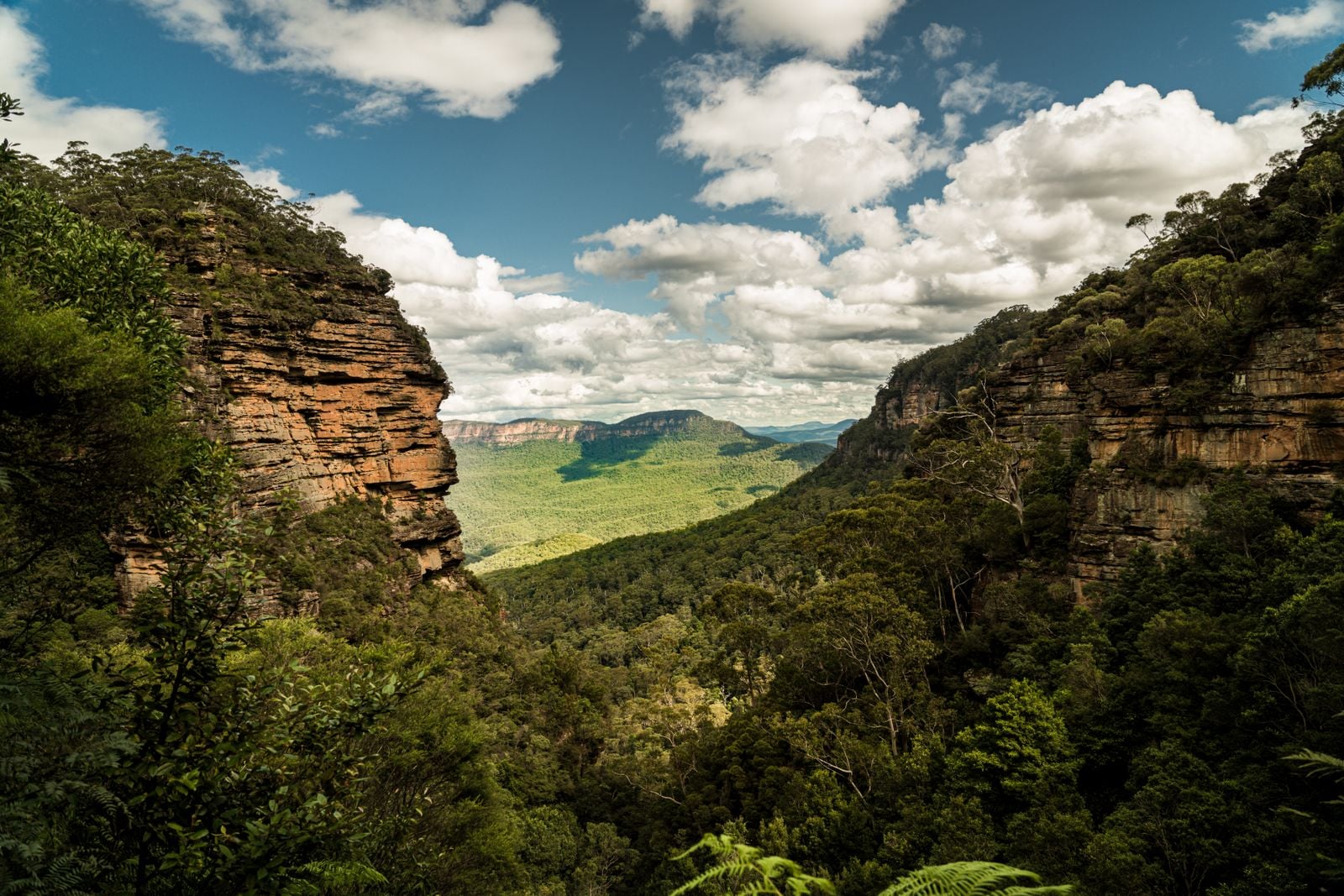
In September 1994, David Noble used ropes to enter a remote sandstone gorge in Wollemi National Park, northwest of Sydney. Noble, an off-duty officer with the New South Wales National Parks and Wildlife Service, was exploring the canyon when he noticed a group of trees he did not recognise. They had dark, knobbled bark, long flattened leaves and multiple trunks rising from their bases. Noble took a fallen piece of foliage back for identification. Within months, botanists understood that the canyon held something more consequential than an unusual local pine: it was a living species in a genus unknown anywhere else on Earth, closely matching plant remains that had disappeared from the fossil record millions of years ago.
Nineteen trees in an unnamed gorge
The first documented stand contained 19 mature trees. The location was difficult to reach, which partly explained why the grove had escaped scientific notice despite lying only about 150 kilometres from Australia’s largest city. The current Australian national recovery plan records that Noble found the stand while canyoning off duty, not during a formal botanical survey. The specimen did not fit comfortably within any known Australian tree genus. Wyn Jones of the National Parks and Wildlife Service and Ken Hill and Jan Allen of the Royal Botanic Gardens examined its leaves, cones, bark and anatomy. In 1995, they published the formal description of Wollemia nobilis, creating both a new species and a new genus within the conifer family Araucariaceae. The original taxonomic paper in Telopea credited Noble as the finder; the species name nobilis also honours him. Its closest living relatives are araucarians such as the Norfolk Island pine, monkey puzzle tree and kauri. Yet the combination of features was distinct. Wollemi pines can reach around 40 metres, carry male and female cones on the same tree, and repeatedly produce new stems from the base. Their bark develops rounded, corky nodules that are often compared with bubbling chocolate.
What had been “missing” for millions of years
The Wollemi pine is frequently described as a survivor from the age of dinosaurs. That phrase captures the scale of the discovery, but it can blur several different timescales. The Araucariaceae family extends back more than 200 million years. Fossil pollen associated with Wollemia has been found in deposits ranging from roughly 94 million to two million years old. The Botanic Gardens of Sydney places the youngest fossil record at about two million years ago. After that point, the trace vanished, encouraging the assumption that this branch of the family had died out. That does not mean the individual trees in the canyon are millions of years old, or that the modern species has remained genetically frozen since the Cretaceous. Fossils preserve selected structures, pollen and impressions, not an entire genome. “Living fossil” is a useful description for a surviving lineage with a close resemblance to ancient forms, not a claim that evolution stopped. The discovery also illustrates a limit of the fossil record. A tiny population confined to sheltered gullies may leave no recognisable remains for an immense span of time. The absence of younger fossils showed that paleontologists had stopped detecting the lineage. It did not show that the last living tree had died.
A discovery immediately became a protection problem
Finding the tree did not make it safe. The 2025 recovery plan describes one wild population spread across four small stands, with only 45 mature individuals and 46 seedlings. Counting is complicated because a single genetic individual can produce many trunks through coppicing. Whatever definition is used, the entire natural population occupies an exceptionally restricted area. Authorities have therefore withheld the precise location. This is not theatrical secrecy. Boots can carry soil-borne Phytophthora pathogens capable of causing root rot and dieback. Unauthorised visitors can trample seedlings, compact soil and introduce weeds. The federal threatened-species profile also identifies severe fire, drought and a changing climate as major risks. The vulnerability became visible during Australia’s 2019 to 2020 fire season, when fire entered the Wollemi landscape and threatened the wild stands. Fire crews and conservation staff used a closely guarded operation to reduce the intensity around the canyon. The trees survived, but the event demonstrated how one regional disaster could place nearly every wild individual at risk at once. Related: Psychology says the most dangerous form of loneliness isn’t being alone. It’s being surrounded by people while performing a version of yourself that none of them would recognize if they saw you at home on a Sunday afternoon.
Conservation by making the rare tree less rare
The response to that concentration risk was unusual. Rather than treating every propagated plant as a secret, botanists learned how to grow the species and distributed it widely. A commercial release began in 2005. Cultivated Wollemi pines went to public gardens and private growers, creating a large population outside the original canyon while reducing the incentive to steal material from wild trees. Propagation alone was not enough, because thousands of plants descended from a narrow set of cuttings can still represent little genetic variety. More sensitive chloroplast sequencing later detected three small but distinct genetic groups within the population. Conservation teams can now balance those lineages in seed banks, translocated populations and living collections. That work has expanded into an international safety net. Botanic Gardens of Sydney has sent carefully selected sets of six trees to dozens of institutions, so each collection contains representatives of the known diversity rather than six interchangeable clones. Its global conservation programme treats the gardens as one distributed “meta-collection.” A pathogen, fire or institutional failure in one location cannot erase the whole backup. The wild population remains critically endangered. Cultivated trees do not replace the canyon ecosystem, its soils, fungi, hydrology or evolutionary pressures. They provide insurance and material for research, restoration and possible future reintroductions.
The find changed more than a species list
Thirty years after Noble entered the gorge, the discovery has become a model for conserving plants with extremely small populations. New translocated stands have been established away from the original site. Seeds and tissues are stored under controlled conditions. The latest NSW programme includes genetically representative plantings intended to become a future source of seed, as described in the state’s 30th-anniversary account of the discovery. The Wollemi pine story is sometimes told as though a prehistoric tree stepped directly out of a fossil slab. The reality is better. A small lineage persisted through enormous climatic change in a set of sheltered Australian canyons. Science had lost sight of it, then one ranger noticed that an ordinary-looking patch of rainforest contained trees that did not belong on any modern field guide. Noble’s descent did not bring an extinct species back to life. It revealed that extinction had been inferred from an incomplete record, while a few dozen survivors continued growing beyond the edge of scientific attention.