
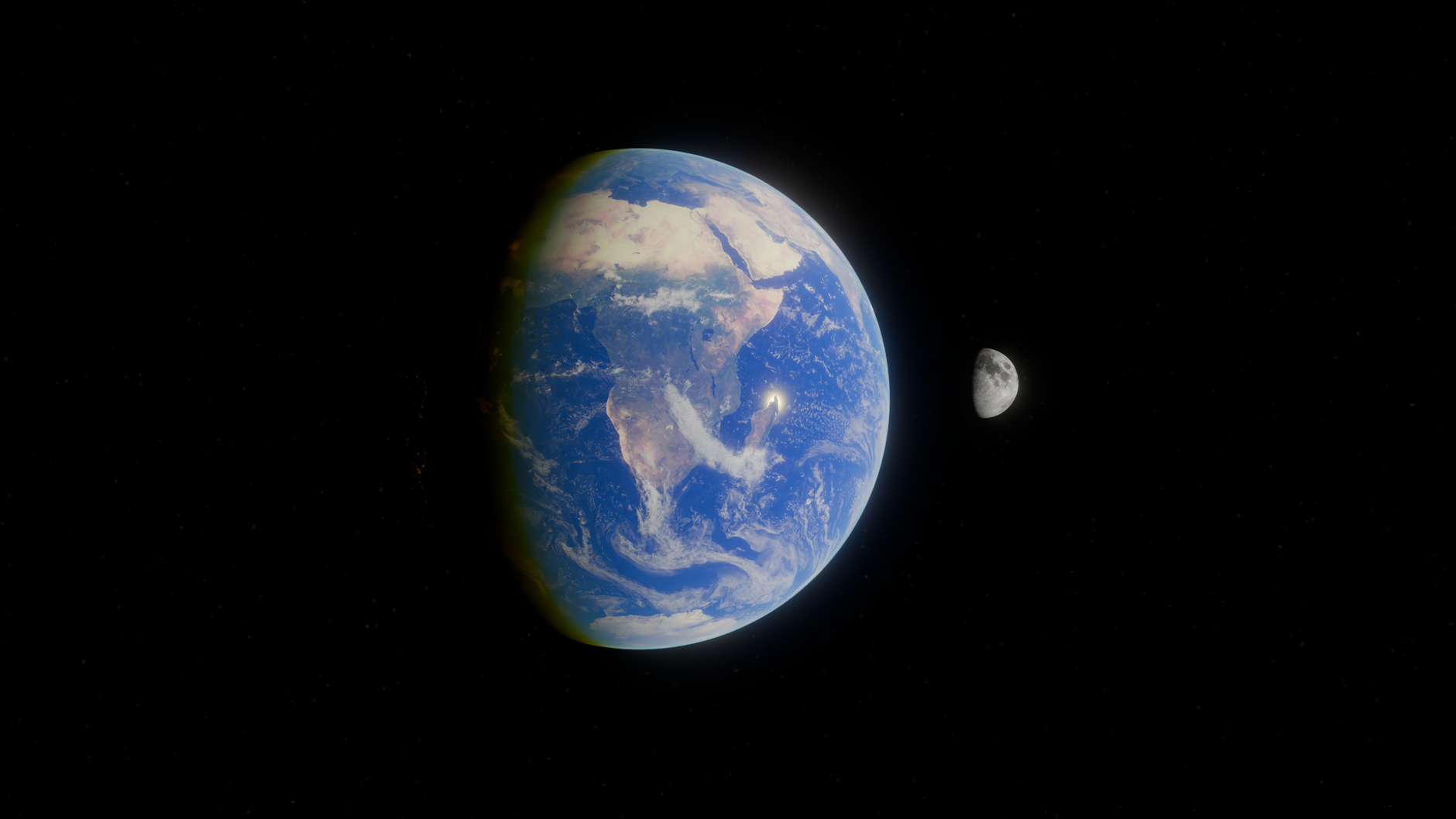
On 1 April 2026, Artemis II lifted off from Kennedy Space Center with four people aboard Orion, beginning the first crewed lunar mission since Apollo 17 in 1972.
By 6 April, the mission had moved beyond the familiar scale of low Earth orbit. NASA astronauts Reid Wiseman, Victor Glover and Christina Koch, along with Canadian Space Agency astronaut Jeremy Hansen, looped around the Moon and travelled farther from Earth than any humans before them.
The distance record is the kind of fact that travels easily. It is clean, countable and dramatic without needing much explanation. But the more interesting part of Artemis II may be quieter. The mission returned a human gaze to a view that had been mostly absent for more than half a century: Earth seen not as territory, weather, politics and borders, but as a small, lit world suspended in blackness.
NASA describes Artemis II as the first crewed flight of the Artemis programme and a test mission for Orion, the Space Launch System and the procedures needed before later lunar surface missions. The agency’s mission page lists the flight as lasting 9 days, 1 hour and 32 minutes, with launch on 1 April 2026 and splashdown on 10 April.
That technical framing matters. Artemis II was not a landing. It did not repeat Apollo by putting boots on the Moon. It was a crewed lunar flyby, designed to test the spacecraft, crew operations, communications, navigation and life-support systems that will matter if humans are to work beyond Earth orbit again in a sustained way.
The crew that went back around the Moon
The crew itself carried several firsts, though the mission is best understood as more than a list of milestones. Wiseman commanded the flight. Glover served as pilot. Koch and Hansen flew as mission specialists, with Hansen becoming the first Canadian assigned to a mission around the Moon.
NASA’s crew profile placed the four astronauts inside a broader programme of preparation rather than personal mythology. They were not sent to perform a symbolic loop for its own sake. They were sent to test what happens when a modern crew lives inside Orion while the spacecraft leaves Earth, circles the Moon and returns at lunar re-entry speeds.
That is why the mission sits in an interesting place between engineering and memory. On one level, Artemis II was a systems test, full of procedures, checkouts and data. On another, it reopened a human perspective that had belonged to a very small group of Apollo astronauts.
For most of the space age, humans have seen Earth from low orbit. That view is still extraordinary, but it is close enough for continents, coastlines, storms and city lights to remain recognisable as geography. From lunar distance, the frame changes. Earth becomes a whole object. It is no longer the surface beneath a spacecraft. It is the thing everyone came from.
What happened on 6 April
On 6 April 2026, Artemis II passed the previous human distance record set by Apollo 13 and reached its greatest separation from Earth during the lunar flyby. Reports at the time placed the maximum distance at about 252,756 miles, or roughly 406,771 kilometres, from Earth.
That figure has an odd emotional quality. It is large enough to feel abstract, yet small enough to make Earth seem suddenly exposed. The astronauts were not crossing interplanetary space. They were still in Earth’s neighbourhood, still bound to a return path home. Even so, they were far enough away for the planet to lose its ordinary visual dominance.
The record also carries a strange historical echo. Apollo 13 set the earlier distance mark during a mission remembered not for its original plan, but for the failure that forced its crew to use the Moon as part of a route home. Artemis II surpassed that distance under very different circumstances, as part of a planned test flight, but the comparison is a reminder that deep-space human missions are never only about reach. They are also about margin, recovery and the ability to return.
Spaceflight language often leans toward conquest. The deeper lesson of missions like Artemis II is less tidy. To go farther from Earth is also to become more dependent on it. Every litre of water, every breathable atmosphere, every system that separates crew from vacuum becomes a small argument against bravado.
The image that changed the frame
NASA’s Earth Observatory later published an image of Earth seen from Artemis II, taken during the mission. It showed the planet under moonlight, with city lights visible and auroras near both poles. The details are interesting scientifically, but the image also belongs to a longer tradition of spaceflight pictures that disturb the scale of human concern.
Photographs of Earth from space have never been neutral. They do not tell people what policy to support or what kind of life to live. They do something subtler. They make the planet visible as a single physical reality, not as the set of divisions people usually inhabit.
The Apollo 8 Earthrise photograph did that in 1968. The Blue Marble image did it in 1972. Artemis II arrived in a different media environment, one saturated with images and far less easily surprised. Yet the basic force of the view remains difficult to exhaust. Earth is not large in the frame. It is not guaranteed by the surrounding darkness. It appears held together by atmosphere, distance and luck.
That is why astronauts have so often spoken of a shift in perception after seeing Earth from orbit or beyond. The so-called overview effect should not be treated as a simple cure for human division. Some astronauts describe it in spiritual language, others in ecological or practical terms, and not everyone experiences it in the same way. But the recurring pattern is real enough to notice: from space, Earth often stops looking like a backdrop and starts looking like a shared condition.
The old astronaut perspective returns
Artemis II did not need to invent this perspective. It inherited it. The mission’s significance is that it brought the view back into living human experience after a long gap.
Since Apollo 17 returned in December 1972, no human being had flown around the Moon until Artemis II. Robotic spacecraft have done extraordinary work in that time, often with more precision and endurance than people could manage. But there is still a difference between an instrument recording a view and a person looking out of a window, knowing that everyone they have ever met is behind them on one bright object.
That difference is not an argument against robotic exploration. It is an argument for being precise about what human spaceflight adds. Humans are expensive, fragile and difficult to keep alive beyond Earth. They also carry memory, language, fear, judgement and attention. When they return, they do not only bring data. They bring descriptions.
Some of those descriptions can become overused. Fragility is an easy word to repeat until it loses force. But in the context of Artemis II, the word earns its place because the mission itself made the contrast visible. The crew travelled inside a machine built with decades of engineering, yet the thing that mattered most in the window was not the machine. It was the small world the machine had briefly left.
Why the mission matters beyond the record
NASA has positioned Artemis II as a step toward later missions that could return astronauts to the lunar surface and eventually support longer-duration work around and beyond the Moon. That programme will involve budgets, politics, industrial contracts, international partnerships and difficult technical questions. A single flight does not settle any of that.
But Artemis II did settle one narrower question: whether a crewed Orion mission could leave Earth, fly around the Moon and come home. That is not a small thing. It makes later ambitions less theoretical, while still leaving many of the hardest problems ahead.
The mission also arrived at a time when Earth itself is under intense observation from satellites, climate instruments and scientific networks. In that sense, Artemis II’s Earthward view sits beside a larger body of work rather than above it. The distant image is emotionally clarifying, but the close measurements are what describe the planet’s changing systems in detail.
There is a useful tension there. The far view can make Earth feel singular. The scientific view shows how varied, stressed and dynamic it is. One view gives scale. The other gives evidence. Neither is enough alone.
The fragile thing in the window
When the Artemis II crew came home, they returned from a mission that was both new and old. New, because it belonged to a modern programme with modern spacecraft, modern safety expectations and a different geopolitical setting from Apollo. Old, because the emotional centre of the flight was recognisable from the first era of lunar travel.
Four people left Earth, passed around the Moon and looked back. They went farther than any human crew before them, but the distance mostly sharpened the meaning of the place they had left.
That may be the enduring value of this kind of mission. It expands the map, but it also compresses the moral scale of home. From far enough away, Earth does not look like a platform for human ambition. It looks like the one place that has carried every human ambition so far.
Artemis II was a test flight, and it should be judged partly on those terms. Yet its public meaning will probably rest on something less technical: the return of a human voice from lunar distance saying, in effect, that the farther away Earth gets, the more singular it becomes.
