
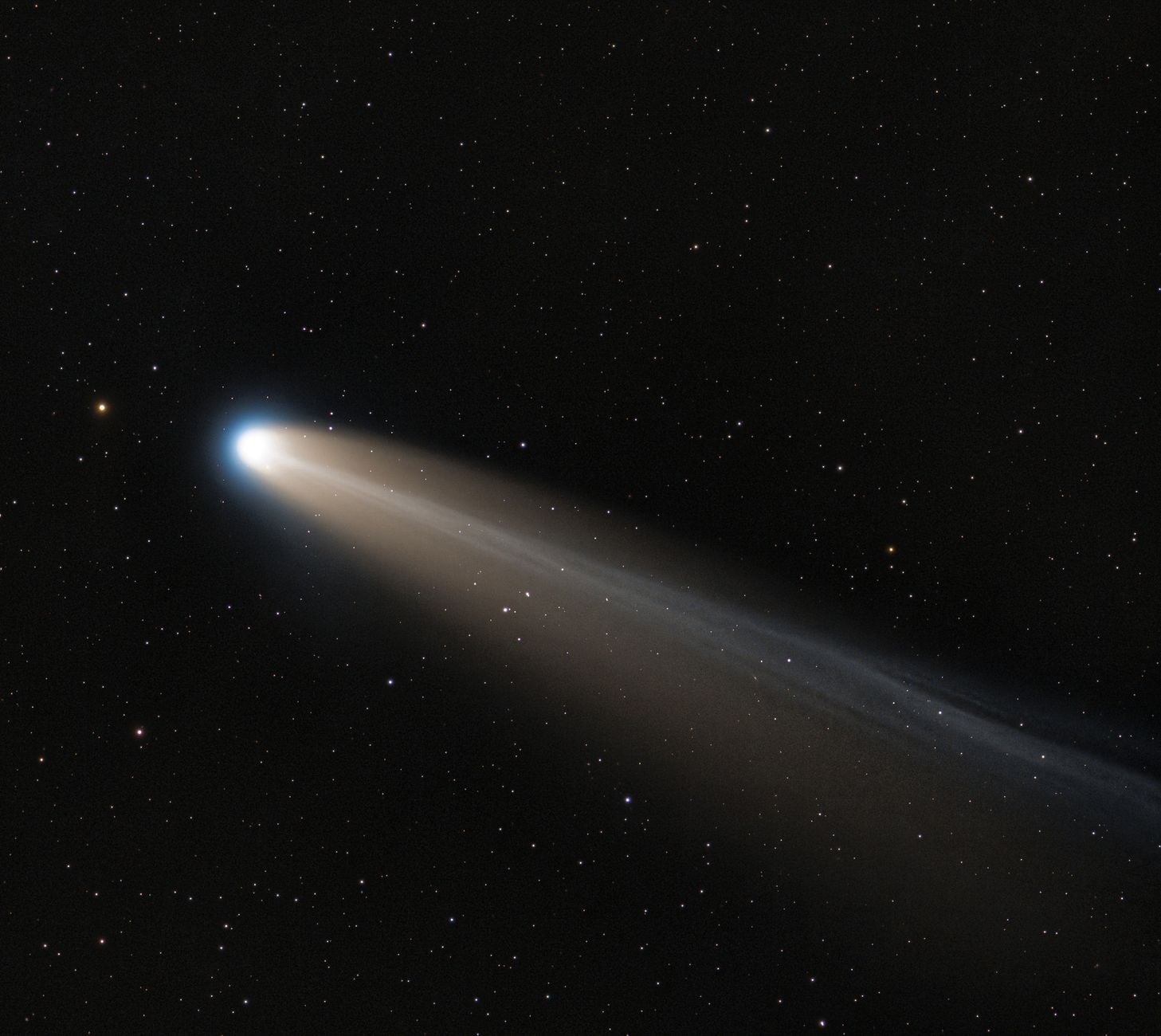
An interstellar comet that passed through the Solar System last year did not come from here, and new measurements of what it is made of suggest it did not form anywhere recent either. The chemistry of 3I/ATLAS, published this week in Nature, points to a birthplace that was cold, distant, and old enough to predate the Sun by billions of years.
It is a strong result, drawn from a rare chance. It is also a reading of a single object, caught once, on a brief pass through our neighbourhood, and the age is an estimate rather than a measurement.
A visitor from outside
3I/ATLAS is the third confirmed interstellar object, after 1I/’Oumuamua in 2017 and the comet 2I/Borisov in 2019. It was found in July 2025 by ATLAS, the NASA-funded survey that lends it its name, and it rounded the Sun late in the year. As it warmed and its ancient ice turned to gas, telescopes had a window to read its composition before it headed back out for good.
It behaves, in the ways that matter, like a comet, a body of ice and dust throwing off a coma of gas. What sets it apart is not how it moves but what that gas is made of.
What the isotopes show
A team led by Martin Cordiner of NASA’s Goddard Space Flight Center used the Near-Infrared Spectrograph on the James Webb Space Telescope to measure the comet’s ices. Two signatures stood out.
The first is hydrogen. The comet’s water is heavy with deuterium, a weightier form of hydrogen, at roughly thirty times the level seen in Solar System comets. That kind of enrichment forms only in extreme cold, below about thirty degrees above absolute zero, and it survives only if the ice is never warmed enough to be reworked.
The second is carbon. The comet carries very little carbon-13 relative to ordinary carbon-12, again unlike comets from our own system. A separate study, using the European Southern Observatory’s Very Large Telescope and led by Cyrielle Opitom of the University of Edinburgh, found the same carbon pattern and an unusual nitrogen ratio as well, measured through the comet’s cyanide.
Why that points to great age
The carbon is the clock. Galaxies build up carbon-13 slowly, as generations of stars are born and die, so a body made with very little of it most likely formed early, before that enrichment had gone far. Our own Sun, which formed about 4.5 billion years ago, carries more.
Put the carbon and the deep cold together and the picture is of something ancient. The Webb team estimates that 3I/ATLAS may have formed 10 to 12 billion years ago, in a dense, frozen, metal-poor cloud in the early galaxy. That fits a separate line of evidence drawn from its path. The steep, fast trajectory it arrived on traces back to the Milky Way’s thick disc, a population of stars far older than the Sun, as a team led by Matthew Hopkins at Oxford argued soon after the comet was found.
How firm this is
It is worth keeping the limits in view. This is one object, measured during a single brief passage, and some of the ratios carry wide uncertainties, the nitrogen value especially. The age is inferred from chemistry and trajectory, not read off a dial, which is why the careful phrasing is that the comet may be this old, not that it is.
The carbon and hydrogen signatures, though, are clear enough that the researchers are confident of the broad conclusion. 3I/ATLAS formed somewhere very cold, very old, and chemically unlike our own system. For once, that is not an inference about a distant star drawn from its light. It is a direct sample of material from another planetary system, brought close enough to read.
What to watch
Most of the comet is already past, but the data are not exhausted, and more analysis of the Webb and ground-based observations will follow. The larger question, of how common or rare such ancient, unfamiliar chemistry is, cannot be answered by one visitor.
That is where the next few years matter. The Vera Rubin Observatory, now opening its survey of the southern sky, is expected to turn up interstellar objects far more often than the once-every-few-years rate of the past decade. A single sample is a curiosity. A catalogue of them would be a way to start asking what the chemistry of other planetary systems is actually like.
