
In July 1054, court astronomers in China recorded a new “guest star” near Tianguan, the star we now call Zeta Tauri. It was bright enough to be seen in daylight. For nearly a month it remained visible against the daytime sky, then lingered at night long after the first shock of its appearance had passed.
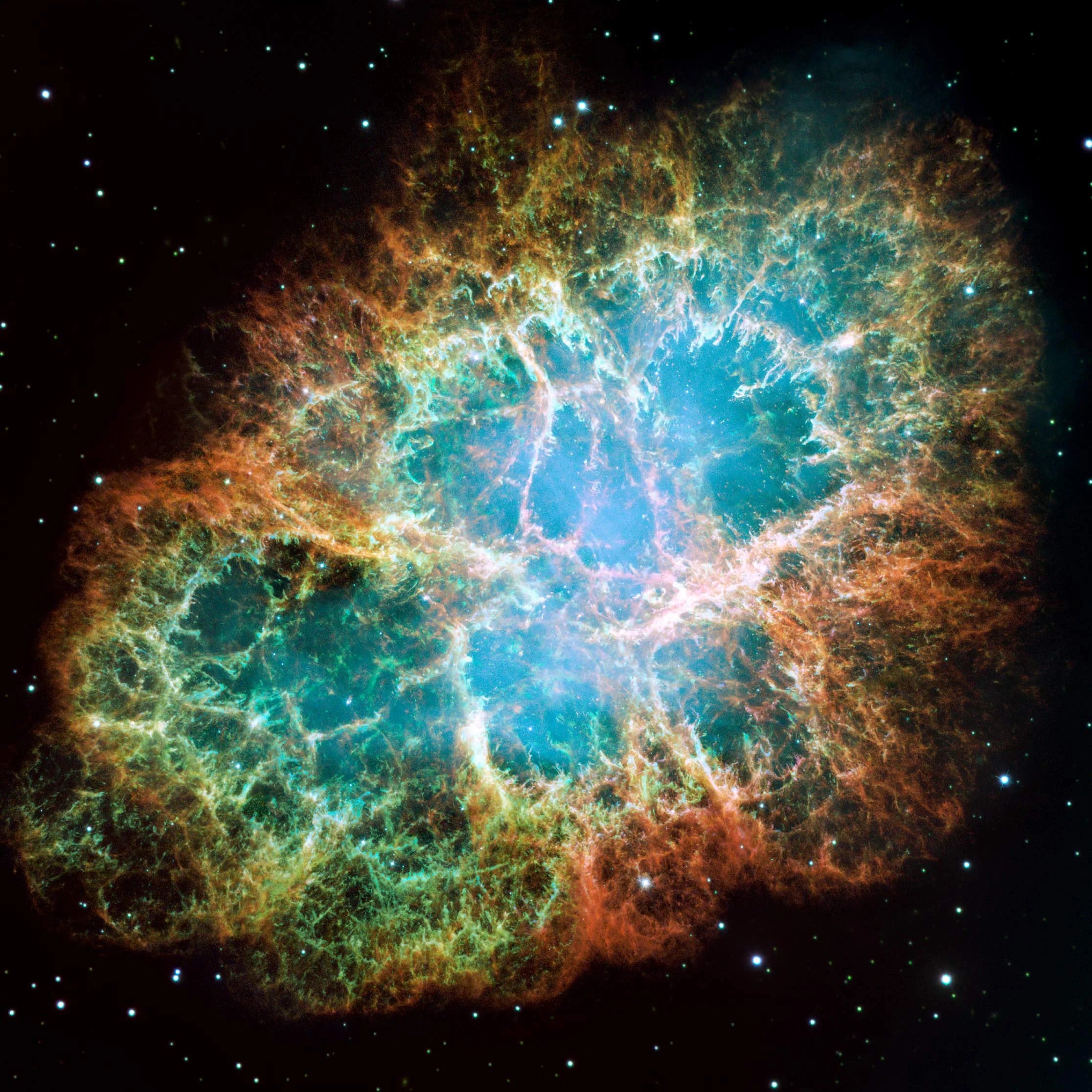
Nearly a thousand years later, the object left behind by that explosion is still changing quickly enough for a human-built telescope to measure. In a recent Astrophysical Journal paper, William P. Blair of Johns Hopkins University and colleagues compared new Hubble Space Telescope observations of the Crab Nebula with Hubble images taken in 1999 and 2000. Comparing those frames with new Hubble observations about 24 years later, the remnant’s filaments have shifted outward, turning a medieval record into a moving object on modern detectors.
The careful version is important. Hubble has not watched the whole thousand years unfold. It has done something more modest and more precise: it has returned to the same remnant after a quarter century with enough resolution to measure changes in an object whose origin was recorded by human sky-watchers almost a millennium ago.
The star that became Messier 1
The Crab Nebula sits about 6,500 light-years away in Taurus. NASA’s Hubble Messier catalogue lists it as Messier 1, a supernova remnant with an apparent magnitude of 8.4, too faint for unaided eyes today but reachable with a small telescope under good conditions.
Its history is unusually human. The supernova itself was seen in 1054. The nebula was later discovered telescopically by John Bevis in 1731, then observed by Charles Messier while he was hunting for comets. Messier mistook it for a comet-like object, and the confusion helped lead to his catalogue of objects that could mislead comet hunters. The first entry in that catalogue is the remnant of a star that had already died long before the telescope existed.
The modern identification of the Crab as the remnant of SN 1054 came through motion. Early twentieth-century astronomers noticed that the nebula was changing. By tracing its expansion backward, they connected the cloud to the historical guest star. The Crab became one of astronomy’s cleanest links between a recorded sky event and the physical debris still visible today.
What Hubble measured
Blair and colleagues re-observed the Crab in Hubble Cycle 31 using the Wide Field Camera 3. Their filters were chosen to match, as closely as practical, the earlier Hubble mosaic made with the older Wide Field and Planetary Camera 2 in 1999 and 2000. That comparison was the point. A single beautiful image can show structure. Two well-matched images, separated by decades, can show motion.
The paper notes that many of the Crab’s outer filaments show proper motions of 0.3 arcseconds per year or more. That number looks small because the object is 6,500 light-years away. Physically, it means the debris is still racing outward. NASA’s public Hubble coverage of the comparison put the outward motion of the gas filaments at about 3.4 million miles per hour, or roughly 5.5 million kilometres per hour.
The Crab is not expanding as a simple frozen shell from a single blast. Its centre contains the Crab Pulsar, a rapidly rotating neutron star, the collapsed core left behind by the supernova. NASA describes the pulsar as rotating about 30 times per second. Electrons moving through the pulsar’s magnetic field produce the blue synchrotron glow inside the nebula, while older stellar debris forms the filamentary shell around it.
That pulsar matters because it continues to feed energy into the nebula. Older expansion studies have found that the Crab’s synchrotron nebula and optical filaments have been accelerated since the 1054 explosion, with the synchrotron component expanding more strongly. The remnant is therefore not just coasting passively from an ancient event. The dead star at its centre is still helping shape the cloud around it.
Why a 25-year gap matters
Astronomy often works on timescales that make human life feel brief. Galaxies collide over hundreds of millions of years. Stars spend most of their lives changing too slowly for one generation to watch. The Crab Nebula is different. It is young by astronomical standards, energetic, nearby enough for detailed study and bright across many wavelengths.
That makes it a rare laboratory for watching the aftermath of a supernova as a continuing process. The 2025 Blair paper compares the new Hubble data not only with the earlier Hubble optical mosaic but also with more recent near- and mid-infrared imagery from the James Webb Space Telescope. The goal is not simply to make a sharper picture. It is to understand which structures are gas, which are synchrotron emission, which are dust-rich filaments and how these pieces relate to the pulsar wind pushing outward from the core.
The new Hubble work also reports two previously unrecognised groupings of filaments with similar emission characteristics, almost opposite each other relative to the pulsar. The authors are careful about their origin. The structures are identified, not fully explained. That is the right level of certainty for a remnant whose shape records both the original explosion and centuries of later energy injection from the pulsar.
A thousand-year event that is still not over
The phrase “supernova of 1054” can make the event sound complete, as if the explosion happened, faded, and entered history. The Crab Nebula argues otherwise. The visible guest star was the beginning of what people could record from Earth, not the end of the physical story.
The original star had already exploded thousands of years before its light reached Earth in the eleventh century. The medieval observations marked the arrival of that light here. Since then, the debris has continued to expand, the pulsar has continued to spin down, and the nebula has continued to be reshaped by high-energy particles and magnetic fields.
That is what makes the latest Hubble comparison so direct. The same object that briefly interrupted the daytime sky for people living under the Song dynasty can now be measured as a cloud changing shape across a span shorter than a mortgage. The human record and the telescope record meet in the same remnant.
The Crab Nebula is not just a fossil of a dead star. It is a thousand-year-old explosion with enough motion left in it for Hubble to see the difference.
Sources
- William P. Blair et al., “The Crab Nebula Revisited Using HST/WFC3,” The Astrophysical Journal
- arXiv record for “The Crab Nebula Revisited Using HST/WFC3”
- NASA Science: Messier 1, the Crab Nebula
- Michael F. Bietenholz and Richard L. Nugent, “New expansion rate measurements of the Crab Nebula in radio and optical”
- Tea Temim et al., “Dissecting the Crab Nebula with JWST”