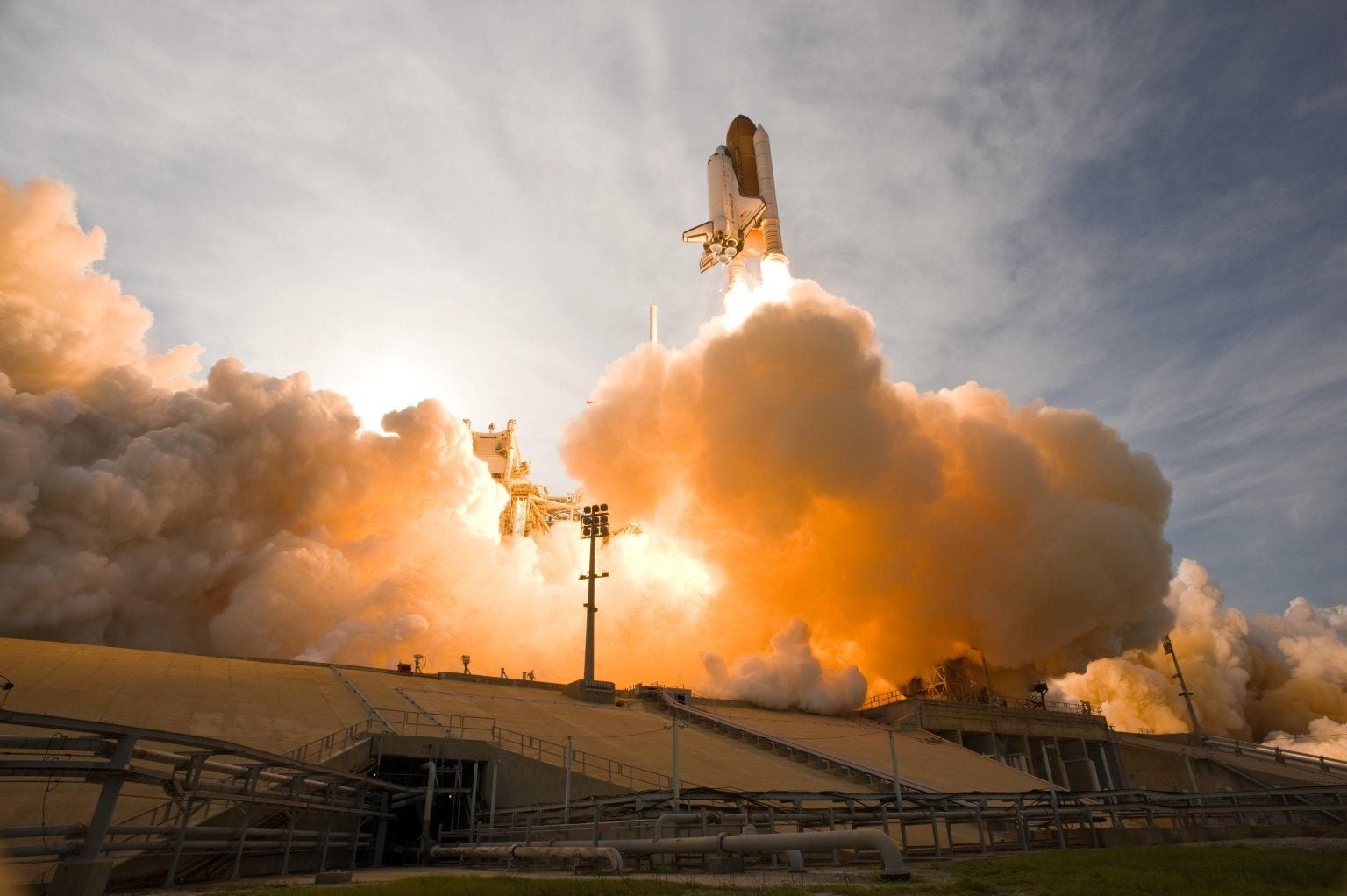
On 12 April 1981, the Space Shuttle Columbia lifted off on its very first flight, and by the time it landed two days later, engineers found sixteen thermal protection tiles missing from its underside and another 148 damaged. Nothing had gone wrong with the engines, the boosters, or the flight itself. The damage had happened in the first few seconds, before Columbia had even cleared the tower, and the cause turned out to be the shockwave from its own ignition, reflecting straight back off the launch pad and into the vehicle.
I hadn’t really thought about a rocket launch as something a rocket has to survive as much as perform, until I started reading into what actually happens in the first ninety seconds after liftoff. Two of the more dangerous moments in that window have nothing to do with the destination. They’re both about the rocket coping with forces it’s generating entirely by itself.
A problem with no obvious villain
The Columbia damage came from what engineers call an overpressure event. A rocket engine at full thrust produces enormous acoustic energy, and on the ground, with nowhere else to go, a meaningful fraction of that energy bounces straight back up off the concrete and into the vehicle sitting right above it. Nobody had modelled quite how severe that reflected wave would be for a vehicle of the Shuttle’s size, and Columbia found out the hard way. NASA’s fix, refined for every crewed launch from the pad since, wasn’t to make the engines quieter. It was to put something in the way of the reflection before it could build.
That something is water. Fine droplets absorb acoustic energy efficiently, and when the energy hits them, they flash to steam, carrying a portion of that energy away as a change of state rather than a pressure wave. The white cloud that billows out from under a big rocket at ignition, which most people assume is smoke or exhaust, is mostly steam from exactly this process.
How much water we’re talking about
For NASA’s Space Launch System, the numbers involved are genuinely startling. During liftoff, roughly 400,000 gallons of water rush onto the pad at Kennedy Space Center’s Launch Complex 39B, released in under thirty seconds through nozzles positioned directly beneath the boosters and engines. To put that pace in perspective, an Olympic swimming pool holds about 660,000 gallons, so this is more than half of one, released in well under a minute. None of it is there to put out a fire. Its entire job is to be in the right place, in liquid form, at the exact moment the ignition shockwave arrives.
This isn’t a new idea bolted onto a new rocket. It’s the direct descendant of the fix that came out of Columbia’s damaged tiles: the original Shuttle-era Sound Suppression Water System released around 300,000 gallons from a dedicated water tower beginning seconds before engine start, and it worked well enough that the overpressure damage never recurred across the rest of the Shuttle program. The scale has grown because the vehicles have, but the underlying idea, put water where the shockwave is about to be, hasn’t changed in more than four decades.
The second danger, a few dozen seconds later
Surviving ignition doesn’t mean the rocket is out of the woods. About sixty to ninety seconds into most launches, a rocket passes through a moment called max Q, short for maximum dynamic pressure, and it’s arguably the most structurally demanding point in the entire flight.
Dynamic pressure is a straightforward idea once you see the two things pulling against each other. Right at liftoff, the air is at its densest, but the rocket is barely moving, so the aerodynamic force on it is low. As the rocket climbs, the air thins out, which would lower that force, except the rocket is also accelerating hard, and force from moving air rises with the square of speed. For a while, the rocket’s increasing speed outpaces the thinning air, and the aerodynamic load climbs. Somewhere around ten to fourteen kilometres up, travelling at roughly Mach 1 to 2, those two effects cross over, the thinning air finally wins, and the load starts falling even as the rocket keeps accelerating. That crossover point, the single worst moment for aerodynamic stress on the airframe, is max Q.
Because the vehicle is briefly at its structural limit, many rockets, Falcon 9 among them, deliberately throttle their engines down as they approach max Q, then throttle back up once they’re through it, a dip in the thrust profile sometimes called the throttle bucket. It’s a strange thing to picture: the moment a rocket is trying hardest to get away from the ground is also a moment when part of the plan is to briefly want less thrust, not more.
Two problems, the same shape
What I like about putting these two moments next to each other is that neither one is caused by anything external. There’s no bad weather, no mechanical fault, no unlucky bird strike. One is the rocket’s own ignition noise, with nowhere to go but back at the vehicle that made it. The other is the rocket’s own speed, briefly outrunning the atmosphere’s willingness to get out of the way gracefully. Both problems exist purely because the rocket is doing exactly what it’s supposed to be doing, just doing it in a physical world that pushes back.
What I’d watch for next time
Next time I watch a launch, I don’t think I’ll be able to un-notice these two windows. The first arrives in the opening seconds, hidden inside that huge white cloud at the base of the pad. The second arrives roughly a minute later, usually announced by a commentator saying some version of “go for throttle up,” a phrase that only makes sense once you know the engines had to throttle down first. Neither one is about reaching orbit. Both are simply about making it far enough to start trying.