

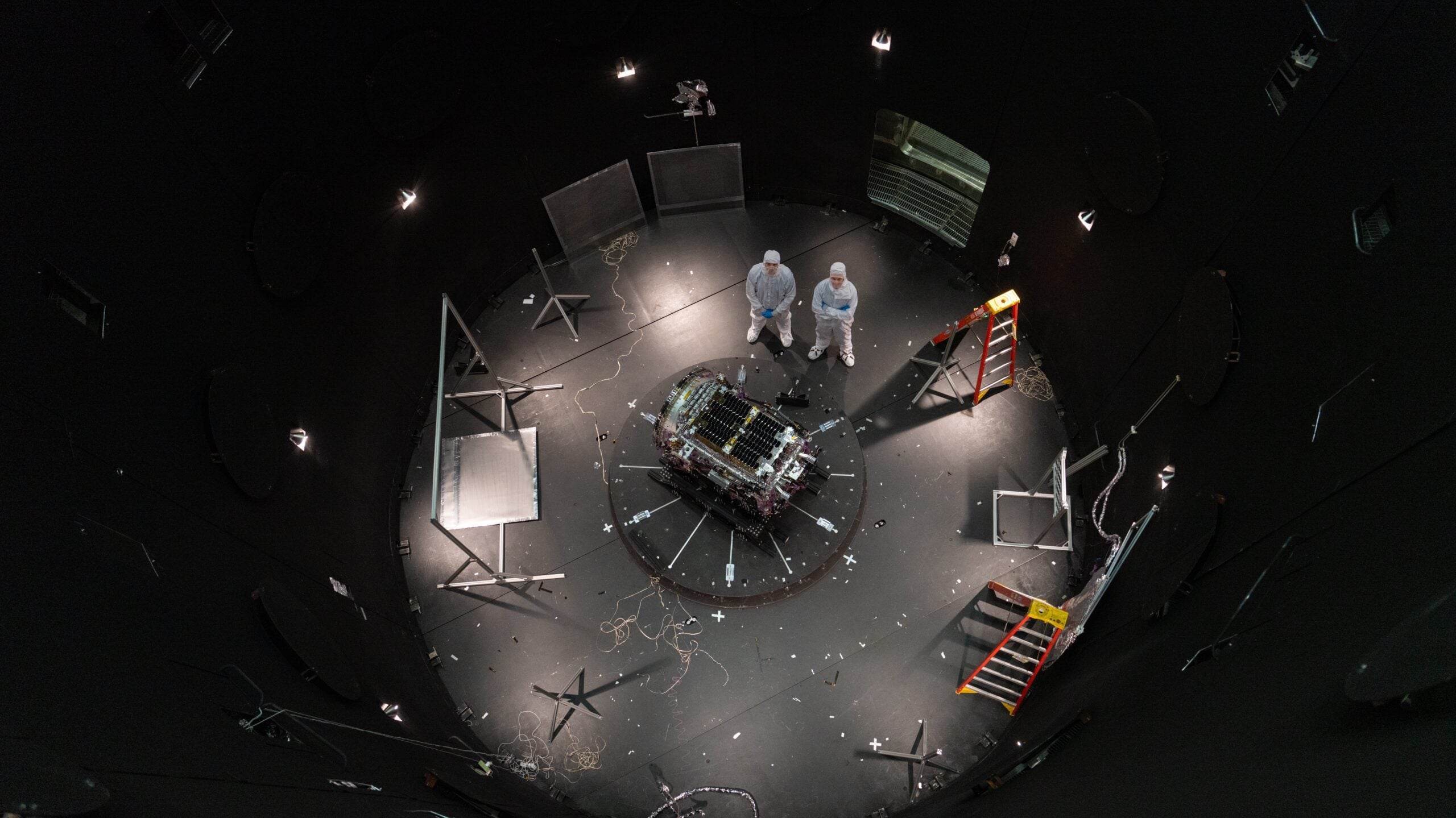
The rescue craft reached orbit. It survived a serious loss of control. Engineers even slowed its spin and rewrote part of its flight software from the ground. But the mission’s decisive act, taking hold of another spacecraft travelling at orbital speed, demanded a degree of stability that the recovering vehicle could no longer guarantee.
The $30 million attempt to save the Neil Gehrels Swift Observatory has ended without raising its orbit. NASA and Katalyst Space abandoned capture because of LINK’s continuing attitude-control problem. NASA formally concluded its involvement on 3 September, and LINK re-entered Earth’s atmosphere on 25 September.
The decision leaves an unusual split verdict. The servicing mission fell short of its central objective, yet the observatory it was sent to rescue remains scientifically useful after nearly 22 years in space. NASA restarted two of Swift’s three instruments on 26 August, beginning what is likely to be the telescope’s final observing period while the thin upper atmosphere steadily takes away its remaining altitude.
A rescue assembled against the clock
Swift was never designed to be refuelled, repaired or boosted after launch. It has no docking port and no propulsion system capable of restoring its orbit. When it lifted off in November 2004, the observatory entered a low Earth orbit and began a mission expected to last two years. It ultimately worked for more than ten times that long.
Every spacecraft in low Earth orbit encounters traces of the atmosphere. The gas is extremely sparse at those heights, but a satellite crossing it thousands of times accumulates drag. Without periodic propulsion, its orbit slowly shrinks. Solar activity made Swift’s problem urgent by heating and expanding the upper atmosphere, increasing the amount of gas through which the observatory travelled.
By January 2025, nearly all of NASA’s models indicated that Swift could re-enter by the summer of 2026. The agency first funded two short commercial studies, then awarded Katalyst Space a $30 million contract in September 2025. That left the small Arizona company less than a year to design, build, test and launch a spacecraft capable of meeting a target that had never been prepared for servicing.
As SpaceDaily reported before launch, the schedule was extraordinary. This was not a routine maintenance call with a mature vehicle. It was a deliberately risk-tolerant demonstration assembled while the orbit of its intended client kept falling.
How LINK was supposed to save Swift
LINK is an approximately 880-pound, or 400-kilogram, robotic spacecraft. Its hardware includes three ion thrusters, three robotic arms and solar arrays spanning about 20 feet when deployed. The mission plan called for it to rendezvous with Swift, match the telescope’s motion, establish a secure hold and use its efficient electric propulsion to lift the joined spacecraft over a period of months.
The target was a higher orbit of roughly 370 miles, or 600 kilometres. At that altitude, atmospheric drag would be far weaker and Swift could potentially have continued operating for years. The mission would also have tested a valuable broader idea: extending the lives of functioning satellites that were never built with docking fixtures.
That last detail made the task especially delicate. LINK could not simply insert a probe into a standard port. Its robotic arms had to grip suitable parts of Swift without damaging the telescope, its instruments, its two large solar arrays or the structures needed to keep the spacecraft stable. Once attached, the two vehicles would have become one unwieldy mechanical system whose mass and balance differed from either spacecraft flying alone.
NASA consistently described the effort as high risk and high reward. The phrase matters because the contract was not a promise that a proven servicing system would arrive and perform a familiar manoeuvre. It funded a compressed attempt to create a new one before the target fell too low to reach safely.
A clean launch, then a loss of attitude control
LINK began its mission on 3 July. Northrop Grumman’s Stargazer aircraft carried a Pegasus XL rocket over the Pacific, released it at about 40,000 feet, and the air-launched rocket placed the servicing craft into orbit. Initial commissioning appeared to be progressing, even after engineers corrected an early reaction-wheel issue with software patches.
The more serious failure emerged later in July. LINK lost stable control of its orientation and began rotating on multiple axes at about nine degrees per second. Put very approximately, a steady rotation at that angular rate would complete a turn in 40 seconds, although LINK’s actual motion was a multi-axis tumble rather than one tidy spin.
The tumbling also made communications intermittent. Antennas and solar arrays could not remain pointed as intended, complicating the team’s ability to diagnose the spacecraft and command a recovery. A preliminary assessment reported that two of LINK’s three reaction wheels were inoperable and that some cold-gas-thruster capability had also been lost.
Reaction wheels normally let a spacecraft turn and hold an orientation without continuously expelling propellant. Losing two wheels did not make recovery impossible, but it removed much of the redundancy and control authority the mission had expected to use near Swift.
What engineers managed to recover
The response was substantial. A series of thruster burns first reduced the rotational rate below four degrees per second. Katalyst then used LINK’s electric propulsion system to slow it further. By NASA’s 6 August update, the rate had fallen to 1.47 degrees per second.
Engineers also uploaded flight-software changes that allowed the spacecraft to work with its remaining actuators. On 11 August, NASA said LINK could maintain sufficient control to charge its batteries, communicate with the ground and prepare to continue the mission. That recovery was real. It was not, however, the same as restoring the fully capable and highly predictable attitude-control system assumed in the capture plan.
The distinction can sound narrow from the ground. In orbit it is the difference between keeping a damaged spacecraft alive and authorising it to make physical contact with a valuable telescope.
A servicing vehicle approaching Swift has to control not only its broad direction but also its relative position, closing speed and orientation. The geometry changes continuously as both objects travel around Earth. Near contact, a small unwanted rotation can move the tip of a robotic arm much faster than the centre of the spacecraft. After capture, LINK would also need to arrest any residual motion without twisting Swift or striking one of its appendages.
Why partial control was not enough
NASA has not published a detailed engineering threshold that LINK failed to meet, and it would be misleading to invent one. The agency’s public conclusion is simpler: the ongoing attitude-control issue made capture and boosting unacceptable.
There was little room to treat Swift as expendable. Although its orbit was decaying, it remained a productive scientific asset. A collision, a bad grip or uncontrolled motion after contact could have ended its observations immediately and could have created additional debris. Declining to attempt the grab preserved the time Swift still had.
On 18 August, NASA formally removed capture and boost from LINK’s mission. In its 28 September account, the agency said LINK instead attempted technology demonstrations that included exercising its xenon-powered propulsion system and three robotic arms. NASA’s involvement ended on 3 September, and LINK re-entered on 25 September.
That is a more limited outcome than NASA bought the mission to achieve. It is also more than a total loss of the vehicle. Engineers launched a new servicing craft on an unusually short schedule, diagnosed a multi-axis tumble with sporadic communications and recovered enough authority to contemplate controlled operations. Those lessons have value, but they do not erase the central fact that Swift will not be saved.
Why Swift has mattered for 22 years
Swift is best known for gamma-ray bursts, brief and immensely energetic flashes associated with events such as the collapse of massive stars and the mergers of compact objects. Its strength has never been one instrument alone. It is the sequence the observatory performs after something changes in the high-energy sky.
The wide-field Burst Alert Telescope detects and locates a burst. Swift can then turn quickly so its narrower X-Ray Telescope and Ultraviolet/Optical Telescope can examine the fading afterglow. At the same time, it sends the location to astronomers around the world, allowing other observatories to join the follow-up before the event disappears.
That fast coordination helped make Swift part of the infrastructure of time-domain and multimessenger astronomy. It has also observed black holes, neutron stars, supernovae, stellar flares, comets and other transient or changing targets. A SpaceDaily account of its 20th anniversary described how a revised pointing mode had kept the ageing observatory scientifically effective even after the loss of a gyroscope.
Its longevity also explains why the rescue was attempted. Replacing a working observatory with its particular combination of wide-field detection, rapid autonomous response and multiwavelength follow-up would take far more time and money than lifting the spacecraft already in orbit.
The final observing period has begun
To buy time for LINK, Swift’s operators had sacrificed much of its normal science programme. They placed the telescope in a low-drag orientation in December 2025. The X-ray and ultraviolet/optical telescopes were switched off in February 2026, and the Burst Alert Telescope was paused in April as the team concentrated on preserving altitude.
Once NASA ruled out capture, there was no longer a reason to save every kilometre for a boost that would not happen. The team reactivated the X-Ray Telescope and Ultraviolet/Optical Telescope on 26 August. Engineers were still working to return the Burst Alert Telescope to service when NASA published its 28 August update.
Calling these Swift’s “final observations” is reasonable in the broad sense, but there is no announced final exposure or fixed last day. NASA said the earlier low-drag operations had kept Swift above 300 kilometres until at least October. With science operations resumed and the spacecraft slewing again, the agency expected it to reach that altitude threshold within one or two months.
Below 300 kilometres, operating the observatory becomes harder and the descent accelerates as the atmosphere thickens. Exactly how quickly that happens depends on Swift’s orientation and on upper-atmospheric density, which changes with solar activity. The telescope could lose useful observing capability before it physically re-enters.
Re-entry is a forecast, not an appointment
In its 28 September mission account, NASA said Swift was expected to re-enter by the end of 2026. That is a forecast window rather than a scheduled event. Small changes in atmospheric drag accumulate over thousands of orbits, so the date will remain uncertain until the observatory is much lower.
The location will be even less predictable. Swift circles Earth in roughly the time it takes to watch a feature film, crossing enormous distances while a re-entry estimate can still carry hours of uncertainty. Tracking will narrow the window near the end, but no responsible account can yet say where or exactly when the descent will finish.
NASA and Swift’s partners continue monitoring the observatory, but LINK is no longer in orbit. Swift has returned to the work it was built to do: looking outward while its orbit inexorably brings it home.
What the unsuccessful rescue leaves behind
It is tempting to force the story into one of two simple readings. In one, a daring startup nearly saved a treasured telescope and should be judged by the recovery. In the other, NASA spent $30 million on a mission that did not perform its defining task. Both contain part of the truth, and neither is complete on its own.
The contract accepted unusual technical and schedule risk because waiting for a conventional programme would have guaranteed that Swift fell first. LINK’s failure shows why robotic servicing is difficult, especially when the target was not designed to cooperate. Its partial recovery shows what adaptable flight software, propulsion and ground teams can sometimes retrieve from a damaged spacecraft. Future missions will have to absorb both lessons.
For Swift, the outcome is less ambiguous. The observatory will not receive the orbit it needed. Its instruments have been given back to astronomers for as long as useful pointing and communications remain possible. After a two-year design life became almost 22 years of science, the mission’s closing phase will be measured not by a ceremonial switch-off, but by a thinning margin of altitude and whatever observations the telescope can still return before that margin is gone.