

The strangest part of a naked mole-rat monarchy is not that one female breeds. It is that scores of other females, each carrying the same basic reproductive machinery, usually do not.
A study published in Nature on July 15, 2026 has now identified a chemical that helps the queen preserve that arrangement. Mohammed Khallaf, Daniel Hart, Wenhan Luo and an international team found that breeding queens produce unusually high levels of isopropyl myristate, or IPM. In naked mole-rats, the compound is detected through smell and shifts hormones in a direction that suppresses reproduction in non-breeders.
IPM is also a routine cosmetic ingredient, used as an emollient, solvent and spreading agent in creams and other skincare formulations. The same molecule can therefore sit unnoticed in a bathroom product and function as social information in a subterranean rodent colony. The comparison is chemical only; the work says nothing about human fertility.
This is one study, not settled consensus. Its evidence is stronger than a simple correlation because the researchers added and withdrew the candidate chemical, but its decisive queen-removal test was performed in one captive colony. The result is a tightly observed mechanism with important boundaries, not a universal law established in every colony in the wild.
A monarchy built in darkness
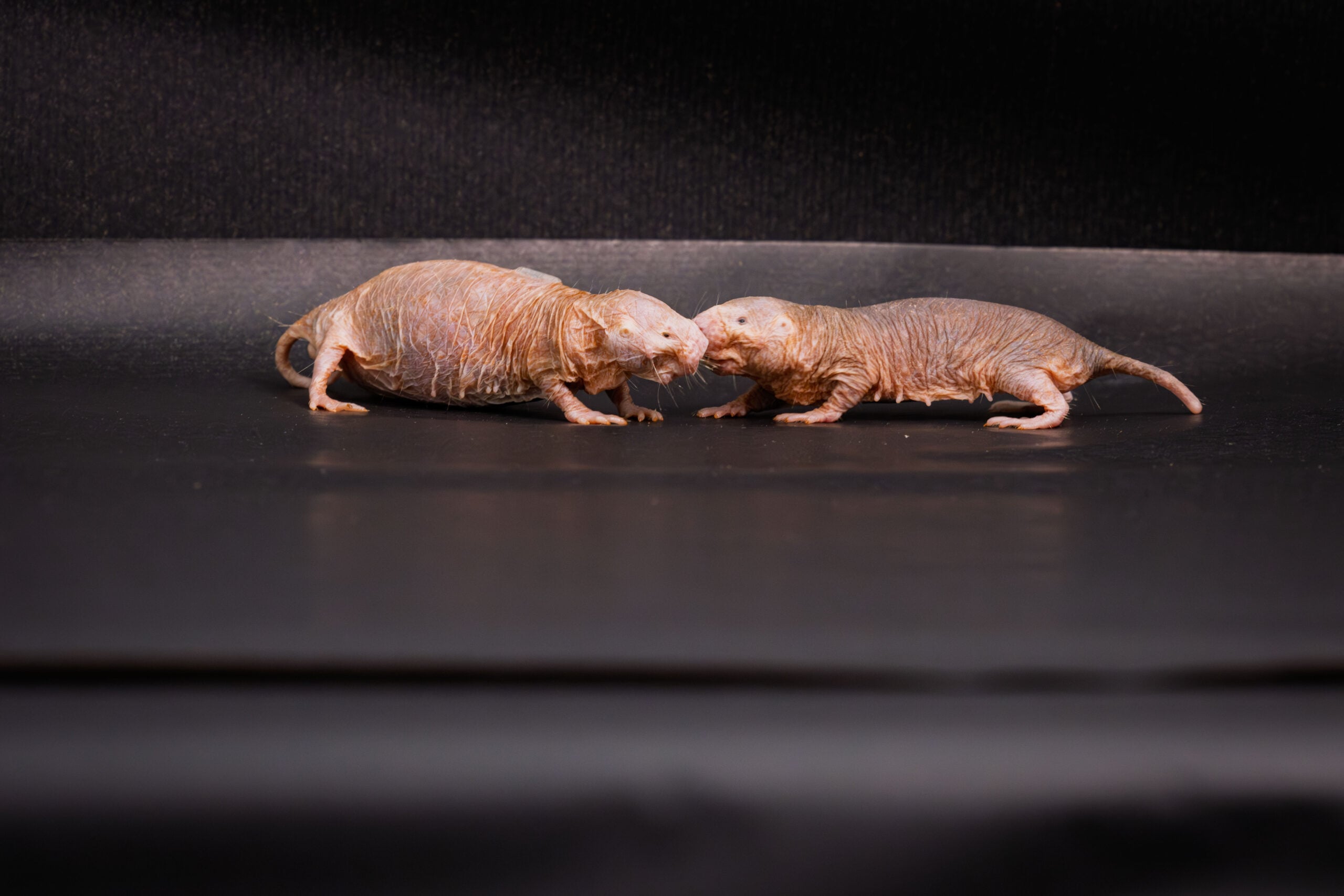
Naked mole-rats live in long underground systems in eastern Africa. Their colonies can include dozens or even hundreds of animals. Workers dig, forage, maintain chambers, defend the burrow and care for young. Reproduction is normally concentrated in one queen and a small number of breeding males.
That makes the species one of the clearest mammalian examples of eusociality, the combination of cooperative care, overlapping generations and an extreme division between breeders and non-breeders. Unlike an ant worker, however, a female naked mole-rat is not locked forever into a physically distinct sterile caste. If the queen dies or is removed, high-ranking females can become reproductively active. The transition is often violent as rivals fight until one becomes the next queen.
For years, direct dominance seemed to offer the obvious explanation. Queens patrol their colonies, shove subordinates and occupy the top rank. Yet touch alone did not explain how one animal could coordinate reproduction throughout a sprawling tunnel network. Colony odours were known to help naked mole-rats distinguish insiders from strangers, suggesting that part of the hierarchy might be airborne, deposited on surfaces or carried on bodies.
The chemical hiding in a cosmetic bottle
The team collected 771 odour samples from 351 naked mole-rats across ranks, ages and reproductive states. Chemical analysis detected 240 compounds and identified 99 of them. Among that crowded chemical background, IPM was the clearest queen-enriched signal. It was abundant in queens and almost absent from ordinary non-breeders.
The molecule is a long-chain fatty-acid ester with relatively low volatility. That makes it useful in cosmetics because it spreads easily and changes the feel of a formulation. Low volatility may also suit a tunnel signal: it can linger on bedding and burrow surfaces instead of disappearing immediately into the air.
Its distribution across the queen was revealing. IPM appeared at several body sites and was especially concentrated in vaginal secretions. Its abundance changed with reproductive state, peaking around ovulation and remaining high through pregnancy before falling during lactation. The researchers estimated roughly 660 nanograms in their queen odour samples, although that laboratory sampling measure is not the same thing as the total output of a living queen across a day.
Humans generally describe IPM as odourless. The team screened 766 human olfactory receptor variants and did not find a convincing dose-dependent response. Naked mole-rats were different. Electrical recordings from their olfactory tissue responded to the compound, and brain imaging showed activity in olfactory centres. Higher-ranking non-breeders avoided IPM when given a choice, while queens and breeding males did not. The signal was therefore not merely present around the queen; colony members could detect and respond to it.
How a smell reaches the reproductive system
The hormonal connection begins with prolactin. In mammals, prolactin has many roles, including the suppression of fertility during lactation. In subordinate naked mole-rats, elevated prolactin is associated with reduced reproductive activity. Higher-ranking animals tend to have lower levels and retain more of the hormonal responsiveness needed to breed.
Across the queen’s cycle, prolactin in non-breeders rose when colony IPM was high. Females isolated from their colonies had less prolactin. When researchers used methimazole to temporarily damage the smell-sensing tissue, prolactin also fell. These interventions link olfaction to endocrine state, although methimazole affects smell broadly and cannot identify IPM by itself.
Direct exposure supplied the more specific test. IPM increased prolactin and kept progesterone metabolites low. Progesterone is associated here with ovarian activation and pregnancy. The authors propose an olfactory pathway that raises prolactin and inhibits the reproductive signalling that would otherwise free a non-breeding female to ovulate. The exact receptor and every intermediate step are not yet known.
That distinction matters. The study establishes a functional chain from chemical exposure to smell-system activation, hormonal change and reproductive outcome. It does not yet give a complete molecular wiring diagram.
The pair experiment made the fertility effect concrete
The researchers removed female and male colony mates and housed them in opposite-sex pairs for 18 weeks. One group received blank bedding, so it had no continuing colony odour. A second received bedding carrying odours from the natal colony and its queen. A third was exposed daily to IPM.
Five of the six females on blank bedding became pregnant. None of the six females given colony bedding did. None of the seven females exposed to IPM did either. Only the blank group showed the full set of reproductive changes, including rising progesterone metabolites, vaginal perforation, mating signs and pregnancy-associated weight gain. Male reproductive hormones were also higher in the blank condition.
The difference was not a single ambiguous hormone reading. It persisted through a period long enough for reproductive activation and the roughly ten-week gestation of the species. Daily IPM exposure produced the same pregnancy outcome as continued exposure to colony and queen odours: zero pregnancies in the study groups.
Still, the treatment was not a delicate trace. Each IPM pair received about 425 milligrams a day, applied as 500 microlitres of the compound. Calibration showed that the concentration in the chamber fell to the level measured around a queen after about five hours and was gone by 24 hours. The dose was designed to create a repeating queen-like environmental signal, not to claim that a queen secretes 425 milligrams daily.
Remove the queen, leave her chemical shadow
The experiment involved one colony containing 19 animals: eight females and 11 males. The researchers removed the queen, then added a 500-microlitre dose of IPM to the bedding every day for 12 weeks.
Normally, losing a queen rapidly opens the hierarchy. High-ranking females become aggressive, reproductive hormones shift and competition can turn lethal. During the 12 weeks of IPM treatment, that did not happen. The team recorded no aggression or dominance contests. Prolactin remained high, progesterone metabolites remained low and no successor emerged. The colony behaved as though a major part of the queen’s presence was still there.
Withdrawal turned the intervention into a stronger test. One week after the IPM stopped, at week 16 of the experiment, high-ranking animals began fighting. One female was killed in an attack. By week 19, a surviving dominant female had gained weight, her prolactin had fallen, her progesterone had risen and she was pregnant. She later gave birth.
The timing is hard to dismiss as a simple before-and-after coincidence. The queen was absent throughout. Stability continued while the chemical was supplied, then competition and reproductive succession appeared after it was removed. In this one colony, IPM was sufficient to postpone the transfer of power.
What the experiment does not establish
The phrase “queen pheromone” is useful, but it can imply more certainty and exclusivity than the data justify. The authors describe IPM as a queen-enriched chemical signal that mediates suppression. They do not rule out touch, vocal communication, physical dominance, other odours or a combination of cues. A living social system rarely runs on only one input.
The colony-removal experiment also needs the right denominator. It was one colony of 19 captive animals, not a randomized set of many colonies. Repeating it across independent groups would show how consistently the effect holds, and observing natural burrows would test whether queens distribute IPM in the way the laboratory setup assumes.
Another open question is why the queen does not suppress herself. Breeding males also remain fertile while continuously exposed. Reaching breeder status may change receptors, prolactin sensitivity or downstream brain signalling, but the paper leaves that mechanism unresolved. The biosynthetic route by which queens make so much IPM is also unknown.
The result sits beside a second, seemingly contrasting 2026 report of peaceful succession in a different captive colony when an existing queen stopped breeding. Together they suggest naked mole-rat politics is more flexible than a single story of chemical dictatorship. IPM can hold suppression in place under one experimental condition, while changes in fertility, environment and social history may alter how succession unfolds.
Why one molecule matters
SpaceDaily has previously followed the naked mole-rat through its slow ageing, rare cancers and unusual survival in low oxygen. The new work shows that the colony is an equally unusual biological system, with one individual’s chemistry capable of changing the endocrine state of many others.
The parallel with social insects is difficult to miss. Earlier SpaceDaily reporting described how queen-bee pheromone helps repress worker fertility. Naked mole-rats and bees arrived at eusociality along very different evolutionary routes, but both appear to use queen-derived chemical information to concentrate reproduction.
IPM was also detected at lower levels in breeding females from four Fukomys mole-rat species. It was absent from the solitary mole-rat species tested. That comparison hints that the molecule may belong to a broader evolutionary toolkit for cooperative breeding, with naked mole-rats pushing its use toward an extreme. It remains a hint because the other species organize reproduction differently and were not put through the same full set of experiments.
The skincare connection is memorable because it collapses the distance between a cosmetic formulation and a burrow hierarchy into one molecular structure. The biology lies not in the molecule’s name but in who produces it, who can detect it and what their bodies do next.
In the strongest version of the finding, a familiar ester became a reproducible piece of social authority. The researchers could remove the queen, preserve her chemical trace and delay succession. When that trace disappeared, the colony’s reproductive future reopened.
Featured image: A pregnant naked mole-rat queen, left, and a worker sniff one another. Photo by Felix Petermann, Max Delbrück Center. Image supplied with the research institution’s July 15, 2026 press materials.