
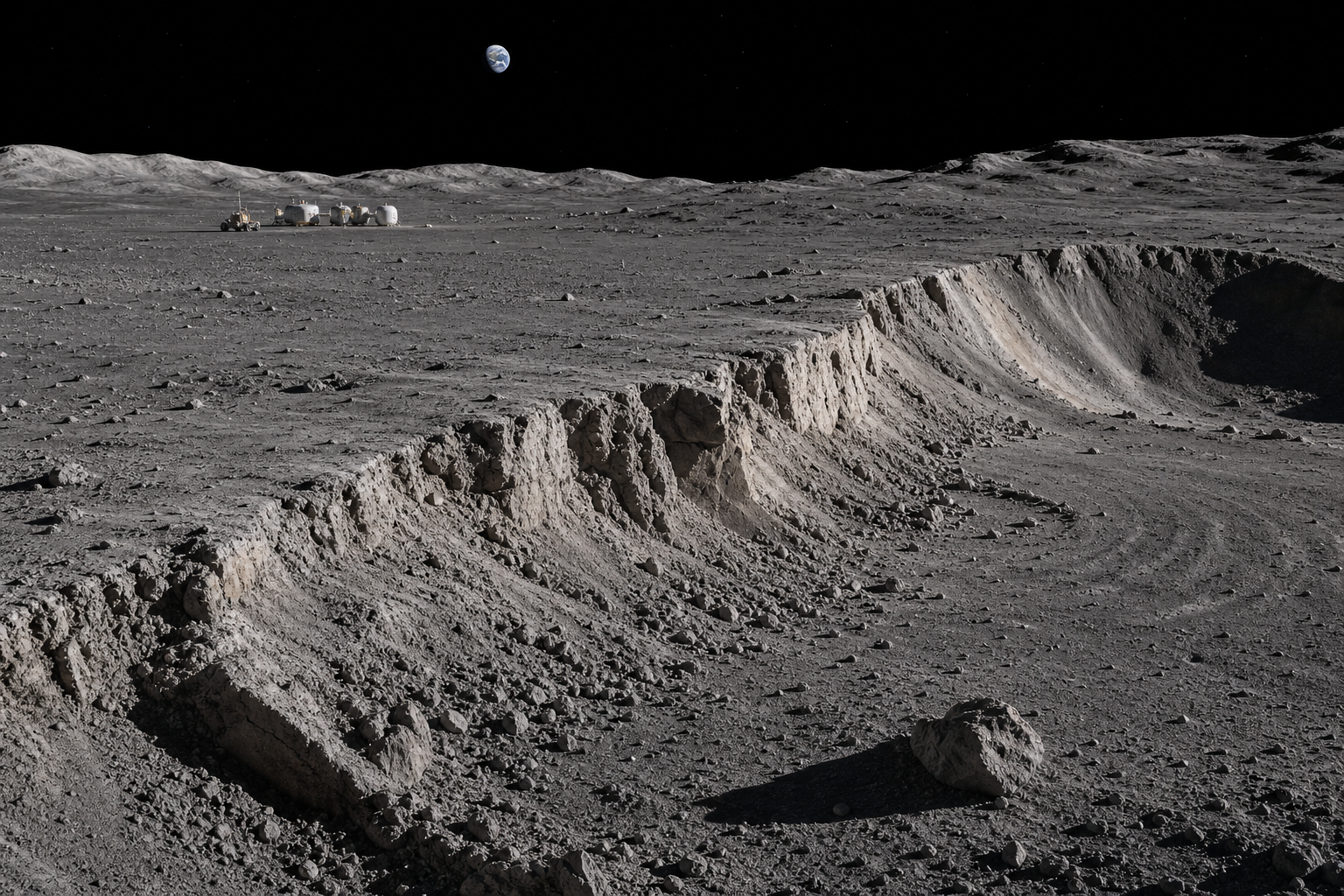
The Moon looks frozen in time, its craters preserving impacts billions of years old. Yet beneath that ancient surface, it is still losing heat. As its interior cools, the Moon contracts, squeezing its brittle crust until sections break and ride over one another along thrust faults.
That slow planetary change is small but measurable. NASA says the Moon’s diameter has decreased by about 50 metres over the past several hundred million years. The contraction is gradual, but the stress it stores can be released suddenly as a moonquake. Some of the young faults produced by this process lie in the south polar region, the same broad landscape that space agencies see as a destination for long-duration human exploration.
The overlap matters, but it needs careful wording. Researchers have not discovered that every proposed astronaut site sits on the edge of an imminent disaster. They have shown that faults capable of producing substantial shaking exist in and around a region being considered for landings and eventual infrastructure. On the Moon, where buildings, landing vehicles and life-support systems would have little margin for failure, even an infrequent hazard belongs in the site-selection calculations.
A cooling world wrinkles rather than splitting open
The shrinking Moon is sometimes illustrated as a raisin, but its surface is not crumpling everywhere at once. The rigid outer shell responds to global contraction by forming relatively small, cliff-like landforms called lobate scarps. At a thrust fault beneath one of these scarps, a block of crust is pushed up and over neighbouring terrain.
Images from NASA’s Lunar Reconnaissance Orbiter have revealed thousands of these scarps across the Moon. Some cut through small craters that are themselves geologically young. Others are associated with bright patches, boulder tracks and landslides that have not yet been darkened by long exposure to space weathering. These clues indicate that the faults are not merely relics from the Moon’s distant youth.
In 2019, researchers combined fault maps with seismic data from the Apollo missions and reported evidence linking shallow moonquakes to young thrust faults. Eight of 28 relocated shallow events fell within 30 kilometres of a mapped scarp, a pattern the team argued was too concentrated to dismiss easily as chance. The timing of some events also tracked the tidal stresses imposed by Earth’s gravitational pull.
Cooling contraction supplies the long-term compression, while tides can help determine when a stressed fault finally slips. The mechanism is therefore more subtle than a world simply getting smaller and shaking. Thermal evolution, brittle faulting and Earth’s changing tug all contribute to the seismic environment.
The Apollo instruments heard a surprisingly active Moon
Astronauts placed seismometers on the lunar surface during Apollo 11, 12, 14, 15 and 16. The four-station network that operated for years recorded thousands of events, including impacts, thermal quakes, deep moonquakes associated with tides and a smaller population of shallow moonquakes.
The shallow events are especially important for future structures because they can be relatively strong and originate in the brittle crust. The Moon also transmits seismic energy differently from Earth. Its intensely fractured, dry crust scatters and reverberates seismic waves, so the shaking can continue much longer than a comparable terrestrial earthquake. NASA notes that a moonquake can ring for hours, potentially disrupting surface work or destabilising equipment even after the initial rupture.
Magnitude comparisons require caution. A magnitude value describes the source, not the exact shaking that a building will experience at a particular spot. Distance, fault geometry, regolith thickness, local slopes and the lunar crust’s unusual wave propagation all affect ground motion. Engineers need estimates of peak acceleration and duration at a site, not just a dramatic number.
A strong event may have occurred near the south pole
A 2024 study in The Planetary Science Journal focused on scarps in the lunar south polar region. The researchers examined a large shallow moonquake recorded by the Apollo network and modelled whether it could have formed the biggest scarp near de Gerlache crater, less than 60 kilometres from the pole.
Their preferred model involved an event of approximately magnitude 5.3. It predicted strong to moderate shaking at least 40 kilometres from the source, with weaker shaking extending farther. One small scarp cluster was inside the de Gerlache Rim 2 region that NASA had identified among candidate areas for an Artemis III landing at the time of the research.
The same study modelled slope stability around the south pole. It found that steep slopes inside Shackleton crater could be susceptible to regolith landslides, particularly if the loose surface material has very low cohesion. Light shaking may be enough to start movement on the most vulnerable slopes.
That does not mean a magnitude 5.3 quake is forecast for a particular mission. The Apollo network was small and concentrated on the nearside, so the locations of distant events carry large uncertainties. The scarps show that deformation has occurred, while modelling establishes a plausible hazard scenario. Neither supplies a timetable for the next rupture.
The interpretation is also still developing. A 2026 reanalysis using the Apollo 17 surface gravimeter as an additional seismometer improved the locations of several shallow moonquakes and found that at least one overlapped a major crustal gravity anomaly associated with a large ancient dike. That result supports a possible deep-seated source for that event rather than a shallow thrust fault. Lunar seismicity is not one simple family with a single cause.
Why the south pole remains attractive
The lunar south pole offers potential access to water ice in permanently shadowed regions, along with elevated ground that can receive long periods of sunlight. Those resources could support science, power systems and eventually longer stays. NASA describes the region as a landscape of extreme lighting, temperature and terrain conditions, all of which already make landing and surface operations challenging.
Seismic risk adds another layer rather than cancelling the case for exploration. A future habitat can be placed away from mapped faults and unstable slopes. Foundations, tanks, antennas and tall structures can be designed for long-duration shaking. Routes can avoid boulder fields and slopes that might fail, while monitoring equipment can identify local activity before a permanent outpost grows around it.
Ground conditions may amplify or reduce shaking. Research on lunar near-surface geology and seismic amplification shows why high-resolution information about local layers matters. A region-wide hazard map is useful, but it cannot replace measurements at the exact landing pad or habitat location.
The next seismic network must do better than Apollo
The Apollo seismic experiment transformed lunar science, but it was never a global monitoring system. Its stations occupied a limited area, and the network was switched off in 1977. Modern broadband instruments distributed across the near side, far side and poles could locate quakes far more accurately, measure local ground response and determine which fault systems remain active.
Lunar Reconnaissance Orbiter images remain essential because fresh scarps and displaced boulders reveal where the crust has moved. NASA’s original announcement on the connection between shrinking and seismicity noted that LRO had imaged more than 3,500 fault scarps. Orbital mapping and surface seismology together can turn those landforms into practical engineering information.
The Moon is still shrinking, but at a pace that does not visibly change its size over a human lifetime. The real consequence is concentrated at faults, where tiny global contraction accumulates into local stress. Some of those faults sit surprisingly close to the south polar terrain humans hope to explore and perhaps inhabit.
That is not a reason to abandon the pole. It is a reason to stop treating the Moon as a perfectly inert foundation. Future crews will live on a world that is ancient, quiet and geologically subdued, but not dead. Choosing where to put a landing pad or habitat will require knowing not only where the sunlight and ice are, but where the ground itself is least likely to move.
