

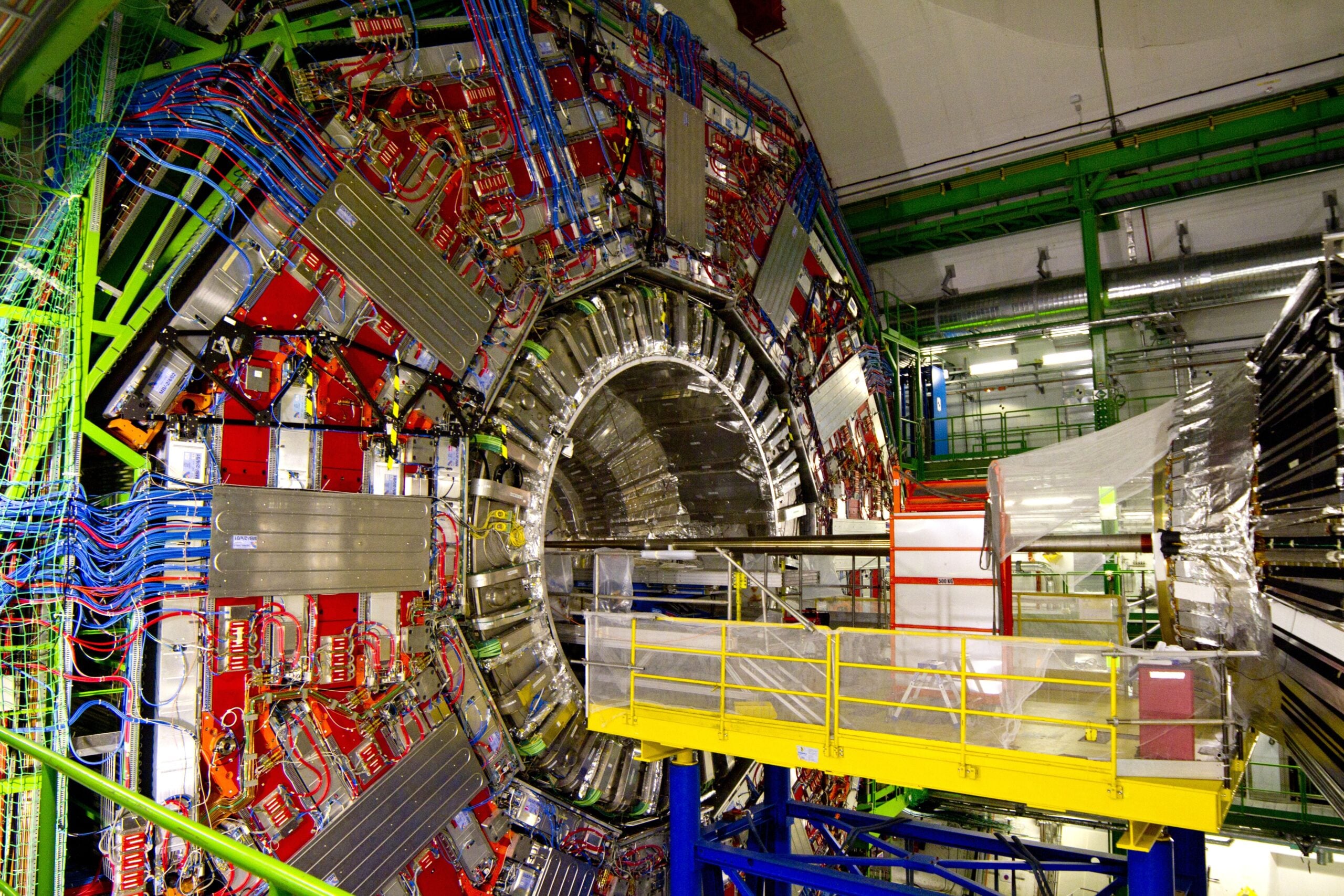
The visible universe is made of matter. Its stars, planets, gas and people contain protons, neutrons and electrons rather than their antimatter counterparts. That familiar fact encodes an imbalance so small in the early universe that it is commonly pictured as one extra matter particle among a billion matter-antimatter pairs.
As the universe expanded and cooled, particles and antiparticles met and annihilated, converting their mass into other particles and radiation. A perfectly balanced population would have left almost no ordinary matter. The tiny excess that remained became the raw material for every later galaxy, star, planet and living cell.
What antimatter is, and is not
Every known elementary matter particle has an antiparticle with the same mass and opposite electric charge or other reversed quantum numbers. The positron is the electron’s antiparticle. An antiproton contains antiquarks in place of the proton’s quarks and carries negative rather than positive charge. CERN’s antimatter overview explains how particles and antiparticles can be produced together and annihilate when they meet.
Annihilation does not mean that conserved physical quantities vanish. Energy, momentum and electric charge still balance. Electron-positron annihilation can create photons. Proton-antiproton annihilation commonly creates mesons, which decay into lighter particles and radiation. The early universe did not become absolute nothingness; it became overwhelmingly radiation with a small residue of ordinary matter.
Antimatter has not disappeared from nature altogether. It appears in radioactive processes, cosmic-ray collisions and high-energy laboratories. The mystery concerns the absence of primordial bulk antimatter comparable to the matter in stars and galaxies, not the absence of individual antiparticles.
Why equality is the natural starting point
In a hot enough environment, energy continually turns into particle-antiparticle pairs and back again. Laboratory collisions reproduce that basic symmetry. With no mechanism selecting matter over antimatter, the natural thermal starting point has nearly equal abundances and zero net baryon number.
That statement is a theoretically motivated starting condition, not a direct photograph of the first instant. Cosmology cannot replay the original pair production event or count each vanished antiparticle. The sharper puzzle is that the observed universe requires a small positive net baryon number, while a symmetric beginning supplies none.
The word “matter” also needs a boundary here. This problem is mainly about baryonic matter, the protons and neutrons in atomic nuclei, together with the electrons required for neutral atoms. Dark matter is a separate unidentified component. Calling the cosmos matter-dominated in this context does not claim that ordinary atoms provide most of its total mass-energy.
What “one in a billion” measures
Cosmologists quantify the relic through the baryon-to-photon ratio, written eta. Baryon number counts baryons minus antibaryons, so it is already a measure of the excess rather than the total number of particles that once existed. The Particle Data Group’s 2025 cosmology review quotes eta as 6.12 ± 0.04 × 10⁻¹⁰ from the cosmic microwave background.
In ordinary language, that is about six net baryons for every ten billion background photons, or one for roughly 1.6 billion. CERN’s widely used explanation pictures approximately one extra matter particle per billion antiparticles before annihilation. Both descriptions communicate the astonishingly small scale of the imbalance.
They are not identical bookkeeping statements. The number of photons per comoving volume changed as species annihilated and heated the radiation bath, and the initial population of pairs is not directly observed. “One survivor per billion pairs” is a defensible physical shorthand, not an exact archived tally of every early-universe collision.
Two independent cosmic ledgers
The ratio is not extracted from the present number of galaxies alone. Big Bang nucleosynthesis provides one record. During the universe’s first minutes, the density of ordinary matter affected the nuclear reactions that built deuterium, helium and small amounts of lithium. Measured primordial deuterium is especially sensitive to the baryon abundance.
The cosmic microwave background provides another record. Before atoms formed, baryons added inertia to sound waves in the hot plasma. That loading changed the relative heights of acoustic peaks now measured in microwave temperature and polarization maps.
The Planck cosmological-parameters analysis found a physical baryon-density parameter near 0.0224. Converted into a baryon-to-photon ratio, it agrees closely with the value required by primordial deuterium. Two phenomena separated by hundreds of thousands of years therefore point to the same small residue.
This agreement is why the imbalance is treated as a measured relic, not a philosophical preference for matter. The difficult question is not whether the residue exists. It is how the laws operating before nucleosynthesis produced it.
Sakharov’s three requirements
In 1967, Andrei Sakharov set out the ingredients needed to generate a baryon asymmetry from an initially symmetric state. His brief paper on CP invariance and baryon asymmetry became the organizing framework for baryogenesis, the general name for processes that create net baryon number.
First, interactions must be able to change baryon number. If baryon number is inviolable, a zero initial balance cannot become positive. Second, charge-conjugation symmetry and the combined charge-parity symmetry must be violated, allowing matter and antimatter processes to proceed at different rates.
Third, the process must occur away from thermal equilibrium. In perfect equilibrium, forward and reverse reactions cancel any preference. Expansion, a phase transition or the out-of-equilibrium decay of a heavy particle can stop those reverse reactions from erasing the imbalance.
These requirements narrow the hunt without naming the culprit. Many proposed theories satisfy them on paper. A viable mechanism must also generate the observed magnitude and survive every relevant collider, flavour, neutrino and cosmological constraint.
The Standard Model contains a clue, not the answer
CP violation means that a process can change when particles are exchanged for antiparticles and spatial coordinates are reflected as in a mirror. It was discovered in neutral kaon decays in 1964, then observed in beauty mesons in 2001 and charm mesons in 2019. Matter and antimatter are therefore not perfect behavioural reflections.
The Standard Model includes CP violation through the mixing of quark flavours. At high temperatures it also permits nonperturbative electroweak processes called sphalerons that can change baryon plus lepton number. Those facts make the model look tantalizingly close to Sakharov’s recipe.
Yet the known quark-sector CP violation is many orders of magnitude too weak in conventional calculations, and with the measured Higgs mass the electroweak transition is a smooth crossover rather than the strong out-of-equilibrium phase transition the simplest mechanism needs. No demonstrated Standard Model calculation produces the observed cosmic value.
Precision equality tests close other doors
A different strategy searches for an unexpected difference in basic properties. If protons and antiprotons had slightly different masses or mismatched charge magnitudes, a fundamental symmetry called CPT would fail and new explanations could open.
So far, precision favours equality. CERN’s BASE experiment compared proton and antiproton charge-to-mass ratios and found them identical within an experimental uncertainty of 16 parts per trillion. Other experiments test antihydrogen spectra and gravitational behaviour.
These measurements do not directly recreate baryogenesis. They test whether matter and antimatter differ in ways that established theory forbids. Every null result removes or constrains a possible route, leaving subtler differences in reactions and decays as the central territory.
Where quarks break the mirror
In 2025, the LHCb collaboration reported the first observation of CP violation in baryon decays. Its peer-reviewed Nature paper compared a beauty baryon, the lambda-b, with its antibaryon counterpart as each decayed into four charged particles.
The measured overall asymmetry was 2.45 per cent, with statistical and systematic uncertainties of 0.46 and 0.10 percentage points. Its significance reached 5.2 standard deviations. In one resonance-dominated region of the decay, the asymmetry was larger.
This result expands the observed territory of CP violation from mesons to baryons, the family that includes protons and neutrons. It does not solve the cosmic problem by itself. The unstable beauty baryon is not a surviving primordial proton, and the measured effect is compatible with Standard Model quark physics whose total baryogenesis contribution remains insufficient.
Why neutrinos remain tempting
Neutrinos offer another possible route because they already reveal physics beyond the original massless-neutrino Standard Model: they have tiny masses and change flavour as they travel. If neutrinos and antineutrinos violate CP symmetry, the lepton sector contains another matter-antimatter difference.
In a mechanism called leptogenesis, very heavy neutrinos in the early universe decay slightly differently from their antiparticles, first creating a lepton imbalance. Electroweak sphalerons then convert part of that imbalance into baryon number. The heavy particles in the simplest versions may be far beyond direct production, so present neutrino properties provide indirect clues rather than a complete test.
The first joint NOvA and T2K oscillation analysis improved constraints on the neutrino CP phase and mass ordering. It found no strong preference for either ordering; under an assumed inverted ordering, the fit would provide evidence for CP violation. That conditional result is not a discovery of leptogenesis.
SpaceDaily has also covered how long-baseline neutrino experiments probe matter’s dominance. Future data from existing experiments and the next generation can show whether leptonic CP violation exists and how large it is, but connecting it uniquely to the cosmic excess will require additional evidence.
A small number with an unfinished origin
Other proposals include electroweak baryogenesis with new particles, the out-of-equilibrium decay of superheavy grand-unified particles, Affleck-Dine mechanisms involving early-universe fields and scenarios tied to dark matter. Some predict electric dipole moments, proton decay, neutrinoless double-beta decay or neutron-antineutron oscillations that experiments can seek.
Each candidate faces a two-sided test. It must make an asymmetry of roughly the observed size without later washing it out, and it must avoid producing other effects already excluded by laboratory and cosmological measurements.
“One in a billion” is therefore both an answer and a question. It conveys how little ordinary matter had to survive for a structured universe to form. It does not identify which interaction tilted the balance, when that interaction acted or whether its particles remain accessible to experiment.
The surviving fraction was enough for atoms, stars and observers, yet the reason it was not exactly zero remains unknown. Physics can measure the residue with remarkable precision; it has not identified the event that created it.