
NASA’s Kepler mission did not detect 300 million temperate rocky planets. It observed a narrow field of stars, found the small fraction of planets whose orbits happened to cross their stars from our viewpoint, and gave astronomers enough information to estimate the population that remained unseen.
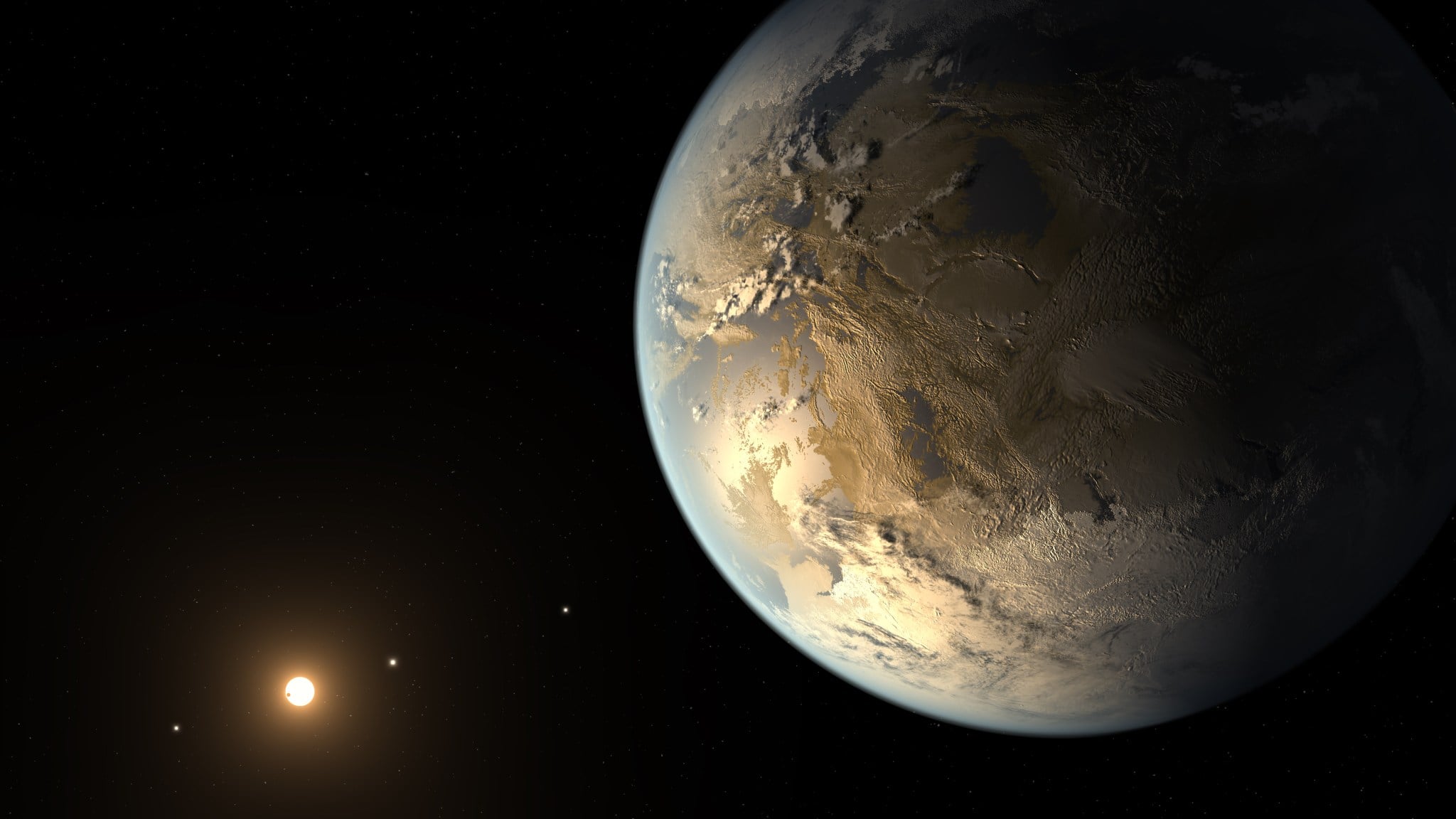
The result of one of the mission’s most complete statistical analyses was that the Milky Way could contain at least 300 million roughly Earth-sized planets in the habitable zones of stars broadly similar to the Sun. The number came from the lowest end of the study’s allowed range. Its central estimate suggested such worlds could be much more common.
This is one study, not settled consensus.
It also counted potential settings for surface liquid water, not inhabited Earth twins. Kepler could measure a planet’s size and orbit. It could not tell whether most of these worlds have oceans, atmospheres, continents or life.
How Kepler turned a small patch of sky into a galactic estimate
Kepler watched stars for repeated dips in brightness caused by transiting planets. The geometry is restrictive. An Earth analogue seen from a random direction has less than a one percent chance of passing directly across its star, and it completes only one orbit each year. A mission must watch for several years to record enough transits while separating them from stellar variability and instrumental noise.
The telescope therefore saw only a biased sample. Large planets in short orbits were easier to find. Small planets with year-long orbits were among the hardest. The final Kepler catalogue, known as Data Release 25, quantified those biases by injecting synthetic transit signals into the processing pipeline and measuring which ones were recovered. It also estimated the reliability of candidates, including the chance that an apparent transit was a false alarm. The catalogue methods were described by Susan Thompson and colleagues in a 2018 Astrophysical Journal Supplement Series paper.
Steve Bryson of NASA Ames and an international team then combined that final catalogue with improved stellar measurements from the European Space Agency’s Gaia mission. Their analysis in The Astronomical Journal modelled how often small planets occur as a function of planet radius, the energy received from the host star and the star’s temperature. Corrections for detection completeness and catalogue reliability allowed the team to infer the planets Kepler had missed.
This was a population calculation, not a list of known destinations.
Where the 300 million figure comes from
The team defined its Earth-like size range as 0.5 to 1.5 Earth radii. It considered main-sequence stars with effective temperatures from 4,800 to 6,300 kelvin, covering cooler K dwarfs, stars like the Sun and somewhat hotter F-type stars. “Sun-like” is therefore a useful shorthand for a broad stellar group, not a collection of exact solar twins.
For planets in the conservatively defined habitable zone, the study’s baseline models produced an average occurrence rate ranging from about 0.37 to 0.60 planets per star, with wide uncertainty intervals. NASA’s October 2020 account of the result summarised the central expectation as roughly half of Sun-like stars hosting such a planet.
NASA then deliberately moved to the low end. It used a minimum occurrence rate of 7 percent, the conservative lower statistical limit, and an estimate of roughly four billion Sun-like stars in the Milky Way. Seven percent of four billion is 280 million, which the agency rounded to at least 300 million potentially habitable worlds.
The word “at least” has a statistical meaning here. It is not a direct lower count produced by surveying the whole galaxy. It is the low end of an inference made under the paper’s definitions, stellar population estimate and completeness model. Change those assumptions and the boundary can move. Use the study’s central rate instead and the implied count rises into the billions.
Related: Psychology says the reason retired men sit in silence isn’t because they have nothing to say — it’s because they’ve lost the only identity anyone ever valued them for
Habitable zone does not mean habitable planet
A circumstellar habitable zone is the range of starlight in which a rocky planet with a suitable atmosphere might sustain liquid water on its surface. Its boundaries depend on the host star’s temperature because hotter and cooler stars emit different mixtures of wavelengths. Bryson’s team used the climate limits developed by Ravi Kopparapu and colleagues, including the conservative range between a moist greenhouse inner edge and a maximum-greenhouse outer edge. Those limits were set out in a 2013 Astrophysical Journal study and later refinements.
The definition assumes far more than Kepler observed. A planet may lie in that zone and have no atmosphere. Another may have a dense greenhouse atmosphere, little water, hostile surface chemistry or damaging radiation from its star. Venus and Mars are the local warning against treating orbital position as a diagnosis of conditions on the ground.
Size is also an imperfect guide to composition. Planets smaller than about 1.5 Earth radii are more likely to be rocky than larger worlds, which is why the study stopped at that threshold. Yet radius alone does not yield a mass or a bulk density. Leslie Rogers’ 2015 analysis of the rocky-to-gaseous transition supports a statistical boundary near 1.6 Earth radii, not a guarantee about every planet below it.
The count is consequently narrower than “300 million other Earths” and broader than “300 million known rocky planets”. It estimates worlds that satisfy two first-pass conditions: a likely rocky size and an orbit receiving potentially temperate starlight.
Why the uncertainty remains large
The final Kepler data were the best available for this calculation, but the mission detected very few small planets in long-period habitable-zone orbits around Sun-like stars. Bryson’s paper identifies that small observed sample, combined with very low catalogue completeness in the relevant region, as the main source of its large uncertainty.
Statistical corrections can recover a population from missed detections, but they cannot create the precision of a larger sample. Different teams have used different radius limits, orbital ranges, stellar samples and treatments of false positives, producing occurrence estimates that do not always agree. The broad conclusion that small planets are common is firmer than any single value for the frequency of an Earth analogue.
The study nevertheless made a useful local prediction. At its estimated rates, the nearest rocky habitable-zone planet around a G or K dwarf should lie about six parsecs away, roughly 20 light-years, on average. It estimated about four such planets within ten parsecs, or 33 light-years. These are population expectations, not four identified planets waiting at known coordinates.
The census changes the search, not the answer
Kepler’s contribution was to replace a sample of one planetary system with a measured distribution. The 300 million figure says that the basic astronomical arrangement represented by Earth may recur often enough for nearby examples to exist. It says nothing direct about how frequently life begins or persists.
Answering that question requires studying individual worlds. Astronomers need masses, atmospheric spectra, stellar radiation histories and, eventually, measurements capable of separating possible biological chemistry from non-biological processes. A census tells mission designers how many targets they might expect and how large a survey must be. It cannot determine what any of those targets contains.
The conservative Kepler count leaves Earth as the only known living planet. It also makes clear that its broad size, orbit and type of star need not be a once-only arrangement.