
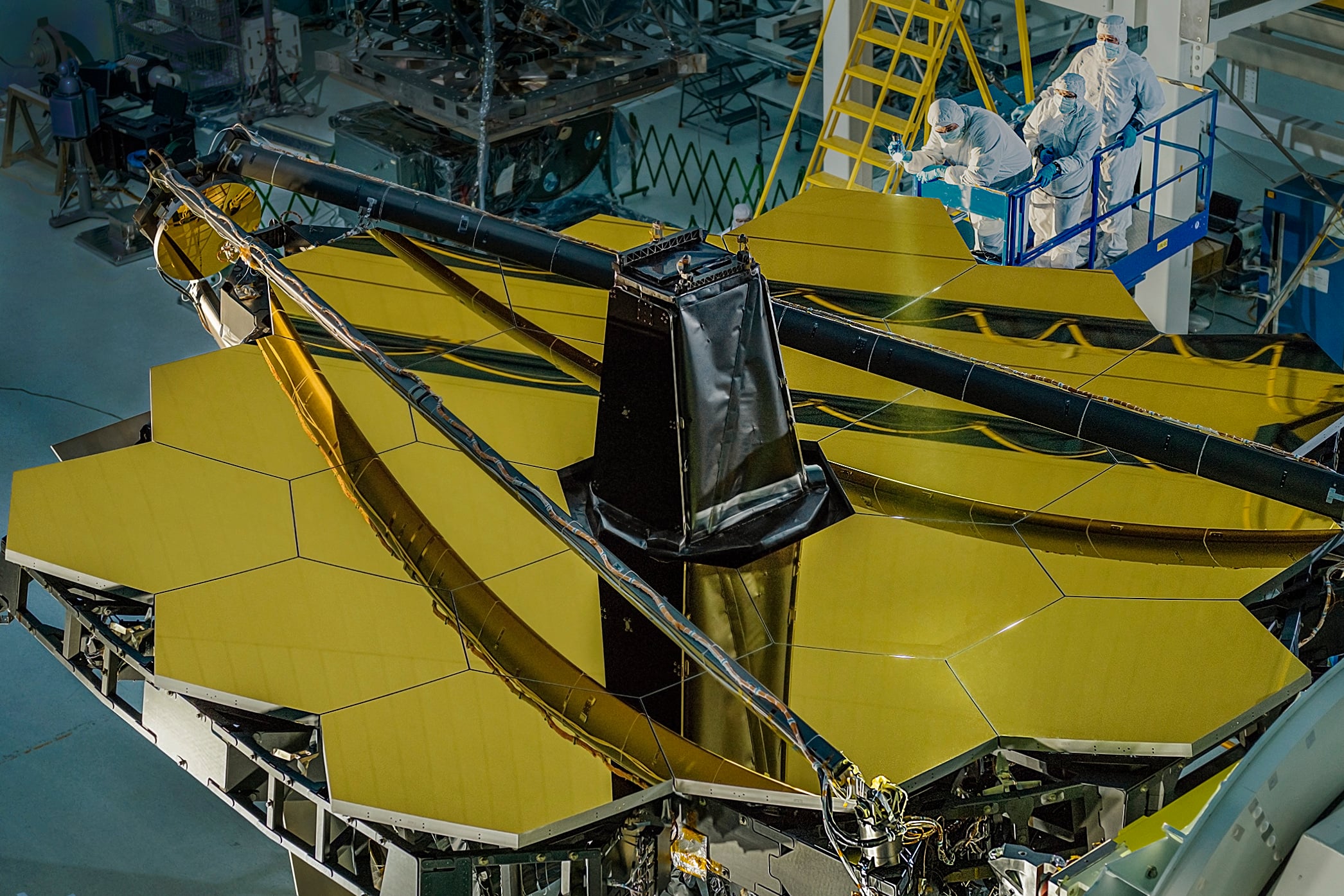
Before the James Webb Space Telescope released its first science images, a micrometeoroid struck segment C3 of its 6.5-metre primary mirror. The late-May 2022 impact left a local deformation that Webb’s actuators could reduce but not completely remove.
That description sounds more catastrophic than the operational result. Webb still exceeded every optical requirement after the strike, and the effect on its overall imaging performance was small. The scientifically unusual part is how the damage was discovered. No camera photographed a crater in the gold. Webb inferred the change from the way starlight crossed its own optical system, resolving a disturbance measured in nanometres while the observatory was roughly 1.5 million kilometres from Earth.
The event is a useful demonstration of both sides of a large exposed space telescope: its mirror is vulnerable to particles that cannot be tracked or dodged individually, but its optical control system is sensitive enough to diagnose and partly compensate for the result.
The impact arrived during commissioning
Webb launched on December 25, 2021, then spent months unfolding, cooling, aligning its 18 primary-mirror segments and commissioning four science instruments. The significant impact occurred in late May 2022, during that checkout period and before science operations began in July.
NASA’s first detailed public account said the strike occurred between May 23 and 25 and affected primary-mirror segment C3. The agency described Webb’s environment near Sun-Earth L2 as a continual bombardment by dust-sized particles travelling at extreme velocities. The particular particle was not recovered or directly sized. “Dust-sized” is therefore an environmental description, not a laboratory measurement of the object that hit C3.
The strike was larger than the team had modelled for such an early point in the mission and beyond the impact conditions that could be practically tested on full flight hardware. It was not associated with a known meteor shower. NASA formed a specialist team to study the event, but it made no change to Webb’s commissioning timetable.
Webb reads its mirror through starlight
The primary mirror is made from 18 gold-coated beryllium hexagons, each about 1.32 metres across. Together they form a 6.5-metre light-collecting surface. For sharp images, those separate pieces must act as one mirror, with their positions and optical phases matched to a tiny fraction of the wavelength being observed.
NIRCam, Webb’s near-infrared camera, doubles as the principal wavefront sensor. Engineers point the telescope at a suitable star and collect deliberately defocused images. Phase-retrieval algorithms work backwards from the resulting patterns to reconstruct how the telescope changed the incoming wavefront. NASA’s mirror guide explains how the system can align the segments to within tens of nanometres.
This was not a new diagnostic improvised after the impact. The same process had already brought the telescope into focus. A SpaceDaily report from February 2022 followed the earlier step in which engineers stacked the 18 separate stellar images and began phasing the segments so their light would overlap coherently.
What “uncorrectable” means for a segmented mirror
Each primary segment has six actuators that control its position and orientation, plus a seventh that adjusts its broad radius of curvature. Those motors can correct piston, tip, tilt and other low-order differences between segments. They cannot reach into the surface and flatten every small dent or ripple.
A hypervelocity impact can therefore create two kinds of optical error. Part of the disturbance looks like a segment that needs to be moved or gently reshaped, which the actuators can address. The rest is a local, high-spatial-frequency change in the mirror’s figure. That fine deformation remains even after the best available realignment.
The peer-reviewed commissioning analysis in the Publications of the Astronomical Society of the Pacific describes the May hit as causing a significant uncorrectable change in the overall figure of C3. The best full-telescope wavefronts achieved before the event were about 50 nanometres root mean square. The permanent high-order component raised that floor to about 59 nanometres.
Webb’s requirement was 150 nanometres root mean square. Even after the hit, the observatory remained far inside that limit. In this context, uncorrectable means a small residual shape error could not be removed by the installed actuators. It does not mean the segment stopped reflecting light, the telescope lost focus or the damage was scientifically crippling.
Nanometres are visible because phase is measurable
A nanometre is one billionth of a metre. Webb does not need to resolve a nanometre-sized feature as a conventional photograph to detect its optical consequence. Light behaves as a wave, and a small change in the path travelled by different parts of that wave changes how they interfere at a detector.
By comparing many measured star images with an optical model, the wavefront software estimates where the mirror system departs from the desired shape. Earlier generations of this control architecture were developed long before launch. SpaceDaily described the central idea in 2007: software would coordinate Webb’s primary and secondary mirrors so the segmented telescope could focus as one instrument.
The impact was detected because it altered that reconstructed wavefront locally on C3. Regular sensing then showed engineers how much correction the mirror actuators achieved and how much high-order deformation remained. Webb effectively used astronomical light as a remote precision gauge for its own surface.
A dust particle can matter at hypervelocity
Size alone is a poor guide to damage in space. Kinetic energy depends on mass and on the square of relative velocity. A tiny particle moving at kilometres per second can concentrate meaningful energy into a very small area before the mirror material has time to respond like it would under a slow mechanical load.
Webb’s primary mirror has to remain exposed to collect faint infrared light. A protective window large and transparent enough for the full observatory would introduce its own optical, thermal and mass problems. Engineers instead designed the beryllium segments, coatings, alignment authority and performance margin around an expected accumulation of unavoidable impacts.
The May event was an outlier in two ways. NASA later concluded that it involved a higher-energy particle and struck a particularly sensitive location. Other measurable impacts recorded around the same period were broadly consistent with prelaunch expectations. The concern was not that every grain would reproduce the C3 result, but that repeating rare head-on encounters could consume optical margin faster than necessary.
The hit changed how observations are scheduled
Webb and Earth travel around the Sun at roughly 30 kilometres per second. When the mirror faces close to that direction of motion, called the ram direction, an incoming particle can meet the observatory with greater relative speed. NASA noted that a head-on encounter can double relative velocity and produce four times the kinetic energy.
Starting with Cycle 2, mission planners introduced a micrometeoroid avoidance zone around the ram vector. Current Space Telescope Science Institute guidance defines a 75-degree half-angle zone and asks observers to avoid its overlap with Webb’s field of regard unless the science case requires it. The policy does not make those sky targets inaccessible. In many cases, the same target can be scheduled at a different time of year when the telescope approaches it from a safer orientation.
This is statistical protection rather than evasive driving. Individual micrometeoroids are too small and fast to track. The schedule instead reduces the amount of time the mirror spends in directions where an impact is more likely to carry damaging energy.
The permanent mark did not define the mission
The C3 impact occurred at a psychologically awkward moment, before the public had seen Webb’s first full-colour science images. It also exposed a literal limit: no servicing crew can travel to L2 and polish away the deformed patch. The residual error is part of the telescope for the rest of its operating life.
Yet the episode also showed why the observatory carried margin and active control. Engineers located a tiny optical change remotely, distinguished correctable alignment error from permanent surface error, reduced the system-level effect and adjusted future operations. Webb entered science service on schedule with performance comfortably better than required.
The mirror cannot heal, but the telescope can measure, compensate and adapt. A dust-scale strike left an uncorrectable deformation; Webb’s nanometre-scale self-knowledge kept that permanent mark from becoming a mission-defining wound.