
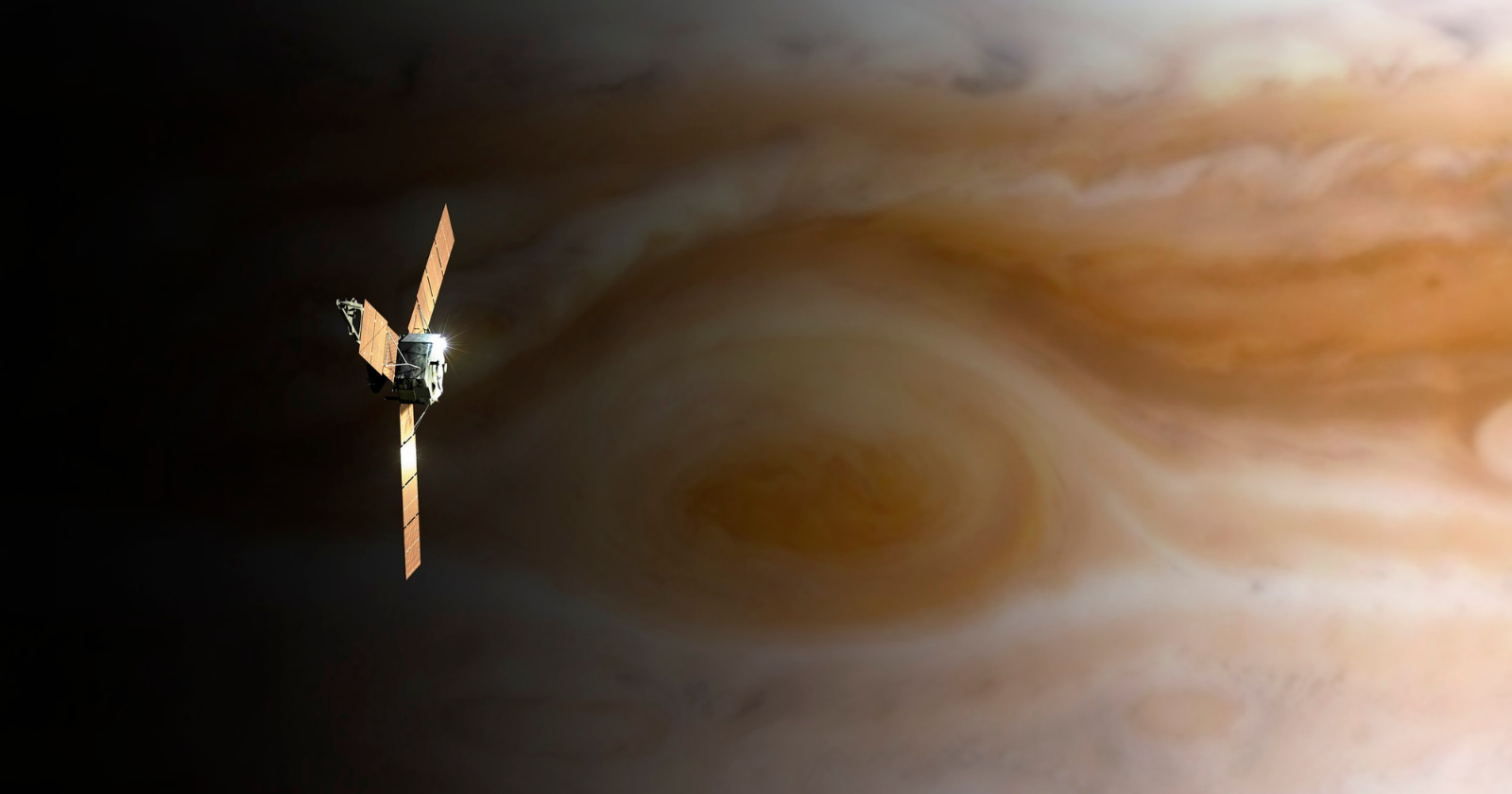
Juno’s survival at Jupiter is not just a triumph of navigation. It is a triumph of hiding. Every close pass takes the spacecraft into a place where high-energy electrons and ions can charge, scramble and gradually destroy electronics. The mission’s answer was to put much of the spacecraft’s nervous system behind metal.
In a JPL image caption from the spacecraft’s assembly, NASA described workers installing Juno’s special radiation vault, a titanium-walled enclosure built to protect the spacecraft’s electronic “brain and heart” from Jupiter’s harsh radiation environment. The same JPL caption says the whole vault, with more than 20 electronic assemblies inside, weighs about 200 kilograms, or 500 pounds. In round-number terms, that is the heavy shield behind the often repeated image of Juno flying with its brain inside a titanium safe.
The vault does not make Juno invulnerable. It buys time. Without shielding, carefully planned orbits and radiation-hardened components, an ordinary spacecraft computer near Jupiter would face a hostile particle storm that could flip bits, damage circuits and degrade instruments far faster than mission planners could accept.
Why Jupiter is so dangerous
Jupiter’s beauty hides a brutal space environment. The planet has the largest and most powerful magnetosphere in the Solar System, a vast magnetic bubble that traps and accelerates charged particles. A review paper on the in-situ exploration of Jupiter’s radiation belts describes them as the most energetic and complex radiation belts in the Solar System, and notes that their hazardous environment is exactly why spacecraft often avoid them rather than fly straight through.
Radiation belts are not simply empty regions with a warning label. They are populations of fast-moving particles, mainly electrons and ions, forced into motion by magnetic fields. When those particles strike spacecraft materials, they can deposit charge, cause false signals, damage detector surfaces and slowly degrade solar cells. In computer chips, a single energetic particle can sometimes change stored information. Enough dose over time can permanently harm electronic parts.
Juno had to enter that environment because its science required close passes. NASA’s current Juno mission page says the spacecraft has explored Jupiter, its moons and rings since 2016, gathering data on the planet’s atmosphere, magnetic field, gravity and interior. To do that, it repeatedly dives low over Jupiter’s cloud tops, then swings far back out again.
The vault inside the spacecraft
The radiation vault is a box inside Juno’s main body. It is not glamorous in the way a camera image of Jupiter is glamorous, but it is one of the reasons those images and measurements exist at all. The JPL caption says the vault contains more than 20 electronic assemblies, including the systems that control and distribute power and handle spacecraft data.
The material matters. Titanium is strong enough for launch loads and structurally useful in a spacecraft, while also adding shielding mass around sensitive electronics. Juno’s design did not rely on the vault alone. The mission also used radiation-hardened parts, protected wiring, shielded instrument electronics and an orbit chosen to limit time in the worst regions.
That orbit is crucial. Instead of circling Jupiter near the equatorial plane, where radiation exposure would be harsher, Juno follows a highly elongated polar path. It rushes close to Jupiter for a science pass, then arcs far away. The spacecraft still enters dangerous territory, but it spends less time there than it would in a tighter, lower orbit.
Why not just build everything tougher?
Spacecraft engineering is a trade between protection, mass, power, cost and science. The easiest way to shield electronics is to add material, but every kilogram has to be launched, accelerated and carried to Jupiter. More shielding can protect one box while making the whole spacecraft heavier and harder to fly.
That is why Juno’s vault is concentrated around the most critical electronics rather than wrapped around the whole spacecraft. Some components cannot live inside it. Instruments need to look outward. Solar arrays need sunlight. Antennas need to communicate. Sensors need exposure to the very particles and fields they are measuring. Juno is therefore partly armored and partly exposed by design.
This is also why the mission’s survival is more subtle than a simple “metal box beats radiation” story. The vault reduces radiation dose for protected electronics, but it cannot stop every particle. Damage still accumulates. Mission planners knew Juno would be living on a clock set partly by Jupiter’s radiation environment.
A spacecraft built to take punishment
Juno launched in 2011 and reached Jupiter in July 2016. It was originally designed for a primary mission of repeated close passes, but NASA extended the mission as the spacecraft kept working. The current NASA mission page, updated in 2026, describes Juno as still an active mission studying Jupiter and its system.
The longevity is striking because Juno was never cruising through a gentle neighborhood. Jupiter’s radiation affects cameras, sensors, solar arrays and electronics. In 2025, NASA described how engineers worked to save JunoCam after radiation-related image problems, explaining that JunoCam had begun showing signs of radiation damage and that the team used heating, or annealing, to help recover the camera’s performance. The vault protects central electronics, but instruments outside it still pay a price.
That makes Juno’s continuing work more impressive, not less. The spacecraft was built with the expectation that Jupiter would hurt it. Its designers did not eliminate the threat. They managed it well enough to keep the science flowing orbit after orbit.
The hidden engineering behind Jupiter science
When people think of Juno, they usually think of swirling storms, blue-brown bands, polar cyclones and close views of the moons. The titanium vault is a quieter achievement. It is a piece of engineering that rarely appears in the finished science image, but every successful downlink depends on it.
The vault is also a reminder that space exploration is shaped by local environments. A spacecraft built for Mars does not automatically survive Jupiter. A computer that works around Earth may fail quickly around a giant planet with an enormous magnetic field. The Solar System is not one kind of place; it is a collection of physical regimes, each with its own hazards.
Juno endures because its designers accepted that Jupiter would be hostile and built accordingly. The spacecraft dives, measures, records and transmits, while its most critical electronics sit behind titanium walls. Around it, high-energy particles race through the magnetic storm. Inside, the brain keeps working.