
Super-Kamiokande has reported the first indication of the diffuse supernova neutrino background, a predicted flux of neutrinos built up from core-collapse supernovae across cosmic history. The result was announced by the collaboration on 26 June 2026, a day after it was presented at the Neutrino 2026 conference in California.
Its statistical significance is 2.6 sigma. That makes it a hint, not a confirmed detection. The collaboration itself uses the word “indication” because particle physics normally reserves a discovery claim for five sigma.
The finding is worth taking seriously, but it should not be read as the final word.
What the detector appears to have found
The analysis combined about 5,000 days of observations: 3,349 days when Super-Kamiokande contained pure water and 1,653 days after gadolinium was added. After removing estimated backgrounds, mainly atmospheric-neutrino events and reactions in oxygen nuclei induced by cosmic rays, the team found an excess of candidate events between 13.3 and 81.3 megaelectronvolts.
The collaboration calculated a best-fit diffuse supernova neutrino background flux of 3.6 plus or minus 1.6 electron antineutrinos per square centimetre per second. That range is consistent with several theoretical models cited in the release.
At 2.6 sigma, the no-flux hypothesis is excluded at a stated confidence level of 99.5 per cent. This sounds more decisive than it is. When experiments examine faint signals and many possible sources of noise, the field uses a far more demanding five-sigma threshold before declaring a discovery.
“The faintest signal ever recorded” is not a formal record claimed in the collaboration’s announcement. Nor is this a sound or literal background hum. It is an extremely small statistical excess in the energy distribution of particle interactions collected over nearly 14 years.
A 50,000-tonne tank under a mountain
Super-Kamiokande sits 1,000 metres underground at Kamioka in Gifu Prefecture. Its cylindrical tank holds 50,000 tonnes of ultrapure water and is watched by about 13,000 photomultiplier tubes.
When a neutrino interacts in the water, the charged particle produced can travel faster than light travels through that medium. This does not violate relativity, because it remains slower than light in a vacuum. The interaction generates a cone of blue Cherenkov light, which the photomultipliers record.
The rock above the detector filters out much of the cosmic-ray interference present at the surface. It cannot remove everything. Atmospheric neutrinos still reach the tank, while the particles produced by cosmic-ray muons can trigger reactions that imitate parts of the signal.
The candidate background is therefore reconstructed statistically. Super-Kamiokande is not counting clearly labelled particles arriving from known dead stars.
Gadolinium supplies a second identifying flash
The main detection channel begins when an electron antineutrino hits a proton in the water, producing a positron and a neutron. The positron creates a prompt Cherenkov signal. The neutron is harder to identify in pure water.
Gadolinium has an unusually large neutron-capture cross section. Once dissolved in the detector water, it captures many of those neutrons and releases gamma rays shortly after the initial positron flash and close to the same location. Matching the prompt and delayed signals makes an antineutrino candidate easier to distinguish from unrelated events.
The Super-Kamiokande gadolinium project began operating in 2020, with more gadolinium added in 2022. The current result combines the cleaner gadolinium-era data with a much longer pure-water record.
This two-part tag is the practical reason a signal that had remained below the experiment’s reach for decades has moved into view.
“Every supernova” is useful shorthand, not a literal count
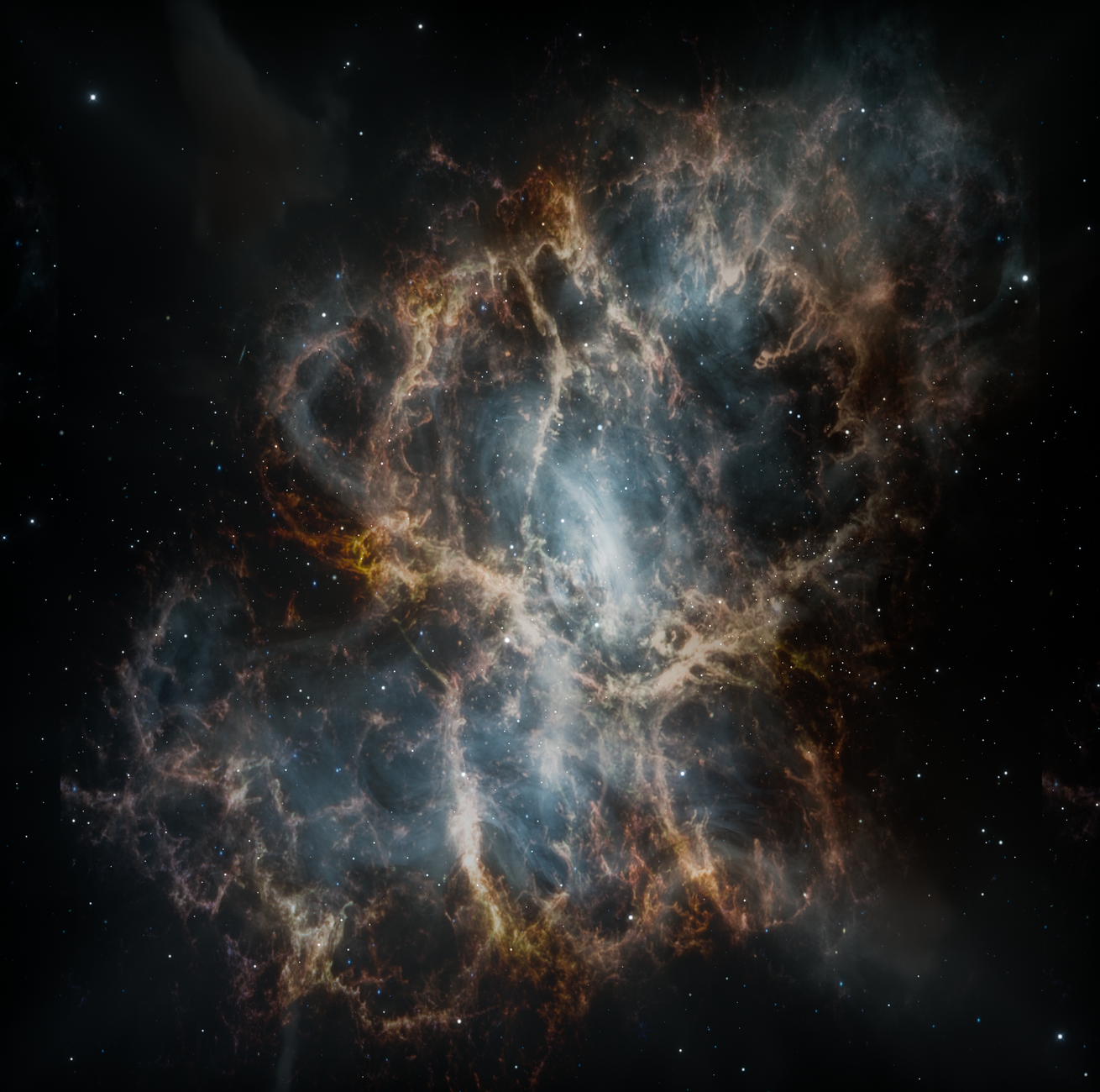
The diffuse background is expected from the accumulated neutrino emission of core-collapse supernovae, the deaths of massive stars that leave neutron stars or black holes. The University of Tokyo release says such explosions occur several times per second across the observable universe.
That does not mean the detector has identified a contribution from each explosion. It also does not include every class of event commonly called a supernova. Type Ia supernovae, for example, arise from thermonuclear explosions of white dwarfs and are not what physicists mean by the diffuse core-collapse neutrino background.
The particles arrive as a blended population rather than a catalogue of sources. Their energies have been shifted by the expansion of the universe, and the signal is shaped by the history of massive-star formation, the average neutrino output of collapsing cores and the fraction of collapses that may form black holes without a bright optical explosion.
A confirmed measurement could therefore test models of star formation and stellar collapse using a messenger other than light. It may also help constrain how often core collapses produce neutron stars or black holes. The present excess is not yet precise enough to settle those questions.
More exposure must decide whether the hint persists
The immediate task is accumulation. A real diffuse signal should become more statistically persuasive as exposure grows, while a fluctuation may weaken. Improvements in background modelling will matter alongside additional observation time.
The collaboration says it plans to use continuing Super-Kamiokande observations and future work with its successor, Hyper-Kamiokande, to improve sensitivity. No peer-reviewed paper for the June 2026 result was linked in the announcement, so the current public basis is a conference presentation and the collaboration’s release.
For now, 2.6 sigma is the number that defines the claim. It is the first indication of the expected background, and it remains short of a discovery.
